
[ICLR 2025] 3DrawAgent: Teaching LLMs to Master 3D Sketching via Self-Reflective "Experience"
3DrawAgent: Teaching LLM to Draw in 3D with Early Contrastive Experience
3DrawAgent is a training-free, language-driven framework for 3D sketch generation that enables Large Language Models (LLMs) to sequentially create 3D Bezier curves. It achieves competitive results against trained SOTA methods like Diff3DS and 3Doodle using a novel contrastive experience optimization strategy.
Executive Summary
TL;DR: 3DrawAgent is a breakthrough framework that enables off-the-shelf Large Language Models (LLMs) to generate complex, spatially consistent 3D sketches using Bezier curves without a single parameter update. By combining a differentiable renderer with a novel "Training-free GRPO" strategy, the model learns from its own mistakes to evolve from drawing flat, fragmented lines to coherent 3D structures.
Background Positioning: This work represents a shift from optimization-heavy 3D generation (like Score Distillation Sampling) to agentic reasoning. It places LLMs in the role of a 3D artist who can plan, draw, evaluate, and learn, setting a new SOTA for training-free 3D sketch intelligence.
Problem & Motivation: The 2D Ceiling
While 2D vector sketching with LLMs (e.g., SketchAgent) has shown promise, the leap to 3D has remained elusive. Prior works faced two major hurdles:
- Geometric Supervision: Most 3D generators require massive datasets of 3D meshes or multi-view images to train.
- Lack of Spatial "Common Sense": Frozen LLMs naturally struggle with 3D coordinates (Z-axis), often collapsing 3D objects into 2D projections or creating "floating" disconnected parts.
The authors' insight? LLMs don't need new weights; they need experience. By comparing a "bad" sketch with a "slightly better" one and explaining why, the LLM can refine its internal logic for 3D layout.
Methodology: The Contrastive Feedback Loop
The core of 3DrawAgent is the Contrastive Knowledge Extraction (CKE) pipeline.
1. Sequential Planning
The LLM (DeepSeek-V3.2 or Gemini-2.5 Pro) acts as a spatial planner, outputting a list of 3D Bezier control points. These points are fed into a differentiable renderer to produce multi-view 2D projections.
2. The Training-Free GRPO Adaptation
Inspired by Group Relative Policy Optimization, the framework generates a group of candidate sketches. It doesn't use a ground truth; instead, it uses:
- Perceptual Reward: CLIP scores the rendered views against the input text.
- Judicial Reasoning: The LLM itself acts as a judge, looking at high-reward vs. low-reward pairs to derive "3D Spatial Principles" (e.g., "maintain symmetry," "ensure curvature continuity").
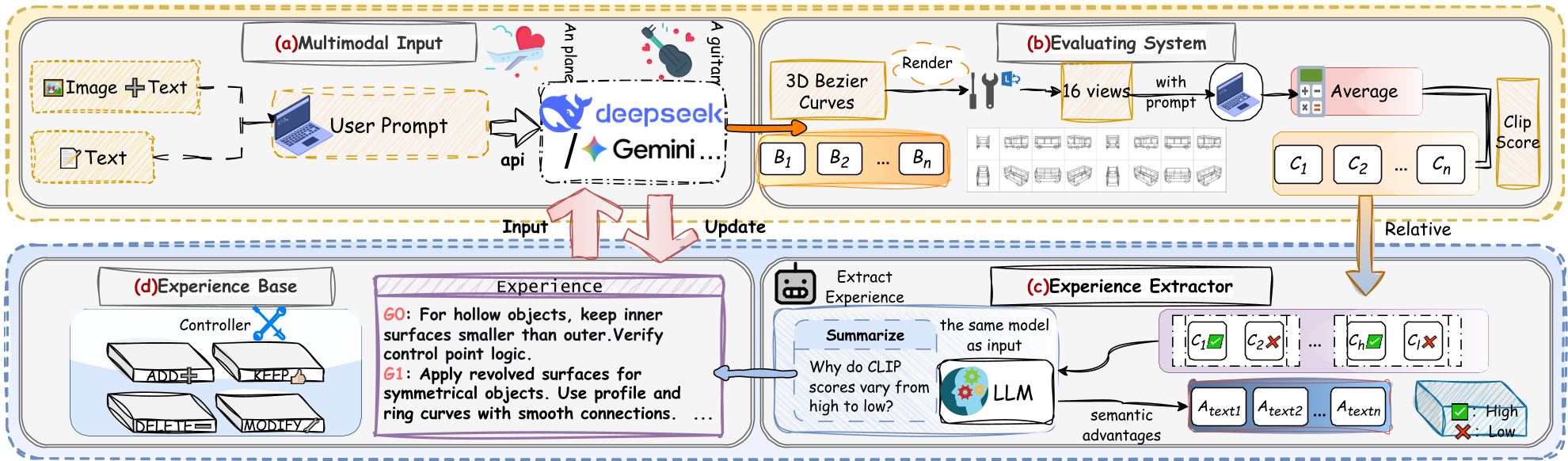
3. Experience Accumulation
These principles are stored in an Experience Library () which is prepended to the system prompt. In essence, the model "remembers" its previous design failures and successes.
Experiments: Superior Quality at Fractional Cost
Quantitative Prowess
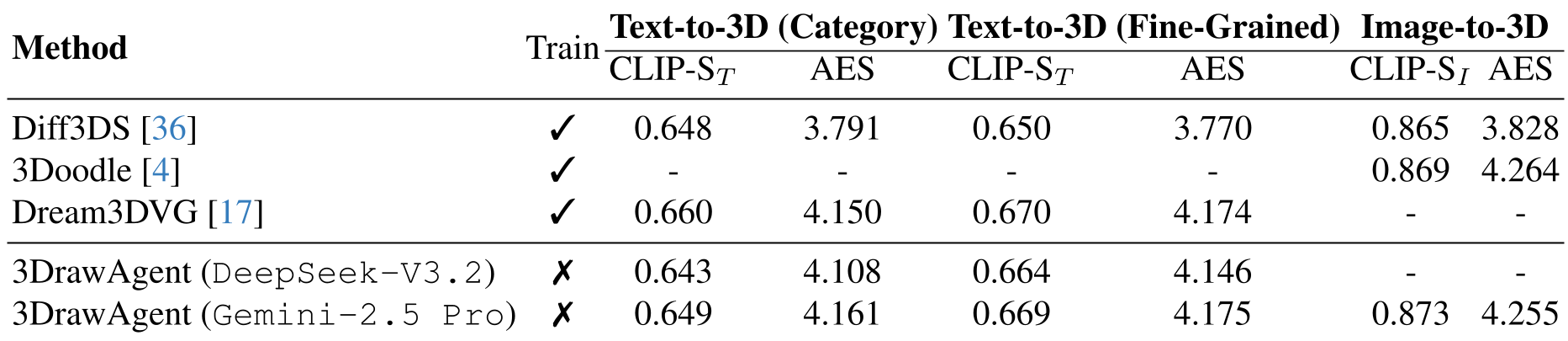
In benchmarks using ModelNet40 and QuickDraw prompts, 3DrawAgent matched or exceeded trained models:
- Aesthetic Quality: Achieved a score of 4.175, surpassing Diff3DS (3.770).
- Efficiency: While traditional SDS-based methods take 60-120 minutes per object on high-end GPUs, 3DrawAgent finishes in ~2 minutes via API calls.
Visual Evidence
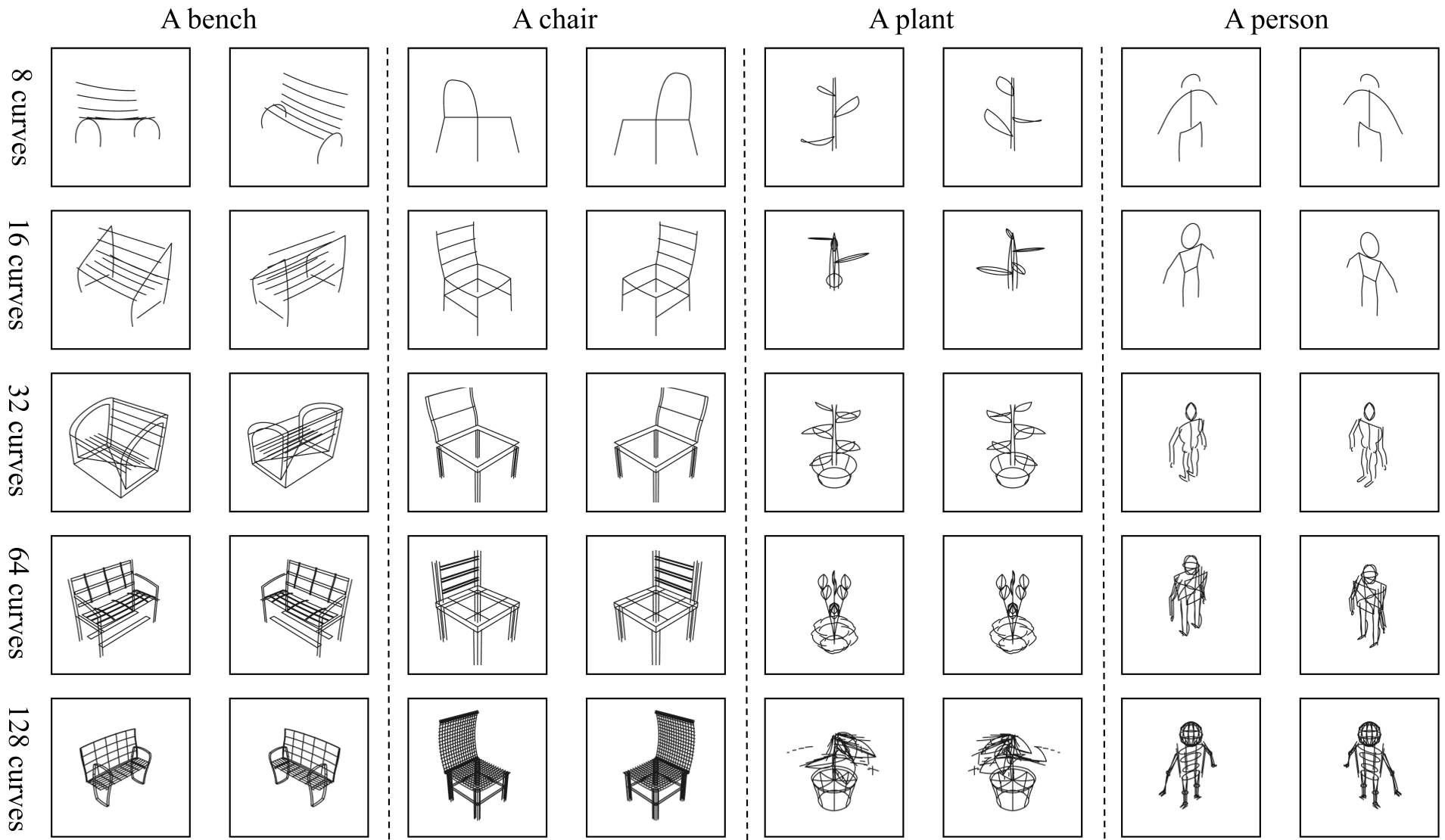
Qualitative results show that 3DrawAgent produces much cleaner "designer-style" wireframes. Unlike diffusion models that often produce "hairy" or fragmented edges, the Bezier curves here are smooth and topologically logical.
Critical Analysis & Conclusion
Takeaway: 3DrawAgent proves that the "Reasoning" capabilities of modern LLMs can extend into 3D geometry if guided by the right feedback loop. The "Training-free GRPO" mechanism effectively democratizes 3D content creation, making it accessible even without massive GPU clusters.
Limitations:
- Local Precision: As seen in failure cases, the model still struggles with "perfect" connectivity at joints (e.g., table legs floating slightly below the top).
- LLM "Over-reasoning": In later iterations, the model sometimes becomes too pedantic about rules, which can slightly degrade the creative fluidity of the sketches.
Future Work: Integrating dedicated geometric constraints (like Chamfer distance or intersection loss) into the LLM judge's toolkit could bridge the gap between "concept sketching" and "CAD-ready engineering."