
[CVPR 2024] 3DreamBooth: Solving the "Flat Subject" Problem in Video Customization
3DreamBooth: High-Fidelity 3D Subject-Driven Video Generation Model
3DreamBooth is a high-fidelity 3D subject-driven video generation framework that combines a 1-frame optimization strategy with a multi-view conditioning module called 3Dapter. Built upon the HunyuanVideo-1.5 backbone, it achieves state-of-the-art 3D geometric consistency and identity preservation for customized objects in dynamic video contexts.
TL;DR
3DreamBooth transforms how we personalize video generation models. By treating 3D identity as a purely spatial attribute, it uses a clever 1-frame optimization trick and a multi-view "router" called 3Dapter to generate videos of specific objects that remain 100% consistent even during complex 360-degree camera orbits.
The Motivation: Why Your AI Videos "Hallucinate" the Back of Objects
Current video customization tools (like DreamVideo or VACE) suffer from a "2D bias." If you show the model a picture of a sneaker's side, it has no idea what the sole or the heel looks like. When asked to rotate the shoe, the model guesses—often resulting in disappearing logos or shifting textures.
The authors realized two things:
- Identity is Spatial: A subject's look is defined by its 3D shape, not how it moves.
- Standard Tuning Overfits: Training on videos makes the model memorize a specific path (temporal overfitting) instead of learning the object's form.
Methodology: 3DreamBooth & 3Dapter
1. 3DreamBooth: The 1-Frame Trick
The authors utilize a brilliant architectural insight: in modern Diffusion Transformers (DiTs), if you only feed the model one frame at a time (T=1), the temporal attention layers are naturally bypassed. This allows the model to focus 100% of its learning capacity on "baking" the 3D geometry into a rare token () without breaking its pre-trained ability to create smooth motion.
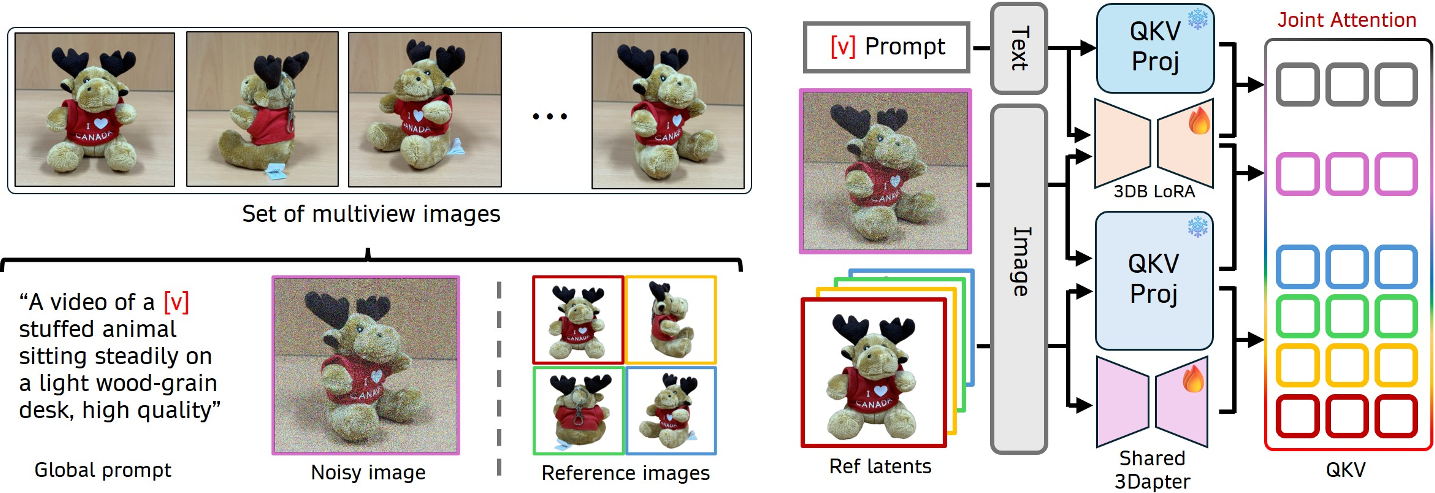
2. 3Dapter: The Selective Router
Personalization usually loses fine details (text, logos) because text tokens are an "information bottleneck." To fix this, 3Dapter provides a direct visual bypass. It takes 4 multi-view images of the object and allows the model to "look at" the reference photos while generating. Crucially, it acts as a Selective Router: it only pulls the visual details relevant to the current camera angle, filtering out the "back" views when generating the "front."
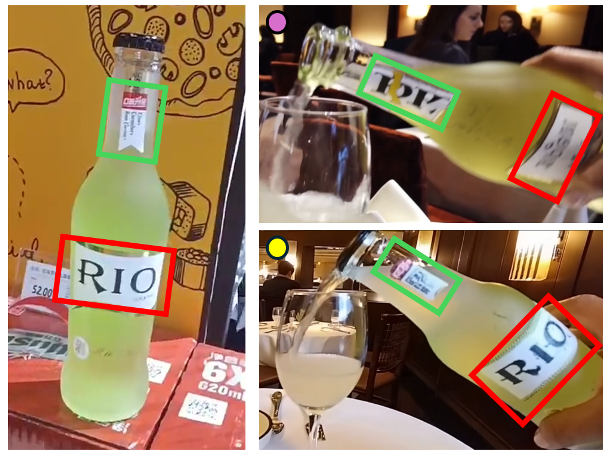
Performance: Halving the 3D Error
The researchers introduced 3D-CustomBench, a dataset of 30 complex objects with full 360-degree coverage.
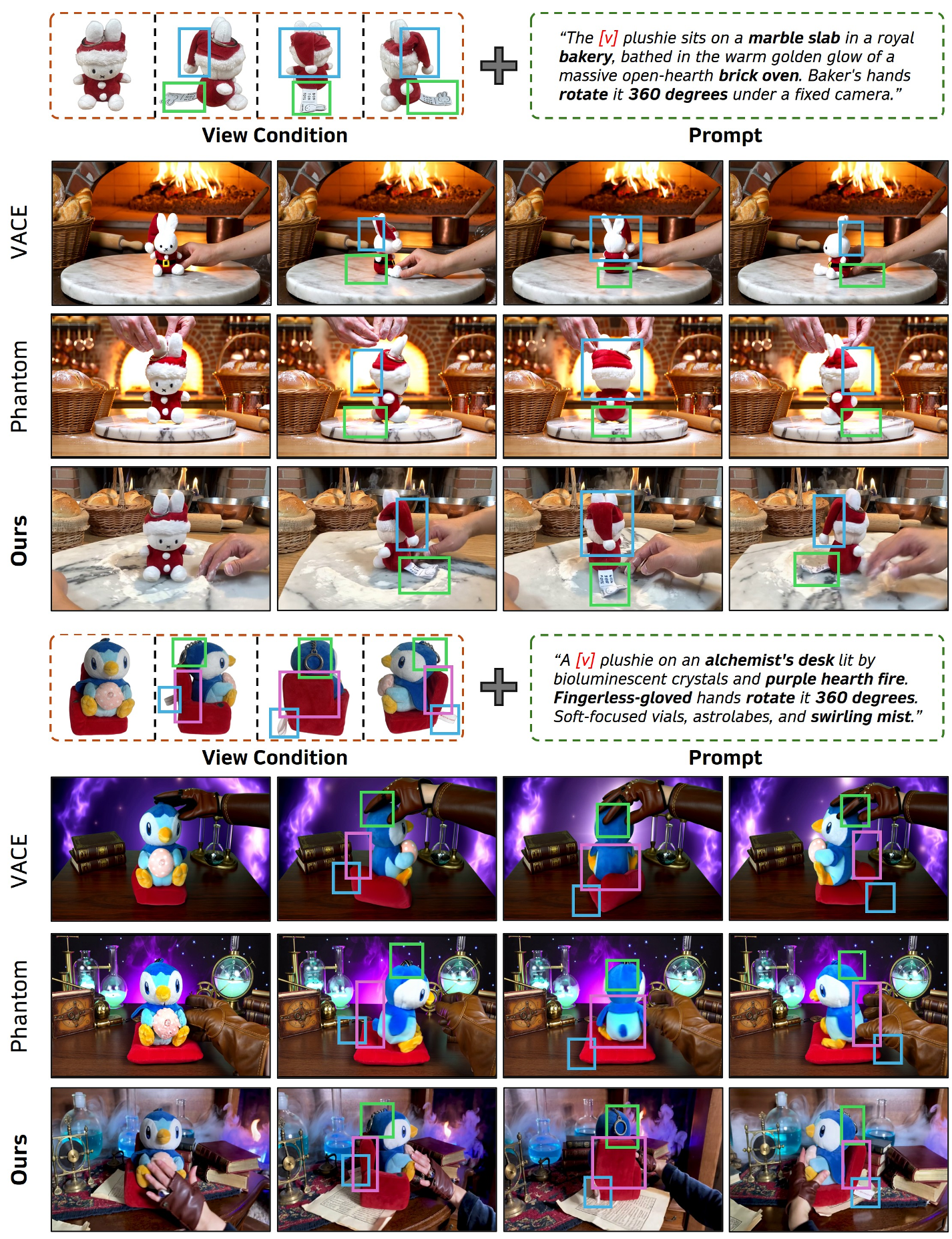
- Geometric Fidelity: Using Chamfer Distance (measured via point cloud reconstruction), 3DreamBooth achieved 0.0177, nearly double the precision of previous SOTA methods like Phantom (0.0338).
- Human Alignment: In GPT-4o evaluations, the model scored near-perfectly (4.8/5) for shape preservation, whereas baselines struggled with structure.
Takeaway & Future Directions
3DreamBooth proves that you don't need massive video datasets to create 3D-consistent videos. By effectively "sculpting" a 3D prior into the model's spatial weights, we can now create high-fidelity commercials or game assets from a few static photos.
Limitations: Currently, the method is optimized for rigid objects (mugs, shoes, toys). The next frontier is Dynamic Subject Customization—applying this 3D-consistent logic to humans or animals that change shape as they move.