
3DSS: Mastering Inverse Rendering via Differentiable Surface Splatting
3DSS: 3D Surface Splatting for Inverse Rendering
3D Surface Splatting (3DSS) is a differentiable renderer for physically-based inverse rendering that represents scenes as unstructured surfel primitives. By formulating surface separation as an interval-merging problem and deriving coverage-based opacity from EWA weights, it achieves state-of-the-art results in joint shape, SVBRDF material, and illumination recovery.
TL;DR
3D Surface Splatting (3DSS) is a breakthrough differentiable renderer that treats 3D scenes as a collection of oriented surface elements (surfels). It solves the long-standing "visibility gap" in point-based rendering by introducing a depth-interval grouping mechanism and a coverage-based opacity model. The result is a system that recovers high-fidelity geometry, materials, and lighting from photos with the flexibility of points and the precision of meshes.
Problem & Motivation: The Surface Identity Crisis
In the current AI-driven 3D reconstruction landscape, researchers usually pick one of two "poisons":
- Triangle Meshes: Great for surfaces, but a nightmare to optimize. Changing topology (like poking a hole in an object) often breaks the manifold or creates degenerate "long-and-skinny" triangles.
- Volumetric Representations (NeRF/3DGS): Excellent for view synthesis, but they don't actually know where the "surface" is. They represent the world as a cloud of semi-transparent particles, making it nearly impossible to simulate realistic light reflections (relighting) because there’s no clear normal or tangent plane to bounce light off of.
3DSS asks: Why not use Surface Splatting? Originally proposed in 2001, surface splatting uses "surfels"—flat, oriented disks. They are unstructured (like points) but have a clear front and back (like meshes). The missing piece was making this process differentiable and capable of handling multiple overlapping surfaces properly.
Methodology: Signal Reconstruction and Surface Separation
The core innovation of 3DSS lies in how it handles the "merging" of points into a continuous surface.
1. Depth-Interval Grouping
Unlike 3D Gaussian Splatting, which just blends points front-to-back, 3DSS groups surfels into distinct "layers." If two surfels' depth extents overlap, they are part of the same physical surface. If there's a gap, it’s a new layer. This allows for correct self-occlusion and sharp visibility transitions.
2. Coverage-based Opacity
In 3DSS, a pixel's opacity isn't a learned parameter—it's earned. A pixel becomes opaque only if the surfels nearby provide enough "coverage" (measured via EWA weights). This creates natural anti-aliasing: as you move to the edge of an object, the coverage drops, and the edge softens automatically.
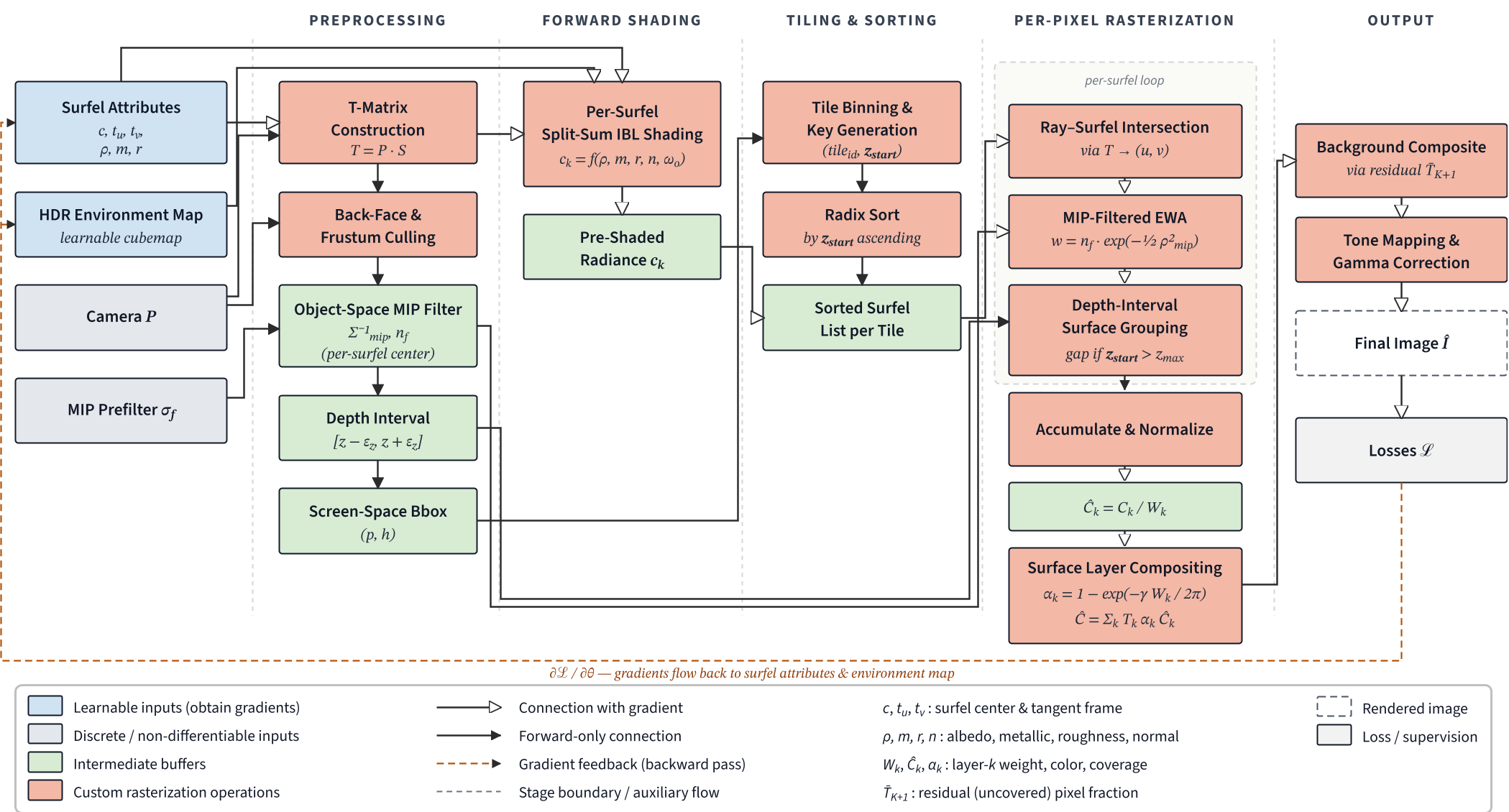 Fig. 1: The 3DSS Pipeline. From pre-shading surfels using HDR environment maps to multi-layer tiling and EWA-based compositing.
3. Forward Shading
To keep the renderer physically accurate, shading is computed before the splatting. This ensures that non-linear light interactions (like specular highlights) are calculated at the sample level, avoiding the "blurry normal" problem that plagues volumetric methods.
Experiments & Results: SOTA in Relighting
The authors evaluated 3DSS on the Stanford-ORB benchmark, which tests geometry, novel view synthesis (NVS), and relighting.
- High Fidelity: 3DSS achieved a PSNR of 40.73 in NVS, significantly higher than mesh-based NVDiffRec (28.44).
- Relighting: Because 3DSS maintains explicit surface normals, it can be relit under entirely new HDR environments while preserving sharp specular highlights.
- Mesh Compatibility: Since the output is an oriented point cloud, it can be converted to a high-quality mesh using standard tools like Screened Poisson Reconstruction.
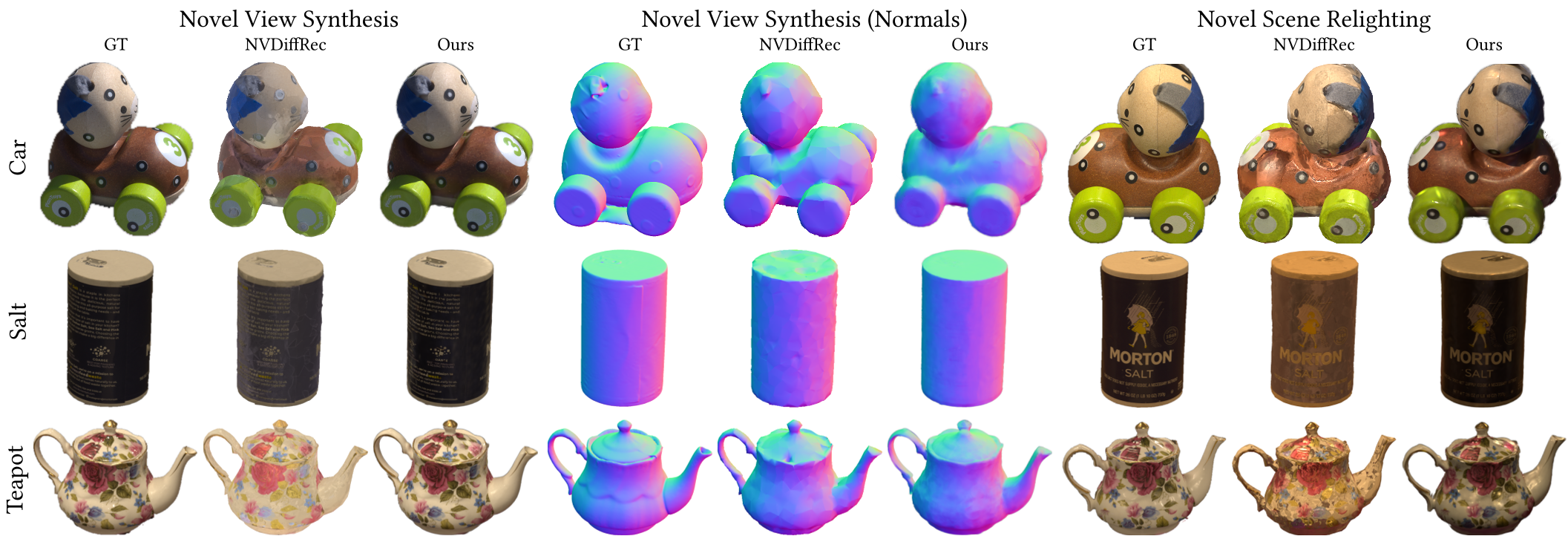 Fig 2: Comparative results showing 3DSS recovering smoother normals and more realistic specular highlights compared to previous SOTA.
Critical Analysis & Conclusion
The Takeaway
3DSS proves that you don't need a triangle mesh to get "mesh-quality" inverse rendering. By replacing volumetric blending with a surface-oriented coverage model, it provides the best of both worlds: the optimization ease of points and the physical correctness of surfaces.
Limitations
- Opaque Assumption: The current model assumes everything is opaque. It cannot yet handle glass or smoke natively.
- Shadows: It uses a simplified IBL (Image-Based Lighting) model, meaning it doesn't currently account for complex self-shadowing or inter-reflections.
In conclusion, 3D Surface Splatting revitalizes a classic graphics technique for the age of differentiable optimization, offering a powerful tool for creating high-quality, editable digital assets from simple photographs.