
4DThinker: How VLMs Develop the "Mental Imagery" to Understand the Moving World
4DThinker: Thinking with 4D Imagery for Dynamic Spatial Understanding
4DThinker is the first framework that enables Vision-Language Models (VLMs) to perform dynamic spatial reasoning by "thinking with 4D" through latent mental imagery. It leverages a two-stage training recipe (SFT and RL) to achieve SOTA performance on benchmarks like DSR-Bench and Dyn-Bench, notably improving Qwen3-VL-32B by +34.0 points.
TL;DR
Understanding how objects move from a single video (monocular dynamic reasoning) is a holy grail for AI agents. 4DThinker is the first framework that allows Vision-Language Models to "visualize" 4D dynamics internally. By interleaving text with latent visual tokens—essentially "mental imagery"—it shatters existing SOTA records, boosting baseline model performance by over 30% without needing any external 3D sensors or human labels.
Problem: The Flaw in "Tell, Don't Show"
Current VLMs try to solve spatial problems in two ways, both of which are flawed:
- Pure Textual Reasoning: Trying to describe a person's 3D trajectory in words. It's like trying to explain a dance move over the phone—it’s imprecise and verbose.
- External Modules: Bolting on specialized 3D geometry engines. This makes the model "smart" only when these tools are present, rather than making the model itself more capable.
Authors of 4DThinker argue that humans don't use "geometry modules" in our heads; we use mental imagery. We simulate the motion in our mind's eye.
Methodology: Simulating the Mind's Eye
4DThinker implements this intuition through three key technical pillars:
1. Annotation-Free 4D Data Pipeline
The authors realized that dynamic reasoning comes down to two things: Camera Motion and Object Motion. They built a pipeline that:
- Identifies static and dynamic objects in raw videos.
- Generates "mask overlays" to highlight these objects.
- Creates a Chain-of-Thought (CoT) that asks the model to "imagine" what these highlighted frames look like.
2. Dynamic-Imagery Fine-Tuning (DIFT)
This is where the magic happens. The model isn't just trained to predict the next word. It's trained to predict the next latent embedding that represents the image of the moving object.
- Dual Loss: It uses Cross-Entropy for text and Cosine Similarity for the latents.
- Recurrent Imagination: During inference, the model’s own previous "imagination" becomes the context for its next reasoning step.
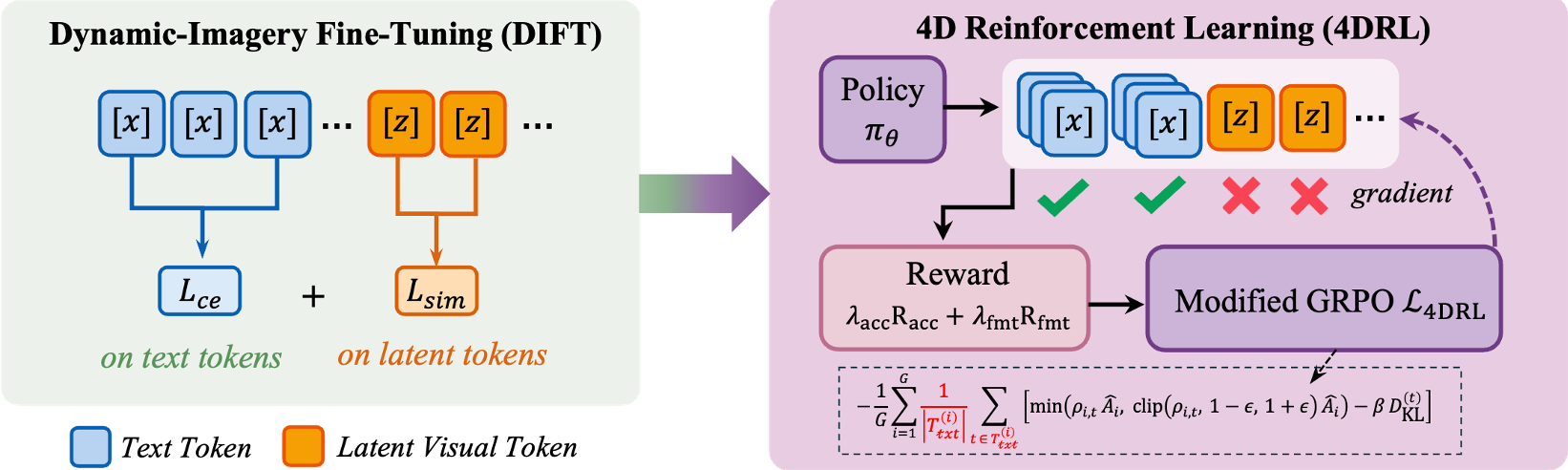
3. 4D Reinforcement Learning (4DRL)
To handle complex motions, the model undergoes RL using a modified GRPO (Group Relative Policy Optimization). Crucially, they restrict gradients to text tokens only. Why? Because continuous latent propagation is too noisy for discrete probability-based RL.
Experimental Performance: A New Paradigm
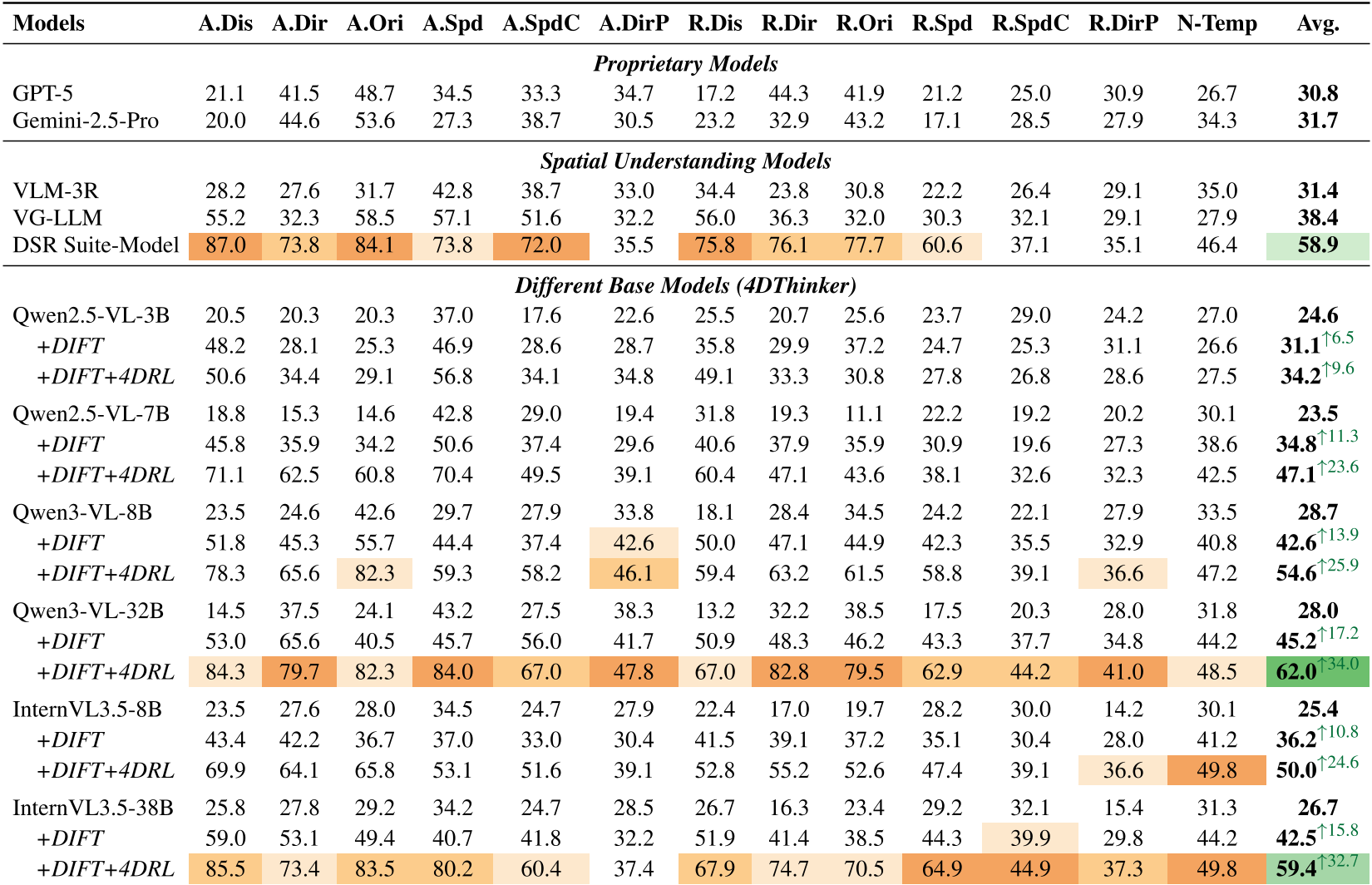
The results on DSR-Bench (precision geometry) and Dyn-Bench (holistic understanding) are staggering.
| Model | Base Accuracy | 4DThinker Accuracy | Improvement |
|---|---|---|---|
| Qwen3-VL-32B | 28.0% | 62.0% | +34.0% |
| InternVL3.5-38B | 26.7% | 59.4% | +32.7% |
| Gemini-2.5-Pro | 31.7% | - | (Surpassed) |
The ablation studies confirmed that latent visual tokens (K=4) are the sweet spot. Too few tokens lack detail; too many tokens distract the language model's "train of thought."
Critical Analysis & Takeaways
The most impressive part of 4DThinker is its ability to disentangle motions. It can tell if an object looks bigger because it's moving toward the camera, or simply because the camera is zooming in—a classic failure mode for LLMs.
Limitations: The model is currently as good as its auto-labeler (MegaSaM). If the initial geometric estimation is wrong, the "imagery" it learns might be skewed.
Conclusion: 4DThinker changes the conversation from "How do we describe space to LLMs?" to "How do we let LLMS visualize space?". This intrinsic 4D capability is a massive step toward embodied agents that can actually understand the physics of the world around them.