
[CVPR 2026] A1Efficient: Breaking the VLA Compute Bottleneck with Adaptive Truncation
A1: A Fully Transparent Open-Source, Adaptive and Efficient Truncated Vision-Language-Action Model
A1Efficient (A1) is a fully open-source Vision-Language-Action (VLA) model that introduces a budget-aware adaptive inference scheme to enable real-time robotic control. It achieves SOTA success rates (e.g., 29.00% on RoboChallenge) while reducing backbone computation by up to 76.6% through early-exit and truncated flow-matching mechanisms.
TL;DR
The adoption of Vision-Language-Action (VLA) models in robotics is often stalled by the "Inference Tax"—the massive compute required by billion-parameter backbones and iterative diffusion heads. A1Efficient (A1) is a fully open-source framework that slashes this cost. By implementing a budget-aware early-exit strategy and a novel Inter-Layer Truncated Flow Matching mechanism, A1 reduces computation by over 70% while outperforming industry heavyweights like π0 and RDT-1B in real-world success rates.
Problem & Motivation: The Heavy Cost of "Thinking"
State-of-the-art VLA models typically follow a two-part architecture:
- A Massive Backbone: A VLM (like Molmo or Qwen) that processes visual and textual inputs.
- An Iterative Action Head: A Diffusion or Flow-Matching head that denoises random noise into a robot command over 10-20 steps.
The problem is redundancy. Many robotic actions change smoothly across time, and not every frame requires the full depth of a 28-layer Transformer to understand. Furthermore, running a full 10-step denoising process at every time step is overkill for simple movements. The authors of A1 observed that intermediate VLM hidden states already contain sufficient "affordance priors" to predict actions, and flow-matching trajectories often converge in fewer than three steps.
Methodology: Spend Only What You Need
A1 introduces a dual-track acceleration strategy that targets both the "brain" (backbone) and the "reflexes" (action head).
1. Early-Exit via Action Consistency
Instead of passing every observation through all layers of the VLM, A1 monitors the discrepancy between actions predicted at layer and layer . If the predicted action "stabilizes" (i.e., the difference falls below a calibrated threshold ), the model exits early. This allows the robot to handle simple tasks (like moving in empty space) using only 3-5 layers, reserving the full 28-layer stack for complex manipulations like "turning a stove knob."
2. Inter-Layer Truncated Flow Matching (IL-TFM)
Standard early-exit schemes often fail for diffusion/flow-matching models because even if the backbone is shortened, the action head still needs repetitive denoising steps. A1's breakthrough is the "Warm-Start": as the VLM processes layer by layer, the action head performs only a tiny number of denoising steps (). Critically, the output of the action head at layer is used as the starting point for layer .
 Figure: The A1 framework showing how Inter-Layer Truncated Flow Matching propagates denoising results across VLM layers.
Experiments & Results: SOTA Performance at a Fraction of the Cost
A1 was tested across a gauntlet of benchmarks, including LIBERO, VLABench, and the rigorous RoboChallenge.
Efficiency Gains
The results are striking. By adjusting the "exit criterion" , A1 can scale from full inference to hyper-efficient modes:
- Computation: Up to 76.6% reduction in TFLOPs.
- Latency: Per-episode inference time on LIBERO dropped from 37.8s to 10.5s.
- Success Rate: Even with massive compute cuts, the success rate on LIBERO-Long remained at 92.3% (compared to 95.8% for full inference).
Success in the Real World
On the RoboChallenge leaderboard, which tests 30 complex real-robot tasks, A1 achieved a 29.00% average success rate, outperforming the previously dominant open-source baselines π0 and RDT-1B.
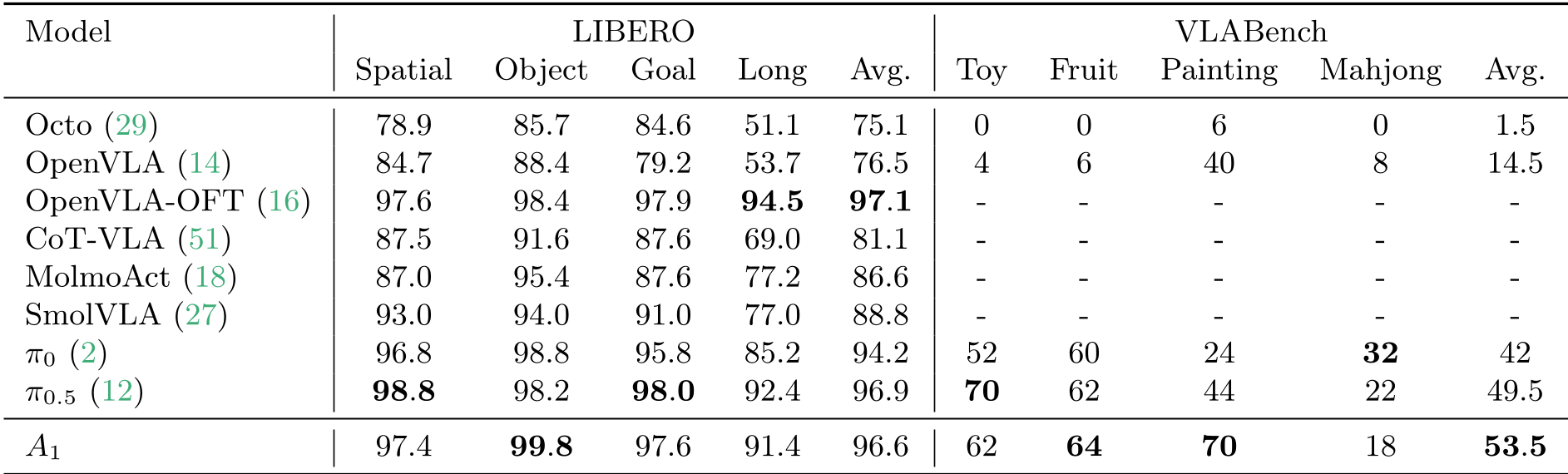 Table: A1 compared against SOTA models in simulation benchmarks.
 Figure: Visualization of early-exit layers. Simple movements exit at layer 3, while intricate pot-handling requires layer 25.
Critical Insight & Conclusion
A1's value lies in its transparency and adaptability. By proving that we can "warm-start" generative action heads across the depth of a transformer, the authors have opened a new path for deploying VLAs on edge devices.
Key Takeaway: High-performance robotics doesn't always need more parameters; it needs smarter execution. A1 demonstrates that affordance-aware representations are hierarchical—simple spatial awareness emerges early, while complex physical reasoning happens late. By exploiting this hierarchy, we can finally move VLAs from high-end GPU clusters to the factory floor.
Limitations
- Affordance Labeled Data: Currently relies on specific datasets for pre-training.
- Synchronization: Network latency between cloud servers and local robots remains a hurdle for perfectly smooth motion.
For more details, visit the A1 Project Page or check out the GitHub Repository.