
A2RD: Transforming Long Video Synthesis through Agentic Self-Correction
A$^2$RD: Agentic Autoregressive Diffusion for Long Video Consistency
A2RD is an Agentic Autoregressive Diffusion architecture designed for long video synthesis (1-10 minutes). It decouples creative synthesis from consistency enforcement using a closed-loop "Retrieve-Synthesize-Refine-Update" cycle, achieving SOTA results with a 30% improvement in character consistency over existing baselines.
TL;DR
Synthesizing a consistent 10-minute video is an order of magnitude harder than a 10-second clip. Google Cloud AI and NUS researchers have introduced A2RD (Agentic Auto-Regressive Diffusion), a training-free framework that turns video generation into a "closed-loop" process. By using a Multimodal Video Memory and an iterative "Talk-Refine-Generate" cycle, A2RD fixes errors before they propagate, boosting consistency by 30%.
The Problem: The "Passive" Generation Trap
Current SOTA models like Sora or Veo are "passive." They generate video in an open-loop fashion—once a frame is rendered, it becomes fixed conditioning for the next. If the model accidentally changes a character's shirt color in frame 50, that error is "locked in" for the rest of the hour. This leads to:
- Semantic Drift: A protagonist might start as a young man and end as a middle-aged woman.
- Narrative Collapse: The story loses its logical thread, repeating scenes or jumping environments nonsensically.
Methodology: The Three Pillars of A2RD
A2RD re-imagines the diffusion model not just as a renderer, but as an agent that manages its own creative process through a Retrieve–Synthesize–Refine–Update cycle.
1. Multimodal Video Memory (MVMem)
Unlike previous methods that only stored raw pixels, A2RD stores:
- Textual States: Visual arcs (Identity, Motion) and Spatial Relations (Subject-Relation-Object).
- Frames/Keyframes: Global anchors (e.g., a "canonical" character face) to prevent identity drift.
- Videos: Past segments used for motion continuity.
2. Adaptive Segment Generation
A2RD doesn't blindly extrapolate. It analyzes the storyline and chooses the best tool for the job:
- Interpolation: Used when a scene transitions between two known environments.
- Extrapolation: Used when the story evolves naturally into new, unknown territory.
3. Hierarchical Test-Time Self-Improvement (HITS)
This is the "brain" of the operation. A2RD generates a candidate, critiques it using an MLLM-Judge against a 10-metric rubric (Physical Plausibility, Identity Consistency, etc.), and if it fails, it uses MAPO (Memory-Augmented Prompt Optimization) to try again.
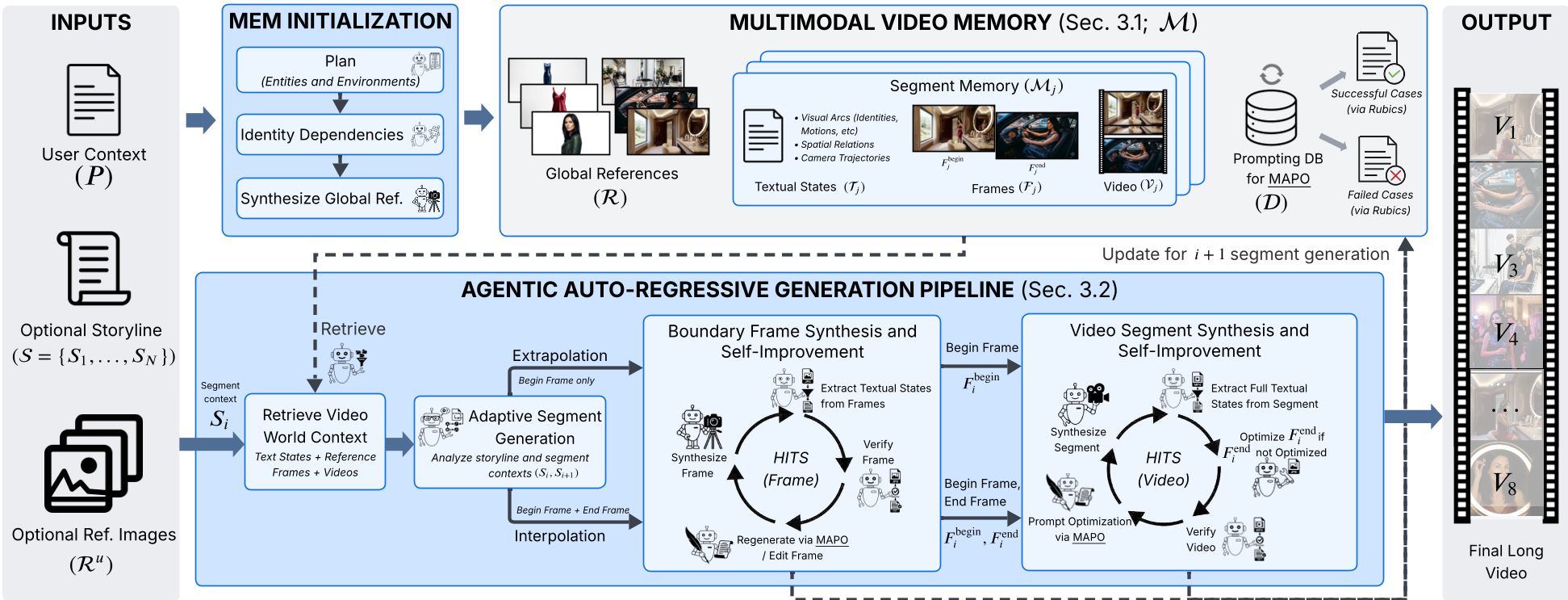
Cracking the "Cyclic" Consistency: LVbench-C
The authors identified that current benchmarks are too easy. Real stories have "cyclic" appearances—a character might leave the room (Scene 5) and come back 10 minutes later (Scene 50). A2RD was tested on LVbench-C, a new benchmark specifically designed to break models that can't "remember" long-range details.
Performance & Results
A2RD represents a massive leap in long-horizon stability. In comparisons against SOTA baselines (like VideoMemory and ViMax), A2RD maintained 96.7% character consistency across 40+ scenes, whereas baselines plummeted as the scene count increased.
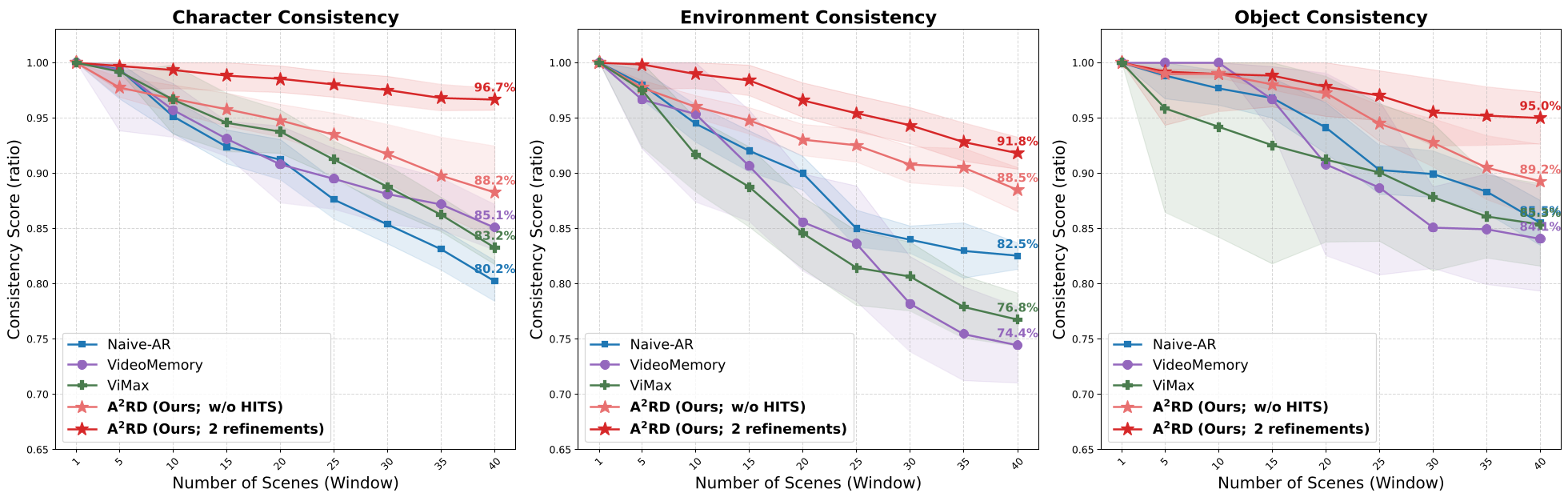
Experimental Evidence: A2RD (Blue line) stays flat as the window size increases, while other methods suffer from "drift" (declining scores).
Critical Insight: Why This Matters
The most profound takeaway is that inference-time compute matters. By spending a few more minutes on "thinking" and "refining" prompts (at a cost of roughly $0.50 per segment for the LLM), A2RD saves hours of human manual editing. It proves that for complex creative tasks, an "agentified" diffusion backbone is superior to a purely "generative" one.
Conclusion
A2RD solves the "memory loss" of modern video AI. While it carries a higher computational overhead during inference, the trade-off is a consistent, narrative-driven video that can scale to 10 minutes and beyond without losing the plot—literally.
For more details, check out the A2RD Project Page.