
[Phys. Rev. 2026] The Death of Far-Detuned Attractive Traps for Alkali Rydberg Atoms
Absence of Far-Detuned Attractive Optical Traps for Alkali Rydberg Atoms
This paper investigates the optical trapping of alkali Rydberg atoms, specifically refuting a previous claim that far-detuned circularly polarized light can create attractive traps. Using Cesium atoms (54S, 54P, 53D states) in a 1064 nm optical tweezer, the authors prove that vector and tensor polarizabilities are negligible in the far-detuned regime, confirming that the ponderomotive force remains the dominant—and repulsive—interaction.
TL;DR
High-energy Rydberg atoms are notoriously difficult to "hold" because optical fields usually push them away (ponderomotive repulsion). While a 2025 proposal suggested that circularly polarized light could create a "fictitious magnetic field" strong enough to trap them, this new research from Harvard proves—both through math and experiment—that these forces are too weak to matter in far-detuned regimes. The verdict: Far-detuned attractive traps for alkali Rydberg states simply do not exist.
Why Trapping Rydberg Atoms is a Nightmare
In the world of neutral-atom quantum computing, we usually trap atoms in the ground state using optical tweezers. But when we kick an electron into a "Rydberg" state (making the atom huge, around 200nm), the atom suddenly hates the light. This is the ponderomotive effect: the free electron in the Rydberg orbital oscillates in the AC field and is repelled from high-intensity regions.
To avoid this, scientists usually have to drop the trap entirely during the "calculation" phase, causing the atoms to drift (spin-motion coupling). Finding a way to keep them trapped—"attractive trapping"—is the holy grail of the field.
The "Fake" Vector Polarizability
A recent theory (Bhowmik & Blume, 2025) argued that by using circularly polarized light, one could exploit the vector polarizability (). They predicted would scale as , making it stronger than the ponderomotive repulsion at high frequencies.
The Harvard Rebuttal
The Ni group at Harvard put this to the test. They measured the light shifts of the , , and states of Cesium.
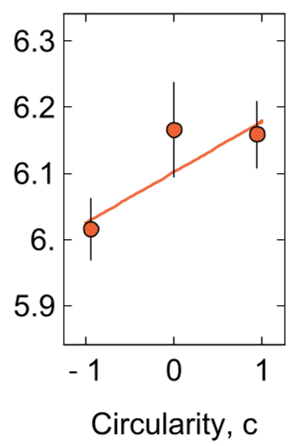 Fig 1: The spectroscopy reveals that the "fictitious magnetic field" (B_fict) from circular light is nearly zero for Rydberg states, unlike the ground state.
Their findings were stark: The predicted "massive" vector polarizability was nowhere to be found. The values were 100 times smaller than predicted.
The Math: Why the Previous Theory Failed
The authors used a Liouvillian super-operator formalism to look at the power series of the polarizability. They discovered a profound symmetry:
- Vector Polarizability (): The term is exactly proportional to , which is zero.
- Tensor Polarizability (): The term cancels out due to commutator symmetries.
The paper points out that previous numerical models (including the popular ARC package) suffered from numerical instability. Because is the result of subtracting several huge numbers (angular momentum channels) that should cancel out perfectly, small errors in the model potential created a "phantom" force in the simulations.
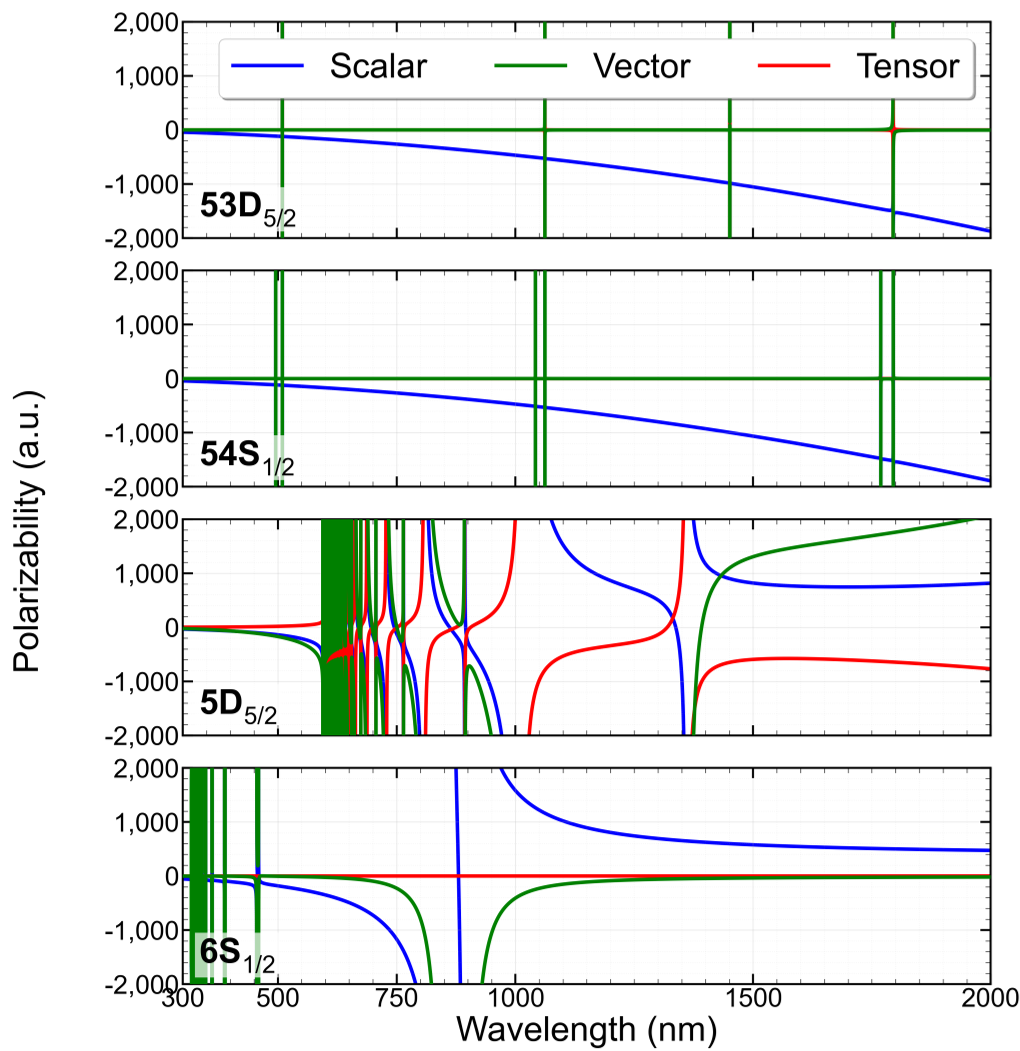 Fig 2: Corrected theoretical scaling showing how Rydberg polarizabilities plummet in far-detuned regimes compared to ground states (6S).
A Silver Lining: Near-Detuned Trapping
While far-detuned traps (like the standard 1064nm) are a no-go, the paper finds that vector effects are useful when you are near-detuned (close to a specific resonance).
By tuning the laser frequency close to a transition (e.g., ), the vector polarizability can be harnessed to:
- Reduce scattering: Circular polarization can boost the "trap depth to heating" ratio () by a factor of 3.
- Extend Trapping: It allows attractive trapping even where the scalar component is normally repulsive.
Deep Insight & Conclusion
This work serves as a "reality check" for the Rydberg community. The valence electron in a far-detuned field acts almost exactly like a free particle. No amount of clever beam geometry or polarization in the far-detuned regime can change that fundamental physical reality.
Future Outlook:
- Stop searching for the "magic" far-detuned alkali trap.
- Focus on alkaline-earth atoms (like Strontium), where the core electron can be trapped while the Rydberg electron stays out of the way.
- Leverage near-detuned circular light for short-duration "magic" pulses where state-insensitive manipulation is required.