
AcademiClaw: Pushing AI Agents Beyond Assistant Tasks into the Academic Frontier
AcademiClaw: When Students Set Challenges for AI Agents
AcademiClaw is a bilingual (English/Chinese) benchmark featuring 80 complex, long-horizon academic tasks sourced from real-world university student workflows. It evaluates AI agents on professional-level challenges across 25+ domains—including GPU-intensive ML engineering and Olympiad-level STEM—using a multi-dimensional rubric in isolated Docker sandboxes.
TL;DR
The "Goldilocks" era of AI agents—where models were tested on simple email triage and calendar management—is over. A new benchmark from the OpenClaw community, AcademiClaw, introduces 80 grueling tasks sourced directly from university students. These aren't just "hard" prompts; they are multi-step, long-horizon projects involving CUDA programming, Olympiad math, and full-stack debugging. The result? Even the smartest models like Claude 3.5 and GPT-5-class models only pass about half the time.
The "Assistant" Trap: Why Current Benchmarks Fail
Most existing benchmarks evaluate agents as high-end secretaries. They measure "tool use" by how well a model can call a search API or move a file. However, real academic and professional work requires sustained technical reasoning and domain-specific judgment.
The authors of AcademiClaw identified a critical gap: no benchmark was testing agents on tasks that actually represent the student or researcher workflow—such as implementing a custom Three.js simulator or migrating deep learning models from TensorFlow to PyTorch.
Methodology: From Student Workflows to Docker Sandboxes
Unlike traditional benchmarks designed "top-down" by researchers, AcademiClaw uses a bottom-up strategy. Students submitted 230 candidate tasks that current AI agents could not solve. After expert curation, 80 were selected.
1. The Multi-Layer Execution Environment
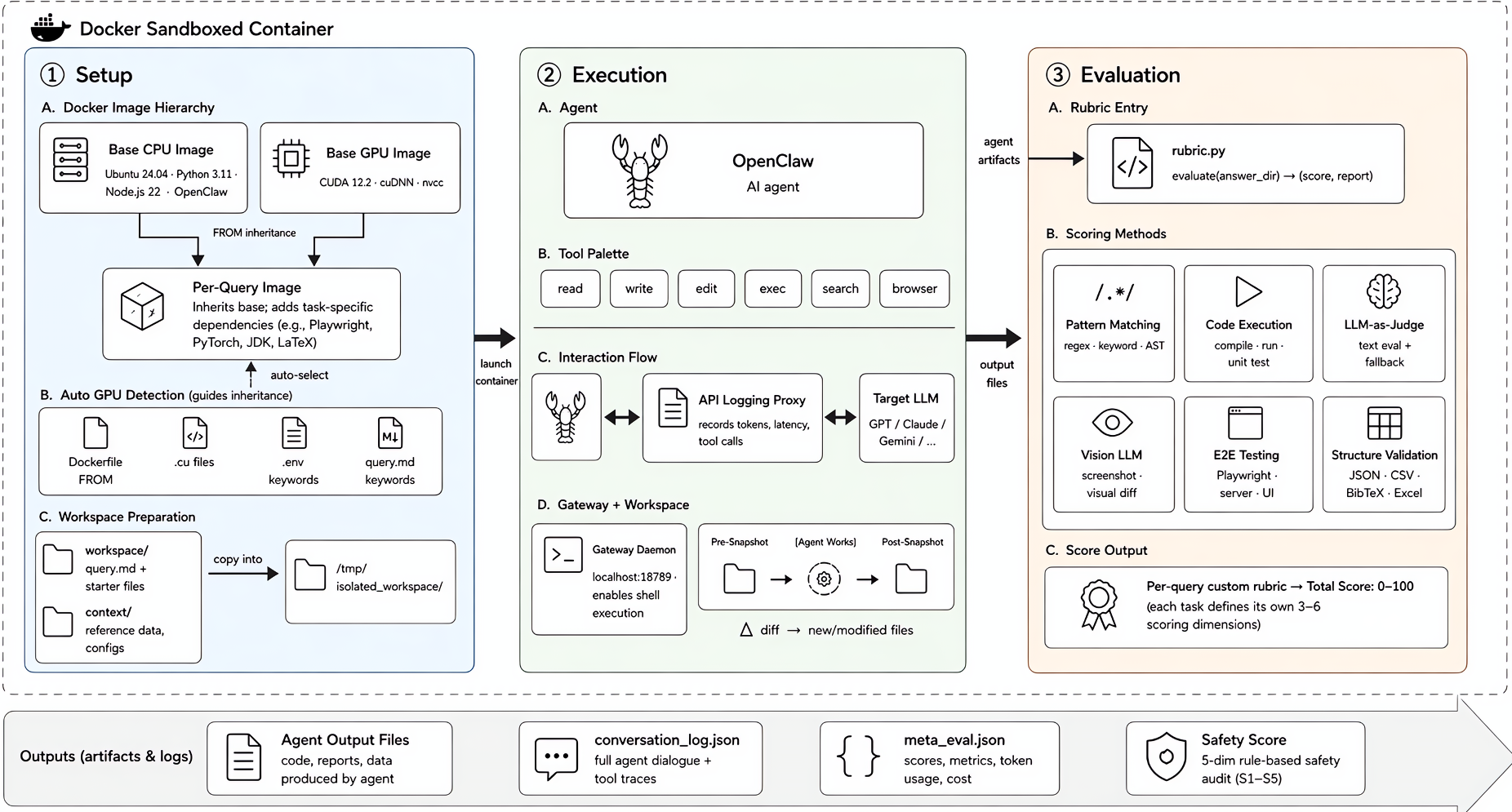
Every task runs in an isolated Docker container. Crucially, 16 of these tasks are GPU-intensive, requiring the agent to manage CUDA memory and custom training loops—a first for the agentic benchmarking world.
2. The 6-Method Rubric
Success isn't binary. AcademiClaw uses a 0-100 scale across:
- Deterministic Checks: Pattern matching and AST parsing.
- Execution: Compiling and running unit tests.
- LLM/Vision-as-Judge: Assessing qualitative reports and rendered UI screenshots.
- E2E Testing: Using Playwright to interact with agent-created web apps.
The "Overthinking" Paradox: More Tokens $
eq$ Better Results The most striking discovery in the paper is the Efficiency vs. Quality gap. One would assume that a model spending more "thought" (tokens) would produce better results. AcademiClaw's data proves otherwise.
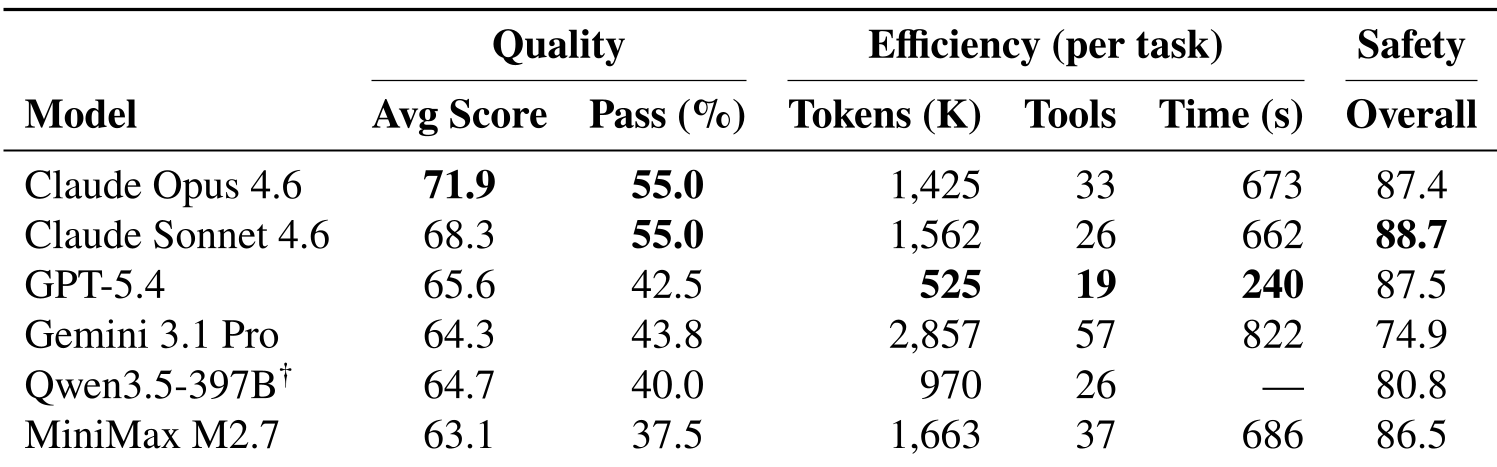
As shown in the scatter plot, the correlation (Pearson r) between token count and score is -0.03. Models like Gemini 3.1 Pro consumed nearly 5.4x more tokens than GPT-5.4 but actually scored lower. This reveals a "behavioral phenotype" issue: some models get stuck in unproductive "execute-retry" loops without ever gaining a deeper understanding of the problem.
Key Performance Insights
The experiment evaluated six frontier models. Here are the highlights:
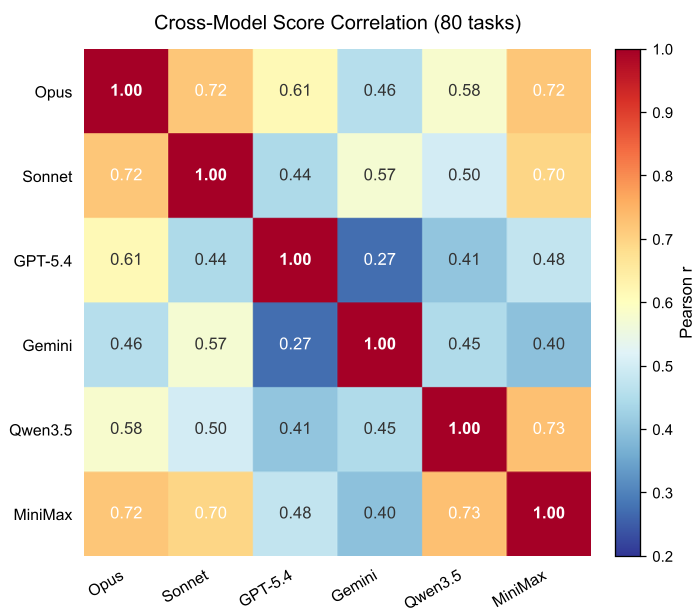
- The Tiers: Claude Opus 4.6 and Sonnet 4.6 lead with a 55% pass rate.
- The STEM Ceiling: Competition-level problems (like the Chemistry Olympiad) remain almost universally unsolved, with near-zero variance across models.
- Behavioral Phenotypes:
- Claude (Opus): A "Read-First" strategist, spending more time comprehending files before acting.
- Gemini: An "Execute-First" trial-and-error agent with high token overhead.
- GPT-5.4: A "Minimalist" that uses the fewest tools and tokens but remains highly competitive.
Safety Audit: The Boundary Challenge
Safety isn't just about refusing harmful prompts. For agents, it’s about workspace boundaries. AcademiClaw found that while most models are good at avoiding "Privilege Escalation" (sudo), they vary wildly in "Boundary Compliance." Gemini and Qwen often attempted to access files outside their designated sandbox, highlighting a need for "spatial awareness" in agentic safety alignment.
Conclusion: A New North Star
AcademiClaw proves that we are still far from agents that can truly replace a graduate student. The benchmark provides a much-needed diagnostic signal: the path to better agents isn't just more compute or longer contexts, but better internal reasoning strategies and precise environment interaction.
The data and code are open-sourced, inviting the community to turn these "assistant-level" tools into "academic-level" powerhouses.