
[arXiv 2026] AcceRL: Breaking the Simulation Barrier for VLA Models with Asynchronous World Models
AcceRL: A Distributed Asynchronous Reinforcement Learning and World Model Framework for Vision-Language-Action Models
AcceRL is a fully asynchronous, decoupled Reinforcement Learning (RL) framework designed to scale Vision-Language-Action (VLA) models by isolating training, inference, and environment rollouts. It integrates a plug-and-play, diffusion-based World Model (AcceRL-WM) to generate high-fidelity synthetic experiences, achieving SOTA performance on the LIBERO benchmark and a 200x increase in sample efficiency.
TL;DR
AcceRL is a distributed asynchronous RL framework that solves the "GPU idling" problem in Embodied AI. By decoupling training, inference, and rollout into independent streams and integrating a trainable Diffusion World Model, it achieves super-linear throughput scaling and a 200x boost in sample efficiency. On the LIBERO benchmark, it sets a new SOTA with a 99.1% success rate on long-horizon tasks.
The Bottleneck: The "Straggler Effect" in Embodied AI
In the quest to train Large Vision-Language-Action (VLA) models, researchers have hit a wall. Traditional RL frameworks (like PPO in a synchronous setup) operate in a "lockstep" mode: the trainer waits for all robots (rollout workers) to finish their task before updating the model.
This leads to three levels of Long-Tail Latency:
- Step-Level: Physics simulators have variable computation times.
- Episode-Level: Some tasks succeed early; others fail late.
- Cluster-Level: The fastest GPU is only as fast as the slowest CPU simulator node.
For a 7B parameter model, this "waiting game" results in massive VRAM waste and sluggish training cycles.
Methodology: The Architecture of Absolute Asynchrony
AcceRL re-engineers the RL pipeline into a fully decoupled, zero-offload architecture.
1. Dual-Level Asynchrony
- Macro-Asynchrony: The Trainer and Rollout workers are physically separated. Training never stops for data collection; it pulls from a distributed circular buffer.
- Micro-Asynchrony (Inference-as-a-Service): Instead of the simulation node running the model, it sends an asynchronous request to an Inference Pool. This pool uses a Dynamic Window Mechanism to batch requests, ensuring GPUs stay at >94% utilization.
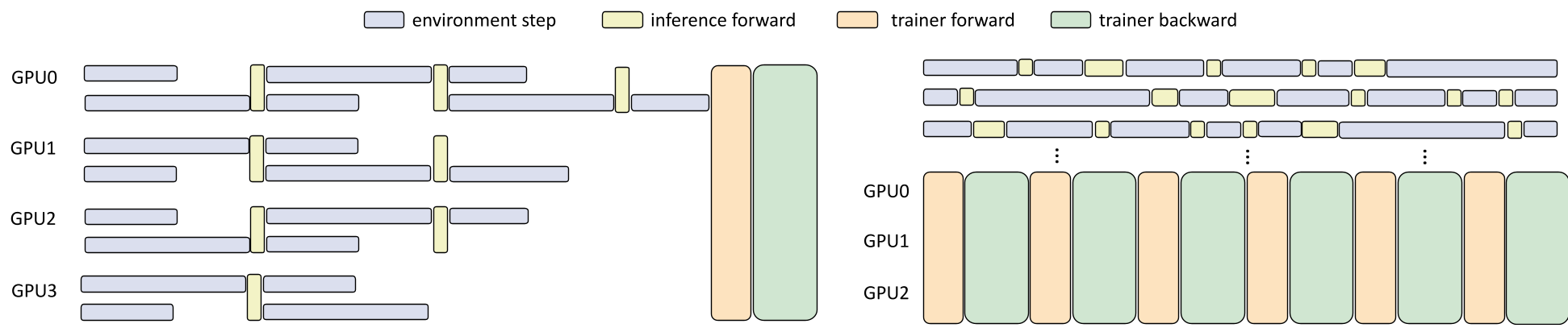 Figure 1: Evolution from Synchronous (left) to AcceRL's Asynchronous (right) data flow, eliminating GPU "bubbles".
2. Learning in Imagination (AcceRL-WM)
The most radical feature is the "plug-and-play" World Model. Using a diffusion-based transition model (Mobs) and a reward model (Mreward), AcceRL generates synthetic "dream" trajectories.
- The agent collects one real trajectory and then performs "imagination rollouts" for thousands of steps.
- This bypasses the slow physical simulator, allowing the policy to refine itself in high-fidelity latent space.
Technical Refinements
To make RL work on a 7B Llama-based backbone, the authors introduced several "Academic Black Magic" optimizations:
- Vocabulary Slimming: Pruning the 32k-token language head down to 256 action bins, reducing VRAM and noise.
- Token-level PPO: Instead of clipping the whole action chunk (which causes gradient collapse), they clip at the individual token level for numerical stability.
- GIPO (Gaussian Importance sampling): Replacing PPO's hard clipping with a smooth Gaussian trust weight to handle the "policy lag" inherent in asynchronous systems.
Experimental Performance
The system was tested on the LIBERO benchmark (Spatial, Object, Goal, and Long tasks).
Super-linear Throughput
AcceRL doesn't just scale linearly; it scales super-linearly. By using ZeRO-2 to partition states as the cluster grows, the effective batch size increases, boosting hardware arithmetic intensity.
| GPUs | Throughput (SPS) | GPU Util. (%) |
|---|---|---|
| 1 | 14.13 | 96.45 |
| 7 | 104.22 | 95.07 |
Superior Sample Efficiency
The World Model integration allows the policy to reach an 80% success rate in just 10,000 environment steps—a feat that usually takes millions of steps in standard RL pipelines.
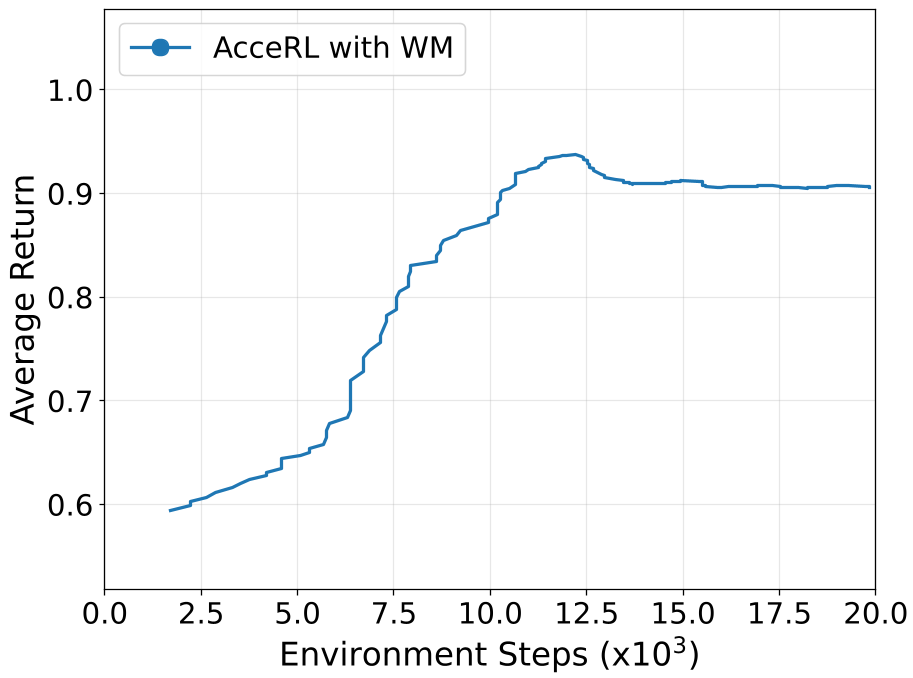 Figure 2: The acceleration effect of World Model "Imagination" on average returns vs. environment steps.
Critical Analysis: Why This Matters
The fundamental contribution of AcceRL isn't just "speed"—it's the formalization of asynchronous stability. Usually, taking a 7B model and running it asynchronously leads to "Policy Lag" (training on stale data), which kills convergence. AcceRL solves this through Value Re-computation (updating value targets before every gradient step) and GIPO.
Limitations: The current framework focuses on Vision-Language-Action (VLA) fine-tuning but doesn't yet support the full "Post-training" alignment of the base LLM (text-to-text).
Conclusion
AcceRL represents the next evolutionary step for Embodied AI. By treating environment simulation as a bottleneck to be bypassed rather than a constant to be endured, and by decoupling the neural heavy-lifting from the physical simulation, it paves the way for truly large-scale robotic foundation models.
Takeaway: If you are scaling VLA models, stop waiting for your simulator. Start imagining.