
[PRX/NJP 2026] Accelerated Rydberg-EIT Quantum Memory: Breaking the Adiabatic Speed Limit via Counter-Diabatic Driving
Accelerated Rydberg-EIT quantum memory via shortcuts to adiabaticity
The paper proposes a high-speed, high-fidelity quantum memory scheme using Shortcuts to Adiabaticity (STA) via counter-diabatic (CD) driving in a Rydberg-EIT system. By introducing an engineered auxiliary field, the authors successfully compress the signal photon writing time beyond the adiabatic limit while maintaining storage fidelity >99% and suppressing lossy intermediate state populations.
TL;DR
The inherent slowness of adiabatic processes has long been the "speed limit" of high-fidelity quantum memories. This paper introduces a Shortcuts to Adiabaticity (STA) protocol that allows for rapid signal photon writing in Rydberg-EIT systems. By using an auxiliary Counter-Diabatic (CD) field, the researchers effectively suppressed the leakage to lossy intermediate states, achieving high-fidelity storage on timescales where traditional EIT protocols fail.
Problem & Motivation: The Speed-Fidelity Wall
Quantum memories based on Electromagnetically Induced Transparency (EIT) are vital for scalable quantum networks. They work by mapping a flying photon onto a stationary collective atomic excitation (a "dark-state polariton").
However, this mapping process is typically adiabatic, meaning the control fields must change slowly enough for the system to remain in the "dark state." If you try to speed up the writing process to increase the throughput of a quantum repeater:
- The Adiabatic Condition is violated.
- The system populates the lossy intermediate state |e⟩.
- Spontaneous emission occurs, leading to information loss and decoherence.
The authors' insight was to use Counter-Diabatic (CD) driving—a technique that introduces an auxiliary Hamiltonian to cancel out the non-adiabatic transitions, effectively "guiding" the wave function along the intended path regardless of speed.
Methodology: Engineering the Shortcut
The heartbeat of this paper is the derivation of the CD field . In a three-level ladder system (), the CD field creates an effective direct coupling between and the Rydberg state .
1. The Superatom Model
Due to the Rydberg Blockade, an ensemble of atoms acts as a single "superatom" that can only transition to a single-excitation manifold. The authors modeled the dynamics using modified Maxwell-Bloch equations to account for both the temporal evolution of the atoms and the spatial propagation of the light field.
2. Physical Implementation
Since the transition is dipole-forbidden, the authors proposed implementing via an off-resonant two-photon Raman process.
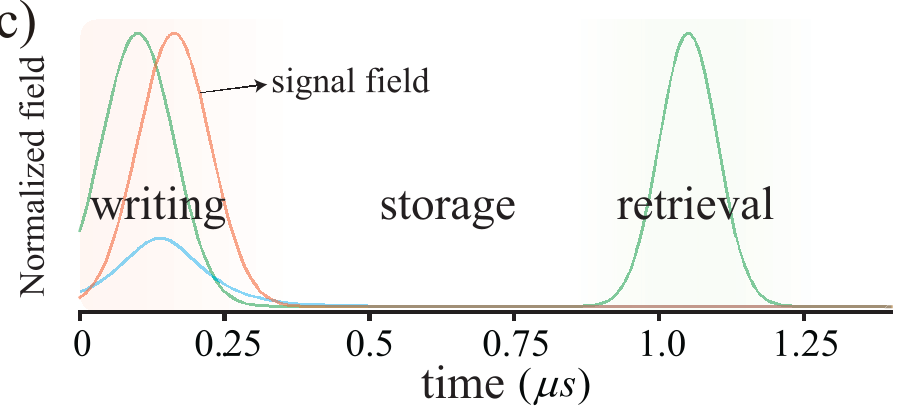 FIG 1. (a) Rb-87 ensemble; (b) Level structure showing the EIT coupling and the auxiliary CD driving; (c) The precise pulse sequence required.
Experiments & Results: Fast but Faithful
The researchers compared the standard EIT writing process with their STA-assisted version.
- At ns: Both methods perform well (adiabaticity holds).
- At ns: The standard EIT protocol crashes, with storage fidelity dropping to ~50%. The STA-assisted protocol remains at >99%.
Robustness Analysis
A key highlight is the analysis of experimental imperfections. Even when the CD field has 20% amplitude noise or phase jitters, the retrieval signal remains nearly undistorted. This is critical for practical deployment where laser stability is a factor.
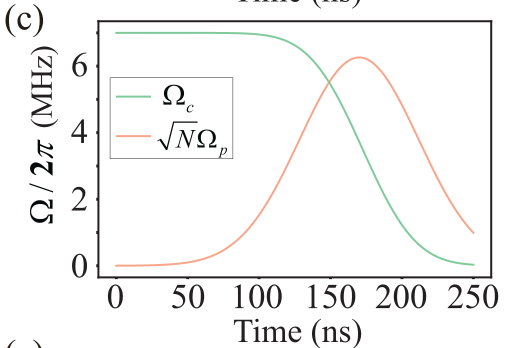 FIG. 2. Comparison of population dynamics. (d) shows the failure of adiabaticity in fast EIT, while (f) shows the recovery via CD driving.
Handling the "Real World"
The authors went a step further by expanding the Hilbert space to a 6x6 density matrix to account for:
- Multiphoton Inputs: Using a coherent state rather than a pure single-photon source.
- Imperfect Blockade: Allowing for leakage into the double-excitation manifold .
- Motional Dephasing: Modeling the thermal motion of atoms that erases the spin-wave phase over time.
Even under these non-ideal conditions, the CD-assisted scheme provided a significant margin over conventional methods.
Critical Insight & Conclusion
The significance of this work lies in its scalability. Most STA research focuses on single atoms or simple internal state transfers. By extending STA to the propagation of optical fields in a many-body Rydberg system, the authors have bridged the gap between theoretical quantum control and practical quantum hardware.
Limitations: The scheme requires precise timing of three different laser pulses (Signal, Control, and CD). Additionally, while it accelerates the writing process, it does not solve the fundamental storage lifetime limits imposed by Rydberg state decay and atomic motion, though it does optimize the time available before those factors dominate.
Future Outlook: This approach could be integrated into photonic quantum logic gates or used to create high-speed interfaces for hybrid quantum systems (e.g., superconducting qubits to optical fibers).