
[CVPR 2026] Act Wisely: Cultivating Meta-Cognitive Tool Use in Agentic Multimodal Models
Act Wisely: Cultivating Meta-Cognitive Tool Use in Agentic Multimodal Models
This paper introduces Metis, a strategic multimodal agent, and HDPO (Hierarchical Decoupled Policy Optimization), a reinforcement learning framework designed to cultivate meta-cognitive tool arbitration. By decoupling task accuracy from tool efficiency, Metis achieves state-of-the-art performance on benchmarks like WeMath (+26.4% improvement) while reducing redundant tool invocations from over 90% to nearly zero.
TL;DR
Researchers from Alibaba and HUST have released Metis, a multimodal agent that knows when not to use tools. By implementing Hierarchical Decoupled Policy Optimization (HDPO), they've solved the "blind tool invocation" pathology—where agents call APIs for no reason. Metis achieves SOTA results on vision-math tasks while cutting tool calls by up to 96%, proving that restraint is a form of intelligence.
The Problem: The "Reflexive Tool Use" Pathology
Modern Multimodal Large Language Models (MLLMs) are often equipped with "agentic" powers—they can crop images, search the web, or run Python code. However, they lack meta-cognition. Much like a student using a calculator for , current agents invoke tools reflexively even when the answer is plain to see in the original image.
Why hasn't Reinforcement Learning (RL) fixed this? The authors identify a mathematical flaw: Reward Scalarization. When you combine accuracy () and tool efficiency () into one number, the high variance of the accuracy signal "drowns out" the efficiency signal. If you penalize tools too hard, the model becomes too scared to use them; if you penalize too lightly, the model ignores the penalty entirely.
Methodology: HDPO and the Conditional Advantage
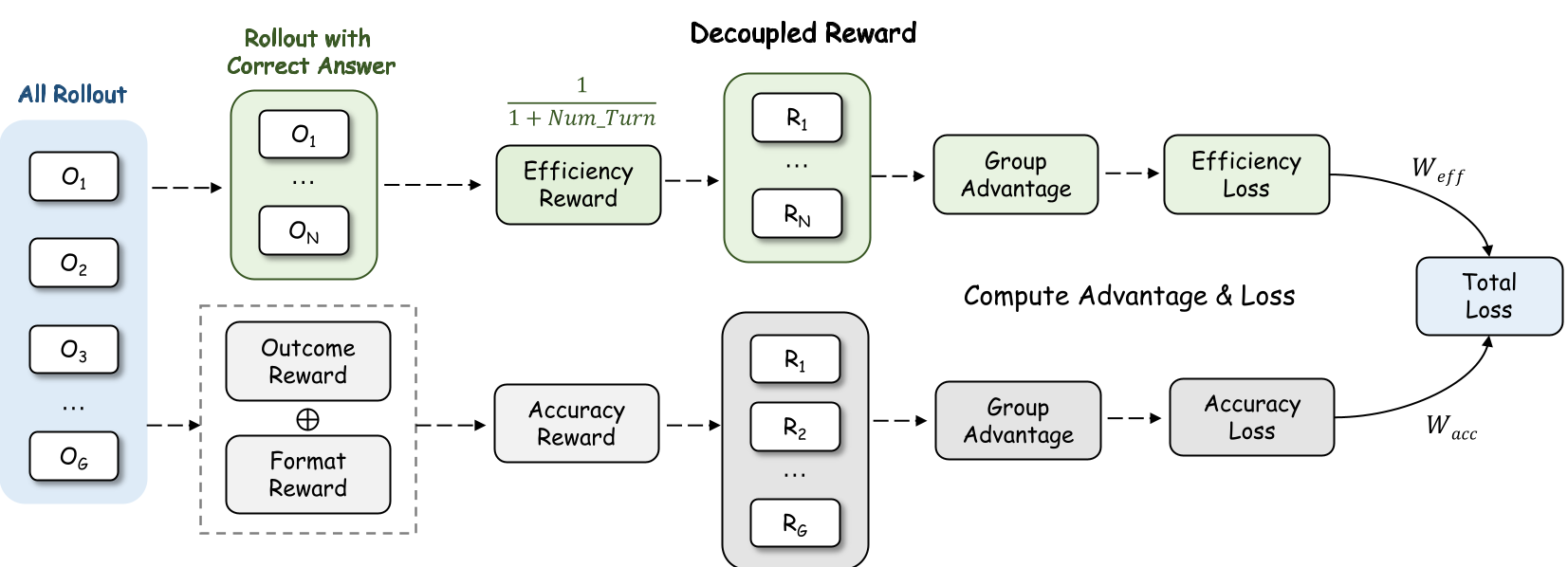
To break this deadlock, the team proposed HDPO. Instead of one messy reward, they split the optimization into two clean channels:
- Accuracy Channel: Maximizes correctness across all attempts (standard GRPO).
- Efficiency Channel: Penalizes extra tool calls, but only for correct trajectories.
This creates a Conditional Advantage. An agent isn't rewarded for being fast but wrong; it is only rewarded for being fast once it has already proven it can be right.
The Implicit Curriculum
This design creates a natural learning path:
- Phase 1: The model learns to solve the problem (Accuracy).
- Phase 2: Once it can solve the problem, it begins to compete with itself to do it with fewer tools (Efficiency).
Experimental Results: Accuracy via Abstention
The results are striking. On the WeMath benchmark, Metis-8B jumped from 38.8% to 65.2%. Most importantly, it did this while virtually eliminating "noise."
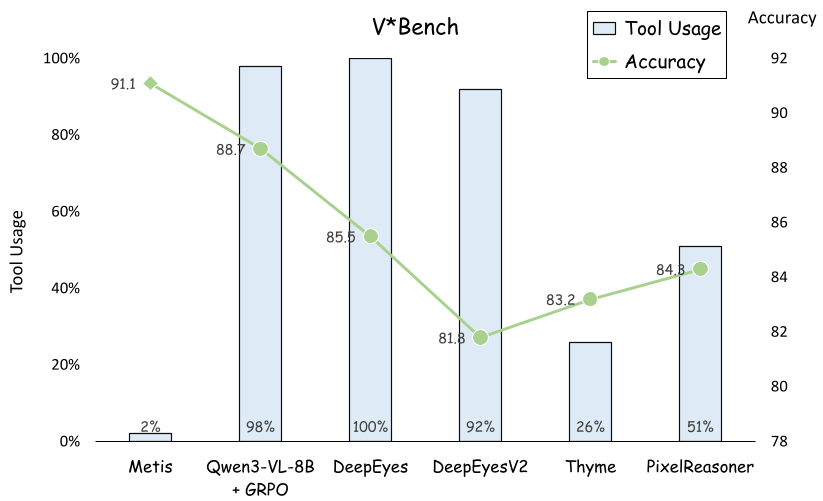
As shown in the figure above, while other models (like DeepEyesV2) use tools nearly 100% of the time, Metis achieves higher accuracy while using tools less than 10% of the time. This debunks the myth that more tool-use equals more "agentic" intelligence.
Case Study: Meta-Cognitive Arbitration
In Figure 4, we see Metis analyzing a clear image. It realizes its internal visual parametric knowledge is enough and abstains from cropping. However, in Figure 5—where the visual data is too dense (overlapping lines on a graph)—it selectively triggers a Python crop-and-zoom. This is "Meta-Cognitive Wisdom."
Critical Insight & Conclusion
Metis represents a shift in AI agent philosophy. We are moving from the "How" phase (teaching models to use a tool) to the "When" phase (teaching models to judge their own uncertainty).
By decoupling the optimization gradients, HDPO provides a blueprint for training agents that aren't just accurate, but are also computationally efficient and less prone to the "noise" introduced by unnecessary external interactions. The future of agents isn't just about doing more; it's about doing only what is necessary.