
ActCam: Mastering Cinematic Control in Zero-Shot Video Generation
ActCam: Zero-Shot Joint Camera and 3D Motion Control for Video Generation
ActCam is a training-free, zero-shot framework for video generation that enables simultaneous control over character motion (transferred from a driving video) and 3D camera trajectories. By building upon any pretrained image-to-video diffusion model (like VACE), it achieves SOTA performance in camera adherence and motion fidelity without requiring expensive finetuning.
TL;DR
ActCam is a revolutionary training-free (zero-shot) framework that finally solves the problem of controlling both what the actor does and how the camera moves. Instead of retraining massive models, it constructs "camera-aligned" depth and pose signals to guide existing Video Diffusion backbones. It achieves superior geometric consistency and visual quality compared to specialized, finetuned models like Uni3C.
Perspective: Why Joint Control is the "Final Boss" of Video AI
In filmmaking, a shot isn't just a character moving; it’s a dance between the actor and the lens. Existing models usually fail here:
- Pose-only models (like AnimateAnyone) break under camera rotation because 2D keypoints can't represent 3D depth.
- Camera-only models treat the scene as static, failing when characters move.
- Finetuned models are "locked" into specific styles and are expensive to update.
ActCam enters the scene as a geometry-aware plug-in that works at inference time.
Methodology: The Geometry-Grounded Pipeline
The secret to ActCam's success isn't a new Neural Network, but a superior way to prepare the Conditioning Signal.
1. The Mask & Inpaint Strategy
To avoid "ghosting" (where a static version of the character from the reference image stays in the background), ActCam inpaints the character out. It creates a clean 3D background mesh.
2. Scene Transfer & 3D Fitting
Instead of just overlaying keypoints, ActCam uses 3D Motion Recovery (GVHMR) to reconstruct the actor in 3D space. It then mathematically aligns (Scene Transfer) that actor into the 3D background mesh based on depth scaling. This ensures that when the actor "walks," they are actually interacting with the 3D floor of the scene.
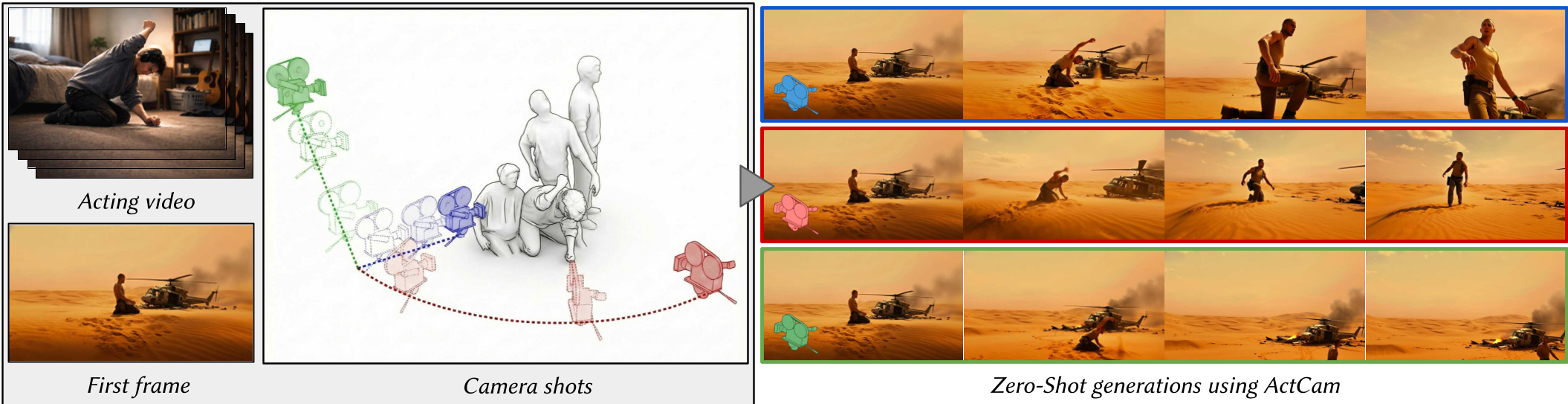 Fig 1: The ActCam pipeline converts a reference image and a driving video into geometrically consistent 3D conditions.
3. The Two-Phase Conditioning Schedule
Monocular depth is often "noisy" or "coarse." If you force the AI to follow it for every step, the video looks rigid and full of artifacts. ActCam introduces a switching threshold ():
- Phase 1 (Early steps): Use Pose + Depth. This "locks in" the camera motion and the floor layout.
- Phase 2 (Late steps): Drop the Depth, keep the Pose. This allows the AI to "hallucinate" high-frequency details (like clothes or hair) without being choked by a blurry depth map.
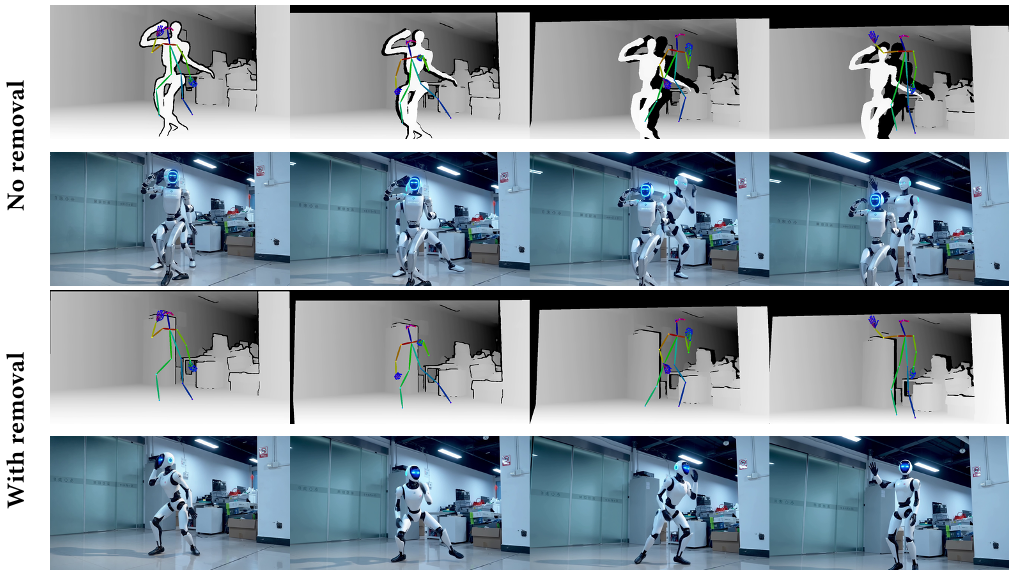 Fig 2: Importance of the schedule. Without the pose-only phase (N=1), the geometry becomes too rigid to allow natural movement.
Experiments: Dominating the Benchmarks
ActCam was tested against Uni3C and other heavyweights. It didn't just win; it dominated in Sampson Error (geometric consistency) and Imaging Quality.
| Metric | Uni3C (Finetuned) | ActCam (Ours - Zero Shot) |
|---|---|---|
| Subject Consistency | 0.9084 | 0.9212 |
| Sampson Error (SE) ↓ | 0.5665 | 0.4546 |
| Imaging Quality | 0.6640 | 0.7212 |
Crucially, human evaluators preferred ActCam across the board for Camera Adherence and Motion Faithfulness, proving that 3D-aligned signals are more intuitive than 2D approximations.
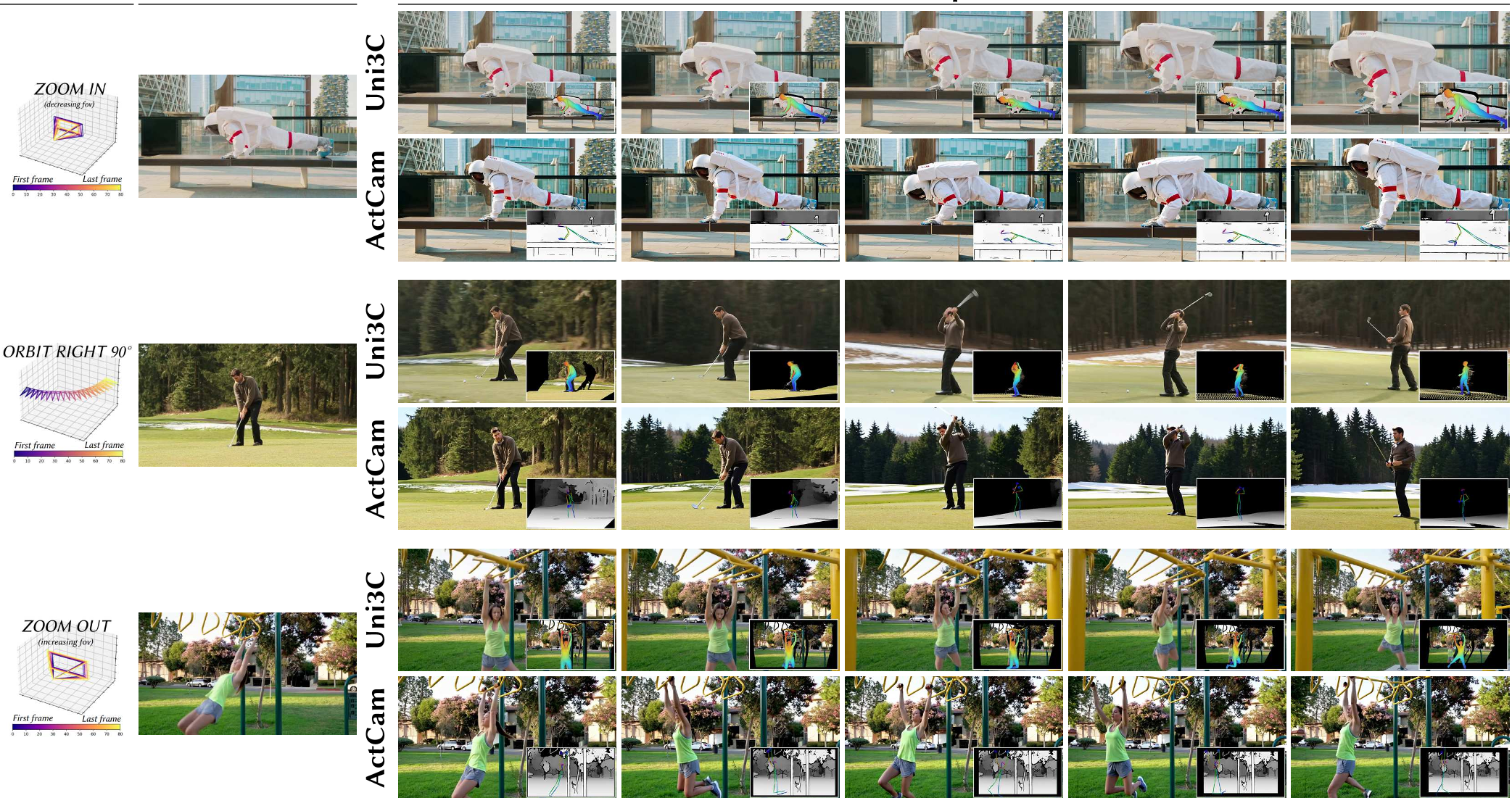 Fig 3: Comparison with Uni3C. Notice how ActCam maintains better character proportions and cleaner backgrounds during camera pans.
Conclusion: A Paradigm Shift for AI Cinematography
ActCam proves that the future of video generation isn't just "more data" or "larger models," but smarter geometry. By treating the latent space as a 3D-aware environment through scheduled depth and pose conditioning, we can achieve Hollywood-level control today.
Future Outlook: The framework is backbone-agnostic, meaning as DiT (Diffusion Transformer) models like Sora or Wan 2.1 improve, ActCam will only get more powerful.