
[ArXiv 2025] Action Draft and Verify: Scaling VLA Robustness via VLM Self-Verification
Action Draft and Verify: A Self-Verifying Framework for Vision-Language-Action Model
The paper introduces Action Draft-and-Verify (ADV), a Vision-Language-Action (VLA) inference framework that combines the high-precision control of diffusion experts with the robust priors of auto-regressive VLMs. ADV employs a diffusion model to "draft" multiple action candidates, which the VLM then "verifies" by reranking them in a single forward pass using a perplexity-style metric.
TL;DR
The Action Draft-and-Verify (ADV) framework bridges the gap between the precision of Diffusion Experts and the reasoning robustness of Vision-Language Models (VLMs). By drafting multiple trajectories via diffusion and reranking them using VLM perplexity, the system achieves a +19.7% success rate boost in the real world, specifically excelling at error recovery in unfamiliar (OOD) environments.
The Motivation: Precision vs. Robustness
In the current VLA landscape, researchers face a trade-off:
- Diffusion Models: Excellent at generating smooth, high-precision continuous actions but prone to "jitter" and lack of recovery logic when facing unseen scenarios.
- Auto-regressive Models: Inherit strong "commonsense" from VLM pre-training, providing stable recovery, but often lack the granularity for fine-grained motor control.
The authors observed that in OOD tasks (like those in RoboTwin2.0 Hard), diffusion models' recovery attempts drop drastically (from 4.5 to 0.4), while auto-regressive baselines actually increase their efforts to fix mistakes. ADV aims to eat the cake and have it too.
Methodology: The "Textual FAST" Bridge
To make a VLM act as a "verifier," the actions must be "readable" by the model.
1. Textual FAST Tokenization
The authors improve upon the FAST tokenizer. Standard FAST uses Discrete Cosine Transform (DCT) and BPE. Textual FAST takes these discrete codes and renders them as plain text strings before re-tokenizing them with the VLM’s standard tokenizer. This ensures the actions "look" like the numerical data the VLM saw during its massive pre-training, making its probability estimates (log-likelihood) much more reliable.
2. The Draft-and-Verify Loop
- Draft: The diffusion expert (conditioned on VLM hidden states) generates candidate trajectories (e.g., ) by varying the noise.
- Verify: All candidates are fed into the VLM in a single batch. The VLM calculates the Perplexity-style score:
- Select: The chunk with the lowest perplexity is executed.
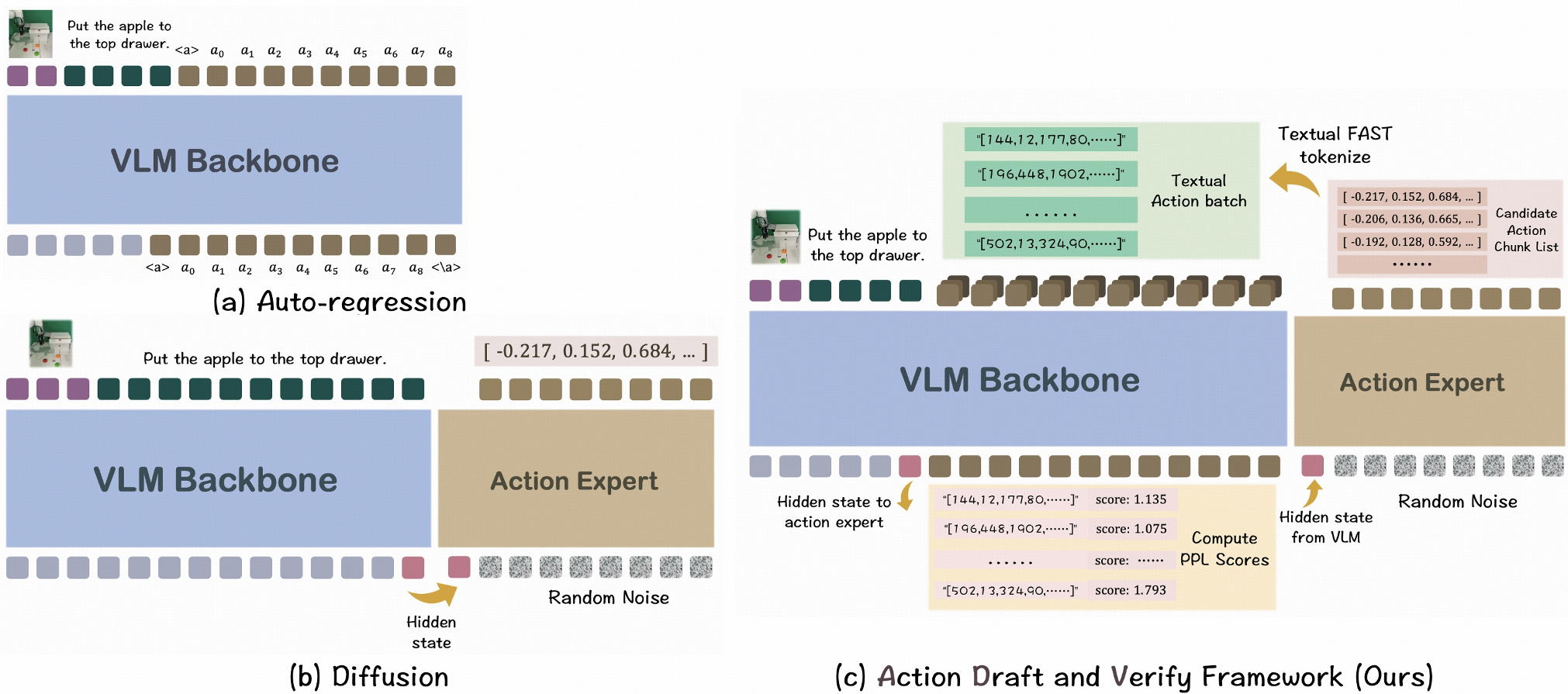 Fig 1: The ADV framework showing the interplay between the VLM backbone and the Diffusion Expert.
Experimental Results: Discarding the "Bad"
The core insight is that the VLM doesn't need to be a "perfect" actor; it just needs to be a "good" critic.
Quantitative Gains
In real-world tasks like "Push Blocks" or "Hang Cups," ADV transformed the performance of general VLMs (like Qwen2.5-VL) to match or exceed specialized, large-scale pre-trained VLAs like .
| Benchmark | Model | Diffusion Baseline | ADV (Ours) | Improvement |
|---|---|---|---|---|
| RoboTwin2.0 (Hard) | Qwen2.5-VL | 6.7% | 10.2% | +3.5% |
| Real-World Avg | Qwen2.5-VL | 49.5% | 71.4% | +21.9% |
Why it works: The "Trajectory Keeper"
Analysis of the "K-th Best" experiment reveals that success rates stay high for the top 3 ranked candidates but plummet after K=4. This proves that the VLM is exceptionally good at filtering out "destroyer" trajectories (actions that would cause collisions) and "slacker" trajectories (actions that do nothing).
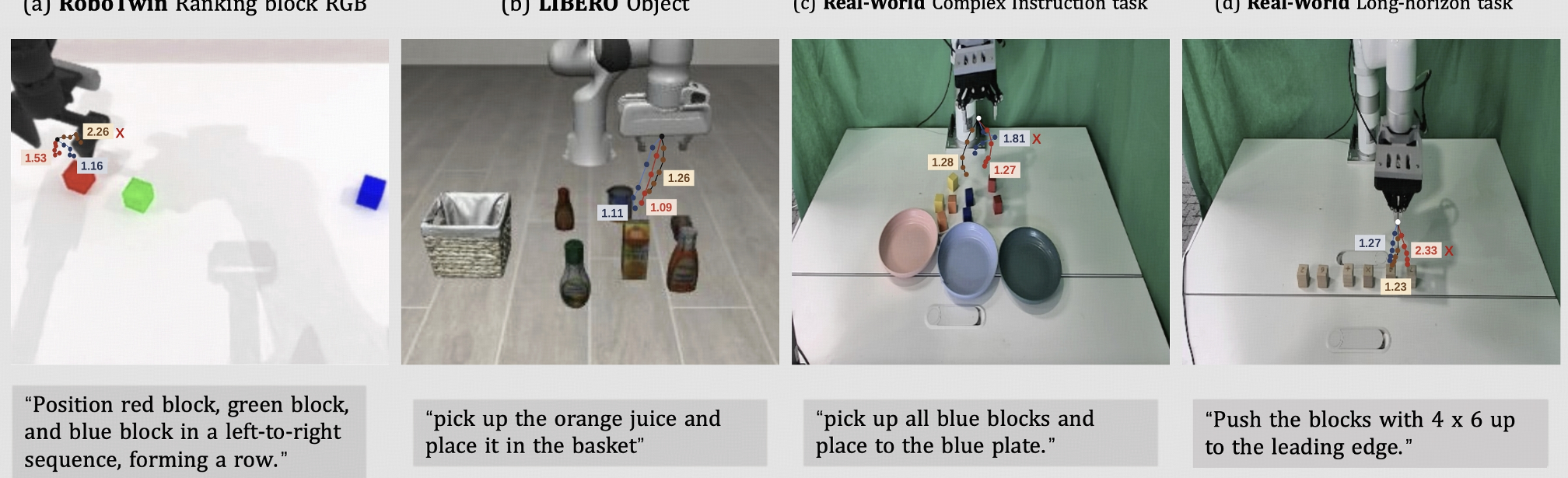 Fig 2: ADV rejects the "red" (erroneous) and "blue" (indirect) paths, selecting the most efficient trajectory.
Critical Insights & Future Work
- Efficiency: While drafting multiple candidates adds overhead, the authors argue that since the VLM only performs a single forward pass for scoring (not token-by-token generation), the latency is manageable (maintaining ~14-53 Hz).
- The Filter Hypothesis: ADV’s success suggests that for embodied AI, the "system 2" (deliberative reranking) might be more critical for safety and OOD robustness than simply scaling "system 1" (instinctive diffusion).
- Limitations: ADV still depends on the diffusion expert's ability to propose at least one valid path. If the expert is completely lost, no amount of reranking can save the trial.
Conclusion
ADV represents a pragmatic yet powerful shift in VLA design—moving away from pure generation toward a generate-then-filter paradigm. By treating the VLM as a linguistic judge of mechanical actions, we can significantly harden robots against the unpredictability of the real world.