
Active Learning for Conditional GCS: When Prompts Dictate Physics
Active Learning for Conditional Generative Compressed Sensing
The paper introduces a novel Active Learning framework for Conditional Generative Compressed Sensing (GCS), utilizing prompt-conditioned generative models (like Stable Diffusion) to optimize both signal recovery and sampling distributions. By applying Christoffel sampling to Fourier measurements, the authors establish a theoretical foundation for prompt-dependent image reconstruction, achieving state-of-the-art stability results in structured sampling scenarios.
TL;DR
This work bridges the gap between high-level text prompts and the low-level physics of signal acquisition. By introducing an Active Learning framework for Conditional Generative Compressed Sensing, the authors demonstrate that text prompts can be used to mathematically optimize how we sample information (e.g., in an MRI scanner) to ensure the most stable and accurate image reconstruction.
Contextual Positioning
In the world of inverse problems, we've moved from "sparsity" (Compressed Sensing 1.0) to "unconditional generative models" (CS 2.0). This paper represents the shift toward CS 3.0: Conditional & Active Sensing, where the metadata (prompts) used at the moment of sensing determines the performance of the recovery.
The Problem: The High Cost of Mismatch
Most compressed sensing theory assumes a "one-size-fits-all" model. However, in reality:
- Hardware Constraints: We don't get Gaussian measurements; we get structured ones (like Fourier coefficients).
- Context Exhaustion: If we know we are imaging a "beach at sunset," we shouldn't sample the same way as if we were imaging a "brain scan."
The authors identify a critical gap: what happens if the prompt used to design the sampling mask () doesn't match the prompt used to recover the image ()?
Methodology: The Prompt Compatibility Factor
The core of the paper is the Prompt Compatibility Factor . This metric acts as a penalty term. If your sampling distribution is poorly aligned with the geometry of your signal class, grows, and you need more samples () to achieve stability.
Architecture & Sampling
The authors use Christoffel Sampling, which places more probability mass on Fourier coordinates that are most informative for a specific class.
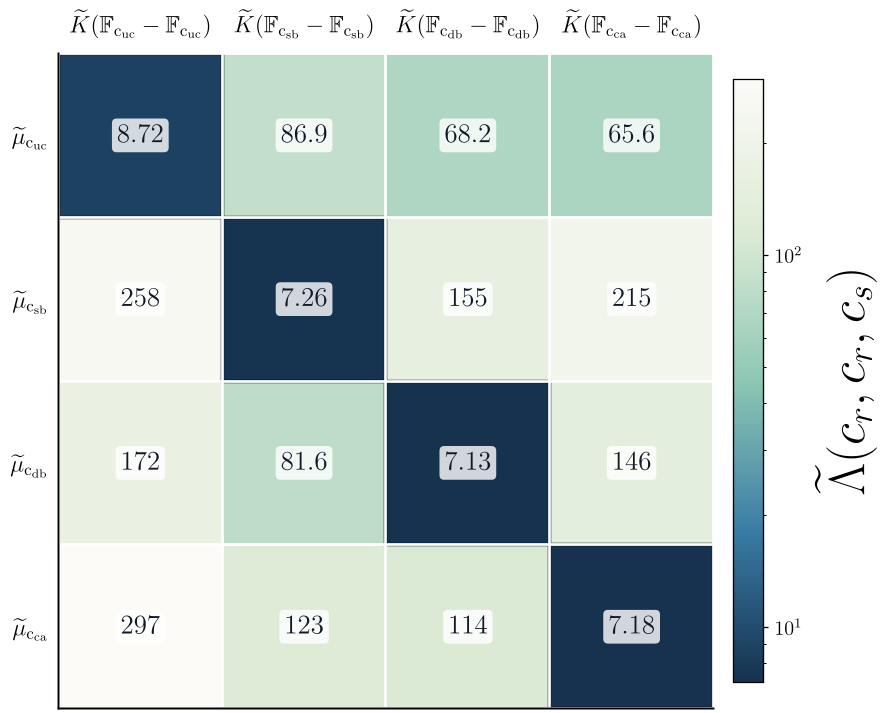 Figure 1: (a) Heatmaps showing how different prompts (Daytime Beach vs. Cat) reshape the optimal Fourier sampling mask. (b) The Compatibility Matrix showing the penalty for mismatched prompts.
Experimental Insights: Stable Diffusion in the Loop
The researchers tested their theory using Stable Diffusion 1.5. They discovered that while semantically matched prompts help, the Classifier-Free Guidance (CFG) scale is a double-edged sword. High CFG makes the model follow the prompt strictly, but actually reduces optimization flexibility, sometimes hurting the final PSNR.
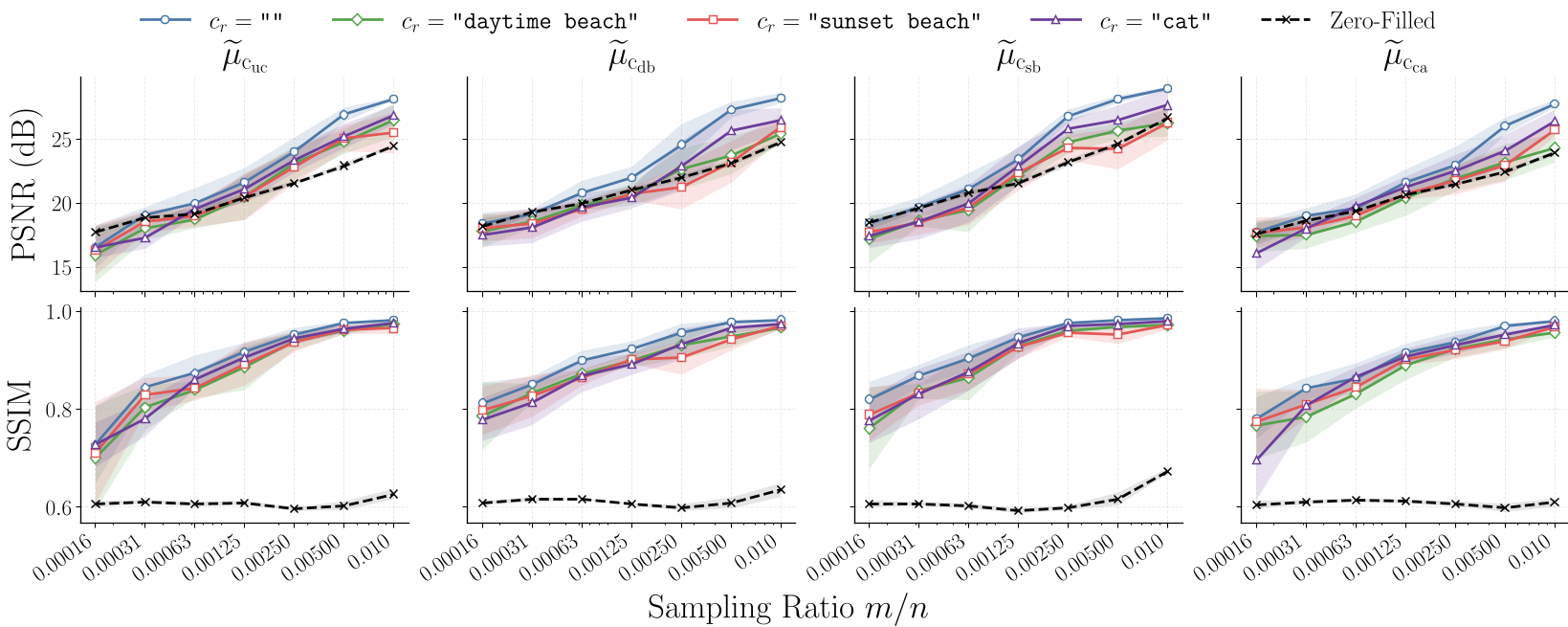 Figure 2: Performance metrics (PSNR/SSIM) comparing different sampling distributions. Notice how distributions adapted to the specific prompt (purple line) consistently outperform generic or mismatched masks.
Deep Insight: Why Unconditional Recovery Often Wins
A surprising "Aha!" moment in the paper is that Unconditional Recovery () often yields better results than conditioned recovery when there is a slight mismatch. Why? Because the unconditional space is a "superset" that allows the optimizer to find a better fit to the raw data without being trapped by the "hallucinations" of a specific prompt.
Conclusion & Future Impact
This research proves that prompts are physical design variables. In the future, we can expect:
- Smart Medical Imaging: MRI machines that ask for the patient's symptoms to "zoom in" on the most relevant spectral frequencies.
- Dynamic Sensing: Real-time updates to sampling masks as the context of a scene changes.
Takeaway: If you know what you are looking for, you don't need to look at everything—but you must be careful not to squint too hard at the wrong things.