
[CVPR 2025] AAPB: Mastering Rare Concepts and Structural Editing via Adaptive Prompt Blending
Adaptive Auxiliary Prompt Blending for Target-Faithful Diffusion Generation
The paper introduces Adaptive Auxiliary Prompt Blending (AAPB), a training-free framework that stabilizes text-to-image diffusion models in low-density (rare) data regions. By adaptively blending target prompts with auxiliary anchor prompts, AAPB achieves SOTA performance on RareBench (semantic accuracy +8.4%) and FlowEdit (structure preservation) benchmarks.
TL;DR
Even the most powerful diffusion models like SD3 or FLUX fail when asked to generate "rare" things—concepts that weren't common in their training data. Adaptive Auxiliary Prompt Blending (AAPB) solves this by introducing a "semantic anchor" and a mathematically derived, per-timestep weighting system. It doesn't require retraining and achieves a massive +8.4% improvement in semantic accuracy while setting new records for structural fidelity in image editing.
The "Low-Density" Nightmare
Why does a model fail to generate an "origami cat" but perfectly generates a "cat"? The answer lies in distribution density. Common concepts occupy high-density regions of the latent space, providing strong gradients (guidance). Rare concepts sit in "low-density" holes where the score function is under-constrained. Consequently, the generation "drifts" toward more common modes, resulting in a plain cat instead of an origami one.
Current solutions try to use "anchor prompts" (using a common word like 'cat' to help the rare 'origami cat'), but they use fixed or heuristic schedules. If the anchor is too strong, you lose the target; if it's too weak, the image becomes a mess.
The Methodology: Physics-Backed Adaptivity
The core innovation of AAPB is moving away from guessing weights. The authors leverage Tweedie’s Formula—a classic Bayesian tool—to align the "posterior mean" (the best guess of the clean image) of the blended prompt with the target.
The Closed-Form Solution
Instead of manual tuning, the authors derived a mathematical solution for the blending coefficient :
This formula calculates the optimal projection in the score space at every single denoising step. It identifies how much "help" the model needs from the anchor to stay on the right path toward the target.
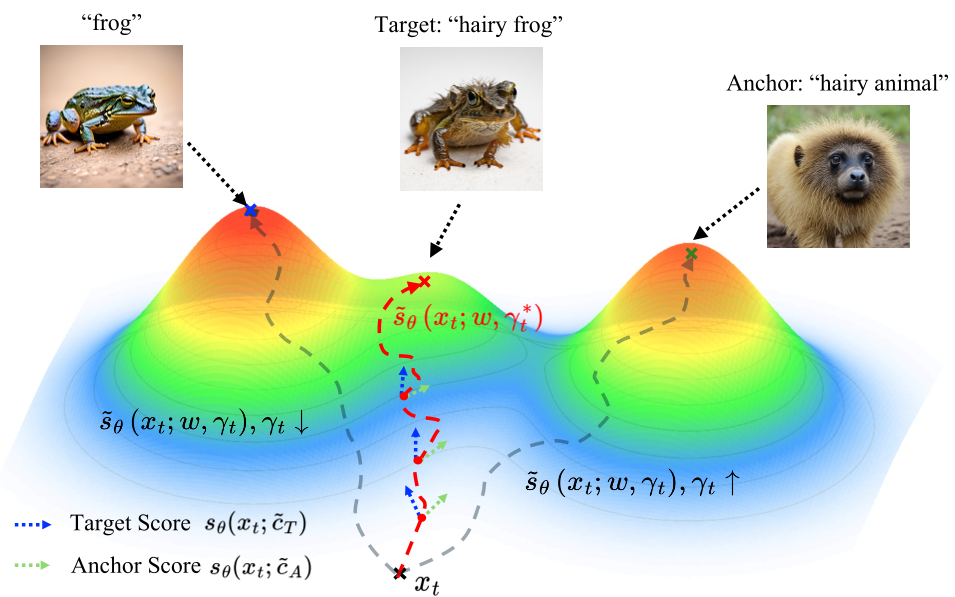 Figure 1: Visualizing how rare concepts drift towards dominate modes and how AAPB's adaptive coefficient corrects this bias.
Two Tasks, One Unified Framework
AAPB isn't just for generating rare objects; it's a general-purpose stabilizer.
- Rare Concept Generation: Anchor = Frequent Concept (e.g., Target: "Hairy Frog", Anchor: "Frog").
- Image Editing: Anchor = Source Prompt (e.g., Target: "Dog wearing a hat", Anchor: "Dog"). Here, the anchor ensures the dog's identity and structure remain perfectly intact while the "hat" is added.
Experiments & SOTA Results
The authors tested AAPB on RareBench and FlowEdit. The results are striking. Under SD3.0, AAPB pushed the average semantic accuracy from 61.5% to 84.1%.
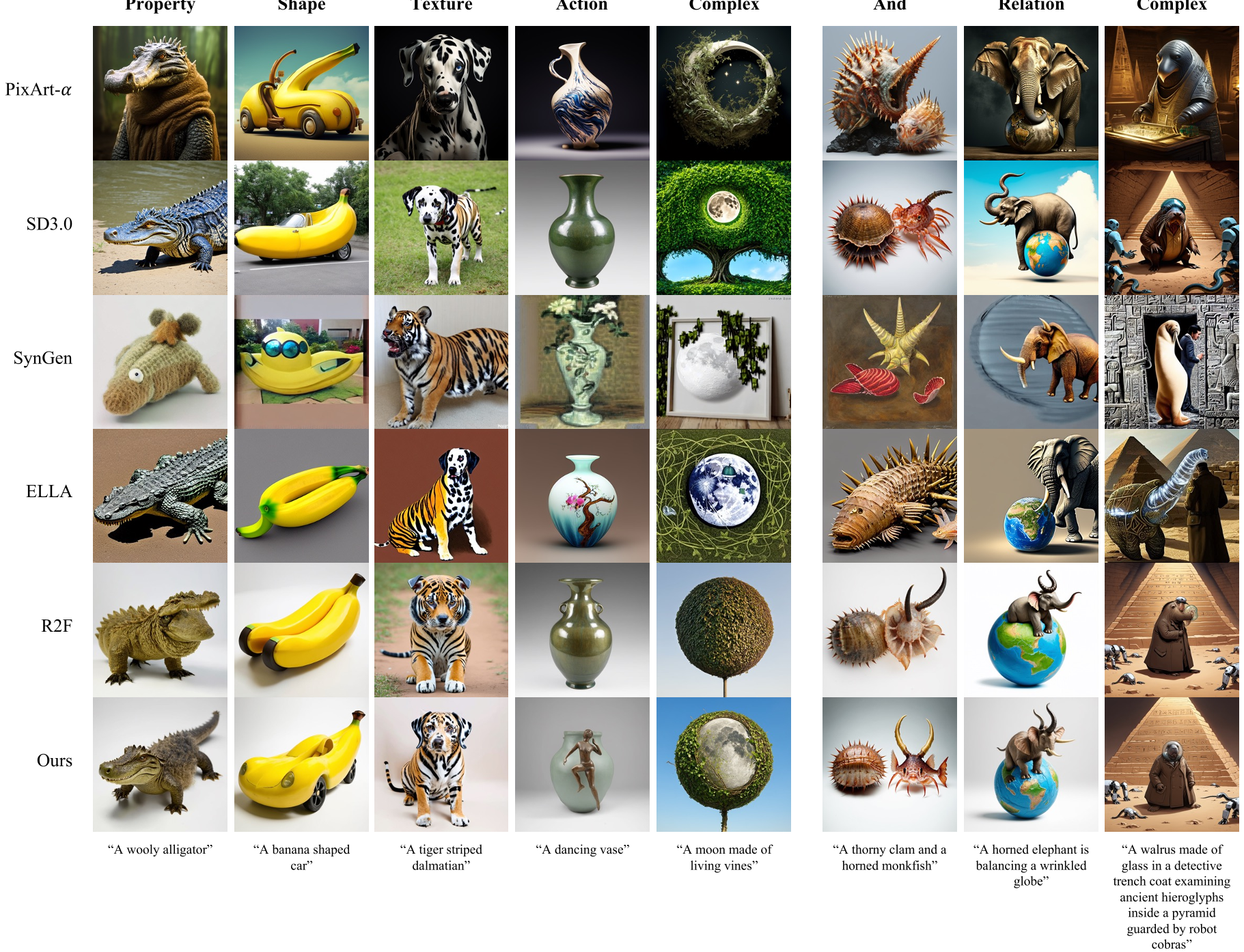 Figure 3: Qualitative comparison showing AAPB correctly capturing rare textures and shapes where other SOTA models fail.
In image editing, AAPB outperformed the baseline FlowEdit in virtually every metric, particularly in structure preservation (DINO score 0.814 vs 0.719), meaning it's significantly better at keeping the original image's "bones" while changing the details.
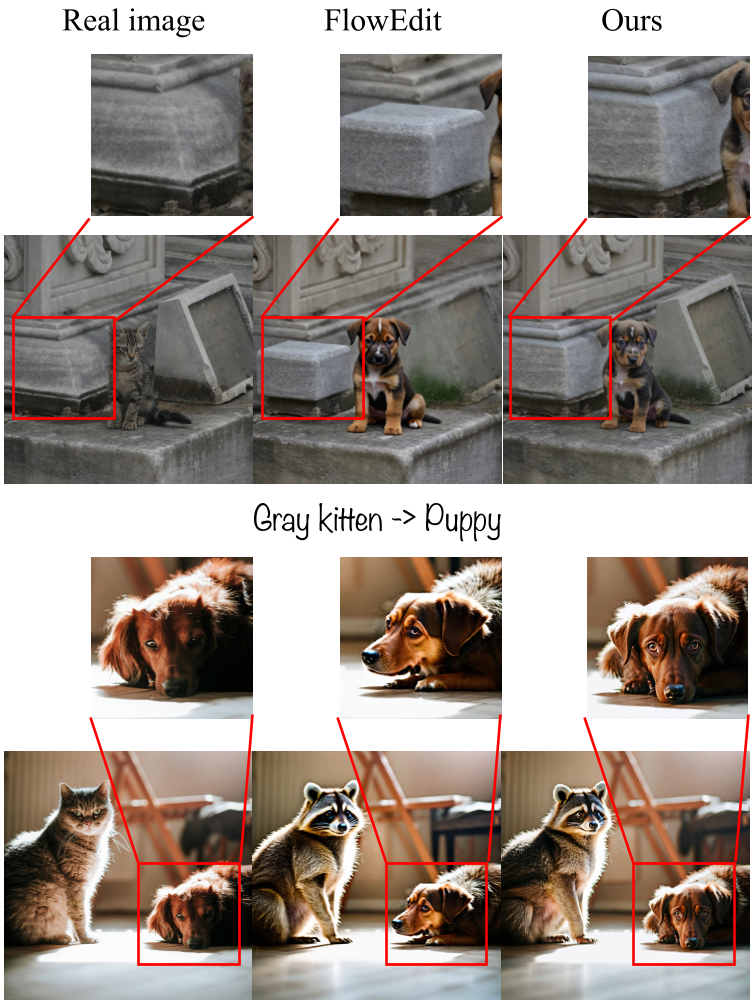 Figure 4: AAPB maintains the spatial and textural integrity of the original image (DINO/CLIP-I) far better than previous inversion-free methods.
Deep Insight: Why Not Fixed Blending?
The ablation study (Figure 5 in the paper) reveals a "convex" relationship: extreme values of fixed blending fail miserably. AAPB's trajectory (the red line) effectively "hugs" the optimal points by changing the weight as the image forms. Early steps often need more anchor guidance to establish structure, while later steps need target-specific refinement.
Critical Analysis & Future Work
Takeaway: This paper proves that we don't need to retrain models to handle rare data; we just need to guide them smarter. The mathematical derivation using Tweedie’s identity provides a robust bridge between high-quality common concepts and underrepresented ones.
Limitations: The model still relies on CLIP-based encoders, which can struggle with "compositional binding" (e.g., if you have many rare objects, the model might mix up which attribute belongs to which object).
Future Outlook: Integrating AAPB with more advanced, compositionally-aware encoders or applying it to video generation (where temporal consistency is essentially a "low-density" challenge) are the next logical frontiers.