
AQC: Bridging Reactive Control and Long-Horizon Planning with Adaptive Q-Chunking
Adaptive Q-Chunking for Offline-to-Online Reinforcement Learning
This paper introduces Adaptive Q-Chunking (AQC), an offline-to-online reinforcement learning method that dynamically adjusts action chunk sizes per state. Utilizing an advantage-based criterion, AQC achieves state-of-the-art results on OGBench, Robomimic, and significantly enhances the performance of large-scale Vision-Language-Action (VLA) models like GR00T N1.6.
TL;DR
Adaptive Q-Chunking (AQC) is a novel offline-to-online RL framework that solves the "one-size-fits-all" limitation of action chunking. By dynamically selecting the commitment horizon (from 1-step to 25-steps) based on a discount-normalized advantage score, AQC allows robots to move smoothly in free space while switching to high-frequency reactive control during complex contacts. It sets a new SOTA on OGBench and generalizes effectively to large-scale VLA models.
Context & Motivation: The Tug-of-War Between Efficiency and Reactivity
In robot manipulation, we often face a dilemma:
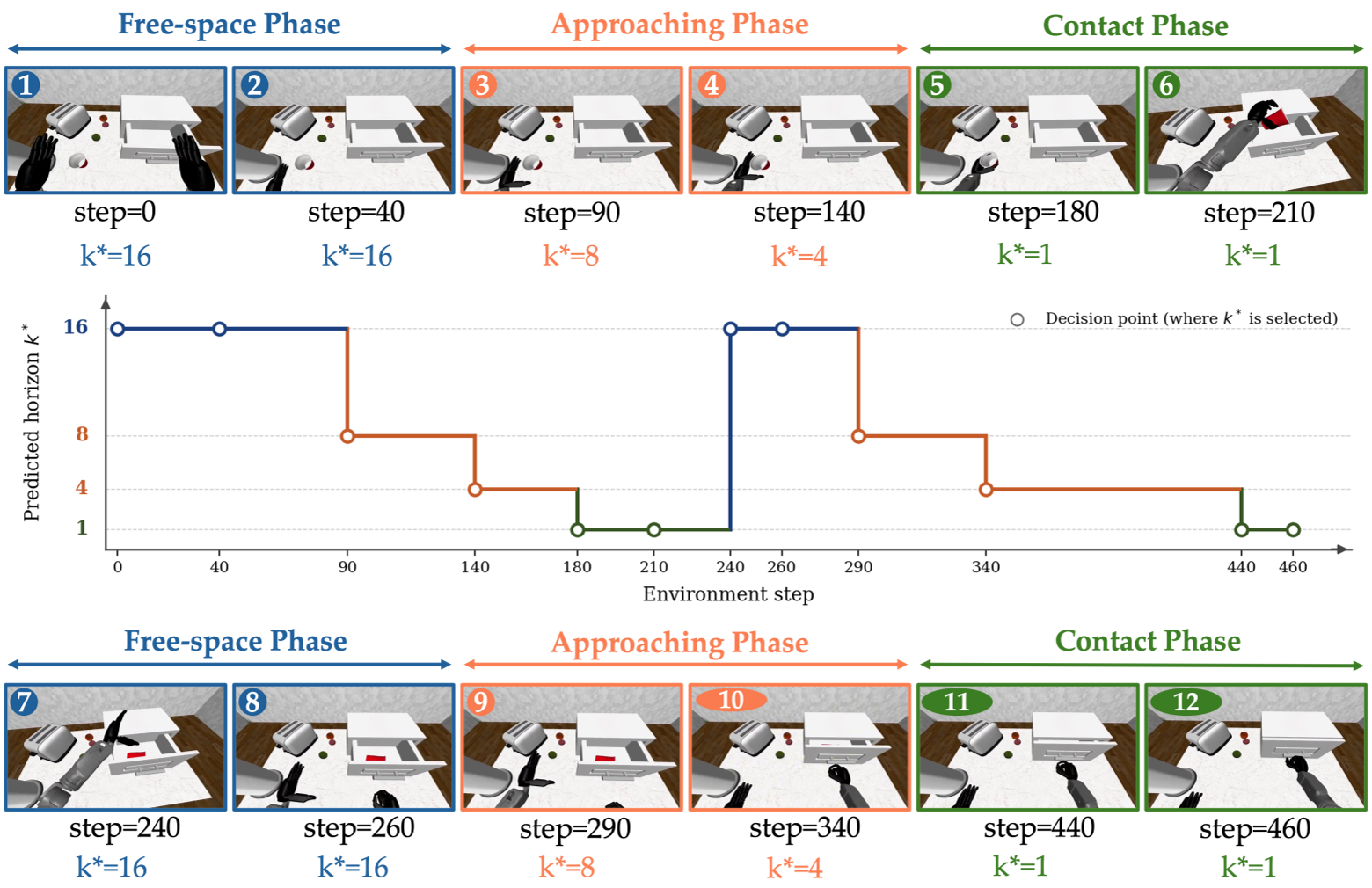
- Long Chunks: Great for exploration and credit assignment. If a robot is moving its arm across a table, it doesn't need to re-think every millisecond.
- Short Chunks: Essential for precision. The moment a gripper touches a delicate object, the physics become chaotic. Small errors accumulate, requiring instant feedback.
Prior SOTA methods like Q-Chunking (QC) and Decoupled Q-Chunking (DQC) use fixed horizons. This leads to a "compromise" performance—too jittery in free space or too "blind" during contact. AQC's core insight is that the optimal planning horizon is not a hyperparameter, but a dynamic state property.
The Technical Hurdle: Why Naive Selection Fails
If you simply train multiple critics for different chunk sizes (, , ) and pick the one with the highest value, the agent will always pick the smallest chunk. Why?
- Discount Mismatch: In sparse reward settings, . Since , the factor is larger for smaller .
- Noise Amplification: In low-value states, the signal-to-noise ratio is poor. Choosing the max merely picks the critic with the largest positive approximation error (noise).
Methodology: The AQC Advantage Criterion
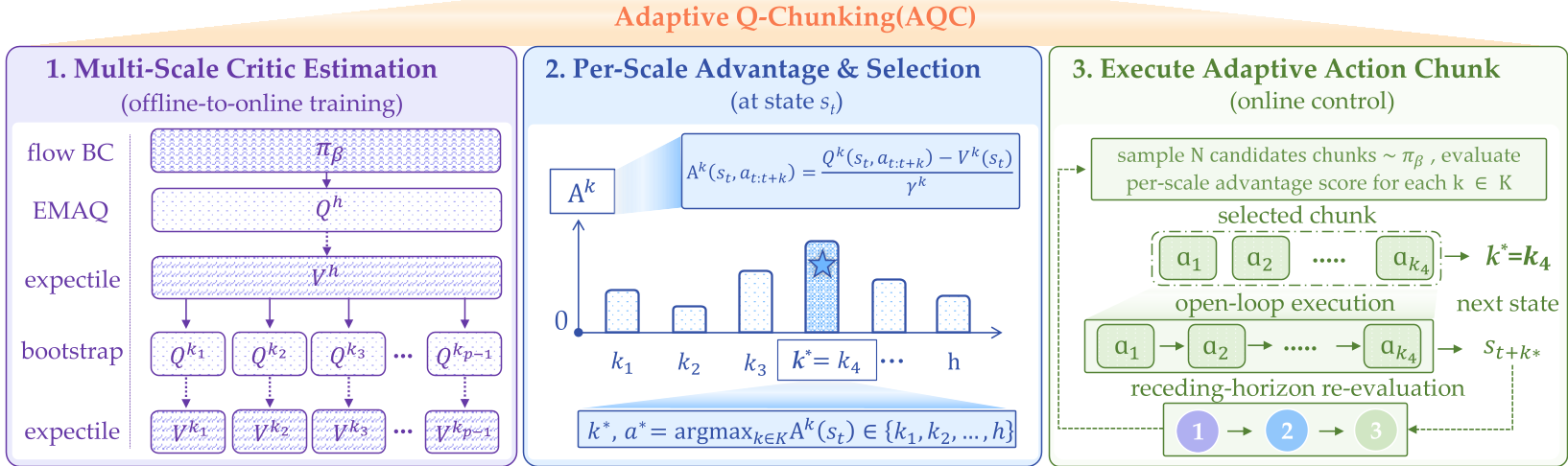
AQC introduces a principled selection rule. Instead of raw values, it compares the discount-normalized advantage:
By subtracting the per-scale baseline (the value achievable by following the dataset policy) and dividing by , AQC places all temporal scales on a level playing field.
Architectural Innovation: Hierarchical Bootstrapping
Unlike previous multi-scale methods, AQC doesn't train independent critics. It uses a long-horizon backbone:
- A long-horizon critic and value are trained first.
- All smaller-scale critics are bootstrapped directly from .
- This creates a regularization hierarchy where information flows from the global task view down to the reactive steps.
Experimental Validation
AQC was tested across 25 tasks in OGBench, including multi-cube manipulation and complex scene navigation.
| Method | Overall OGBench (Online) | RoboCasa-GR1 (VLA) |
|---|---|---|
| QC (Fixed) | 86% | 55.5% |
| DQC (Decoupled) | 52% | 46.1% |
| AQC (Ours) | 96% | 63.2% |
One of the most impressive results is the enhancement of the GR00T N1.6 VLA. Without changing the massive underlying model, AQC acts as a "filter" that selects the best action chunks from the VLA's proposals.
Qualitative Evidence
In contact-rich tasks like square (peg insertion), the authors observed AQC automatically shifting from (reaching) to (insertion).
Deep Insight: Beyond Just Robotics
The value of AQC extends beyond grippers and gears. It provides a mathematical solution to a broader problem in AI: How to compare incomparable values? When multiple critics exist (different horizons, abstractions, or modalities), their raw outputs represent different "units." AQC's advantage-based normalization provides a "universal currency" for decision-making.
Conclusion & Limitations
AQC effectively bridges the gap between high-level planning and low-level reactivity. However, its current iteration relies on a fixed set of candidate chunk sizes (e.g., {1, 5, 10, 25}). Future work could explore continuous horizon optimization or state-conditioned proposal mechanisms to remove this human-in-the-loop design requirement.
Senior Editor's Note: AQC is a classic example of an "Insight-Driven" paper. By identifying that -values are scale-dependent, the authors fixed a fundamental flaw in multi-scale RL, making foundation models for robotics significantly more "grounded" in real-world physics.