
Agentic AI as an Economy: Why "Tokens" are Actually Capital Allocation
Agentic AI Systems Should Be Designed as Marginal Token Allocators
This position paper defines agentic AI as a marginal token allocation economy, proposing a unified first-order condition (FOC) to harmonize four disconnected layers: routing, agentic policy, serving, and training. It argues that systems should optimize based on marginal benefit versus the sum of compute, latency, and risk costs rather than treating tokens as flat-rate text units.
TL;DR
Building an AI agent isn't just an engineering challenge—it's a microeconomic one. This paper argues that every token produced by an agent is a choice in a complex economy. By applying a single marginal benefit equation across routing, agent logic, hardware serving, and RL training, we can solve "invisible" failures like over-routing and serving congestion that plague current systems.
Background: The "Token" Fiction
In the current industry landscape, we treat tokens as units of text billed at a flat rate. If you use GPT-4o, you pay $X per million tokens. However, the authors argue this is an "accounting fiction."
In reality, a token spent on reading a file is economically different from a token spent committing a code patch or a token spent verifying a result. One carries low risk; another might crash a production server. Today’s systems optimize these layers (routing, serving, policy) in silos, leading to "locally rational but globally irrational" behavior.
The Core Insight: The Unified Marginal Equation
The paper's breakthrough is the realization that four disparate layers of the AI stack are actually solving the same optimization problem, just using different "shadow prices":

- VΔQi: The marginal increase in quality multiplied by the task's value.
- ΔCi: The raw compute cost (GPU cycles).
- λΔLi: The cost of waiting (Latency).
- ρΔRi: The cost of being wrong (Risk).
The Four Economic Layers
- Demand (The Router): Decides which model tier to use. It’s a "screening" mechanism.
- Action (The Agent): Decides whether to plan, act, or ask for help. It’s a "Principal-Agent" contract.
- Supply (The Serving Stack): Manages KV cache and GPU throughput. It’s a "production" problem.
- Investment (The Trainer): Decides if a trace is worth learning from. It’s "capital accumulation."

Why Your Agent Fails: Local vs. Global Optimization
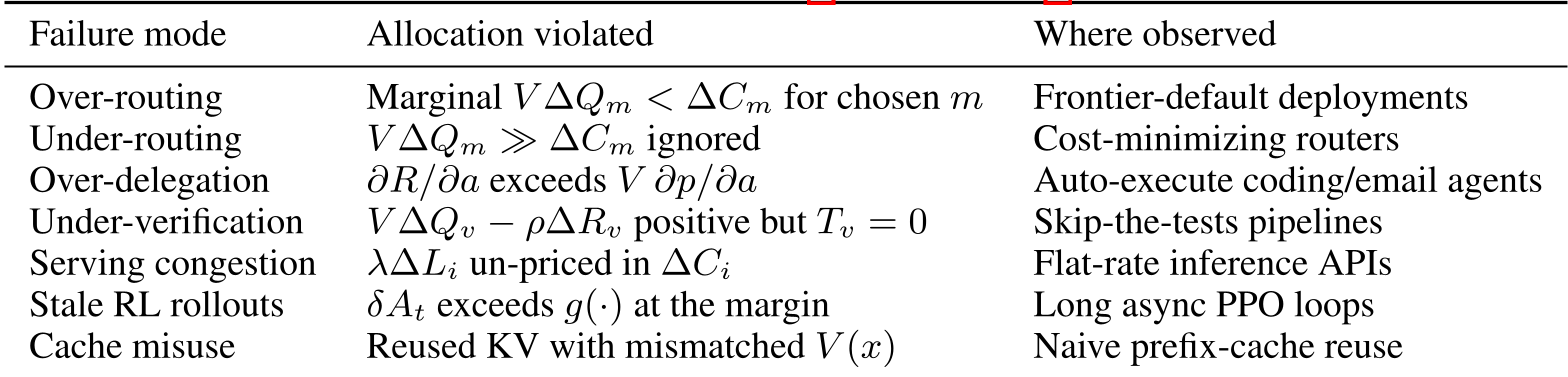
The authors identify seven failure modes that are actually "economic market failures" within the AI system:
- Over-Delegation: An agent acts autonomously (to save time/tokens) even when the risk of a mistake (ρ) outweighs the savings.
- Serving Congestion: One user’s long-context request slows down everyone else because "queueing delay" isn't priced into the token cost.
- Under-Verification: Systems skip "verifier tokens" to look faster/cheaper, but end up paying a massive risk penalty when the final action fails.
Redefining the "Agent Architecture"
To fix these, we don't just need "smarter" models; we need shared price discovery.
- Congestion-Priced Serving: APIs should charge more for tokens that hog the KV cache.
- Autonomy Schedules: Agents should have a clear "authorization matrix" where "irreversible" actions (like
git push) have a much higher shadow price than "reversible" ones (likels). - RL Portfolios: Training shouldn't just be about "more data." It should be about equalizing the marginal capability gain across rollouts, verifiers, and updates.
Critical Analysis & Future Outlook
This paper is a masterclass in applying "The First Welfare Theorem" to AI. It suggests that if all four layers can see the same price vector, the system will naturally become Pareto efficient.
Limitations: The framework assumes task value (V) is observable, which is rarely true in real-world messy data. It also treats risk as a scalar, whereas in safety-critical systems, risk often behaves in "lexicographic" or absolute ways that simple multiplication can't capture.
Conclusion: The next generation of AI will not be defined by who has the most parameters, but by who has the most efficient internal economy. If you aren't pricing your tokens based on latency and risk, you aren't building an agent—you're just running an expensive text generator.