
AI Co-Mathematician: From Oracle to Orchestrator in the Quest for Discovery
AI Co-Mathematician: Accelerating Mathematicians with Agentic AI
The paper introduces the AI Co-Mathematician, a stateful workbench developed by Google DeepMind that utilizes hierarchical AI agents to support open-ended mathematical research. It moves beyond isolated problem-solving to a collaborative workflow including ideation, literature search, and theory building, achieving a record-breaking 48% on FrontierMath Tier 4.
TL;DR
Google DeepMind has unveiled the AI Co-Mathematician, an agentic workbench designed to mirror the actual "messy" reality of mathematical research. Unlike standard chatbots, it manages long-term state, handles literature searches, writes and tests code, and collaboratively drafts mathematical papers. It has already assisted in solving open problems and holds the current "High Score" on the prestigious FrontierMath benchmark.
Beyond the "Oracle" Paradigm: Why Context is King
For the past few years, the narrative of AI in math has focused on the "Oracle": a system that takes a prompt and spits out a proof. However, as any professional mathematician knows, theorem proving is only the final 10% of the work. The preceding 90% involves:
- Iterative Refinement: Figuring out what the question actually is.
- Literature Navigation: Finding that one obscure lemma from the 1970s.
- Computational Exploration: Running simulations to see if a conjecture even feels true.
Current LLMs fail here because they are transient. They forget the context of a two-week-long investigation. The AI Co-Mathematician solves this by introducing a stateful workspace—a persistent memory of every failed hypothesis, literature reference, and computational script.
Methodology: The Hierarchy of Agents
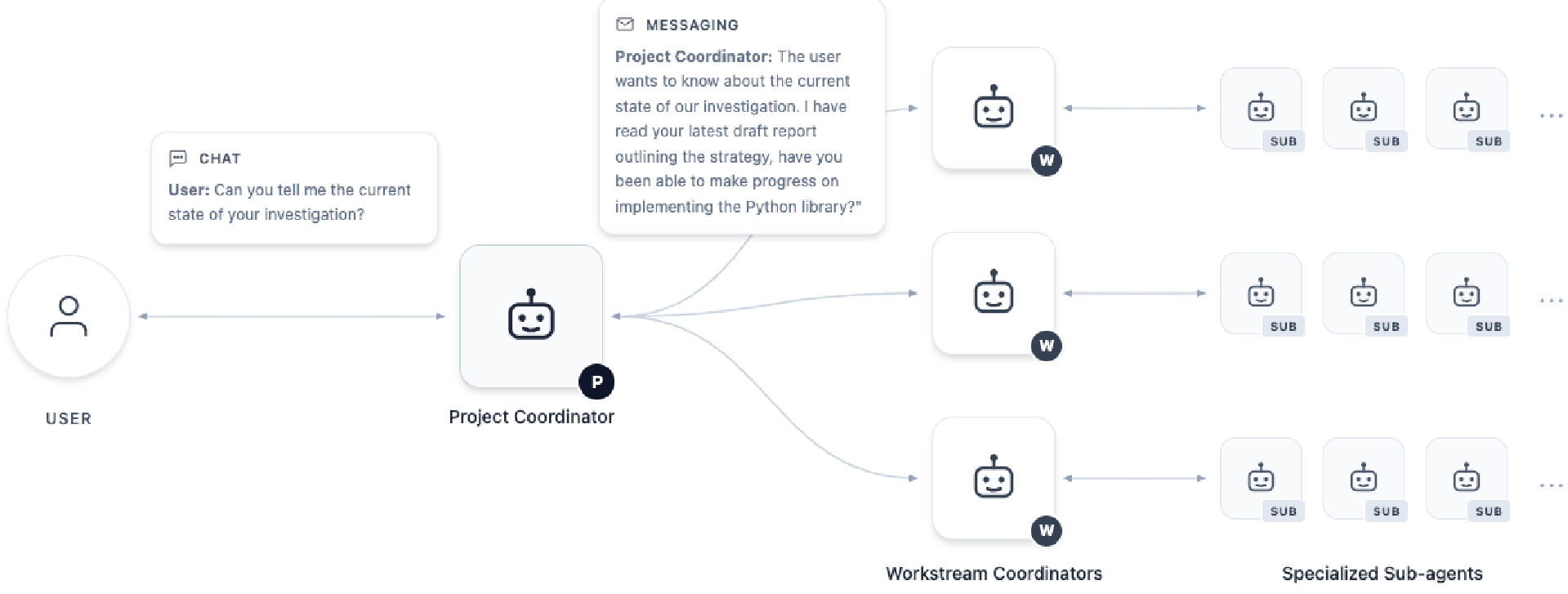
The system architecture is a masterclass in Agentic Orchestration. Instead of a single model, it uses a team:
- Project Coordinator: The primary interface for the human, responsible for high-level strategy and goal setting.
- Workstream Coordinators: Specialized agents that focus on specific goals (e.g., "Review Literature" or "Build Computational SAT Solver").
- Reviewer Agents: The "hard programmatic constraint" layer. They audit proofs and code, refusing to mark tasks as "complete" until rigor is satisfied.
Managing Uncertainty
One of the most profound insights of this paper is how it treats hallucinations. Rather than trying to eliminate them (which is currently impossible for LLMs), the system manages them. It uses "Margin Annotations" to flag sections where agents have low confidence or where the review process stalled. This "Progressive Disclosure" prevents the human from being overwhelmed with low-level execution logs while highlighting areas that require expert scrutiny.
Experimental Results: Slaying FrontierMath
The system’s capabilities were put to the test on FrontierMath Tier 4, a benchmark so difficult that problems are designed by professors to "surpass Tier 3 in difficulty and potentially remain unsolved by AI for decades."
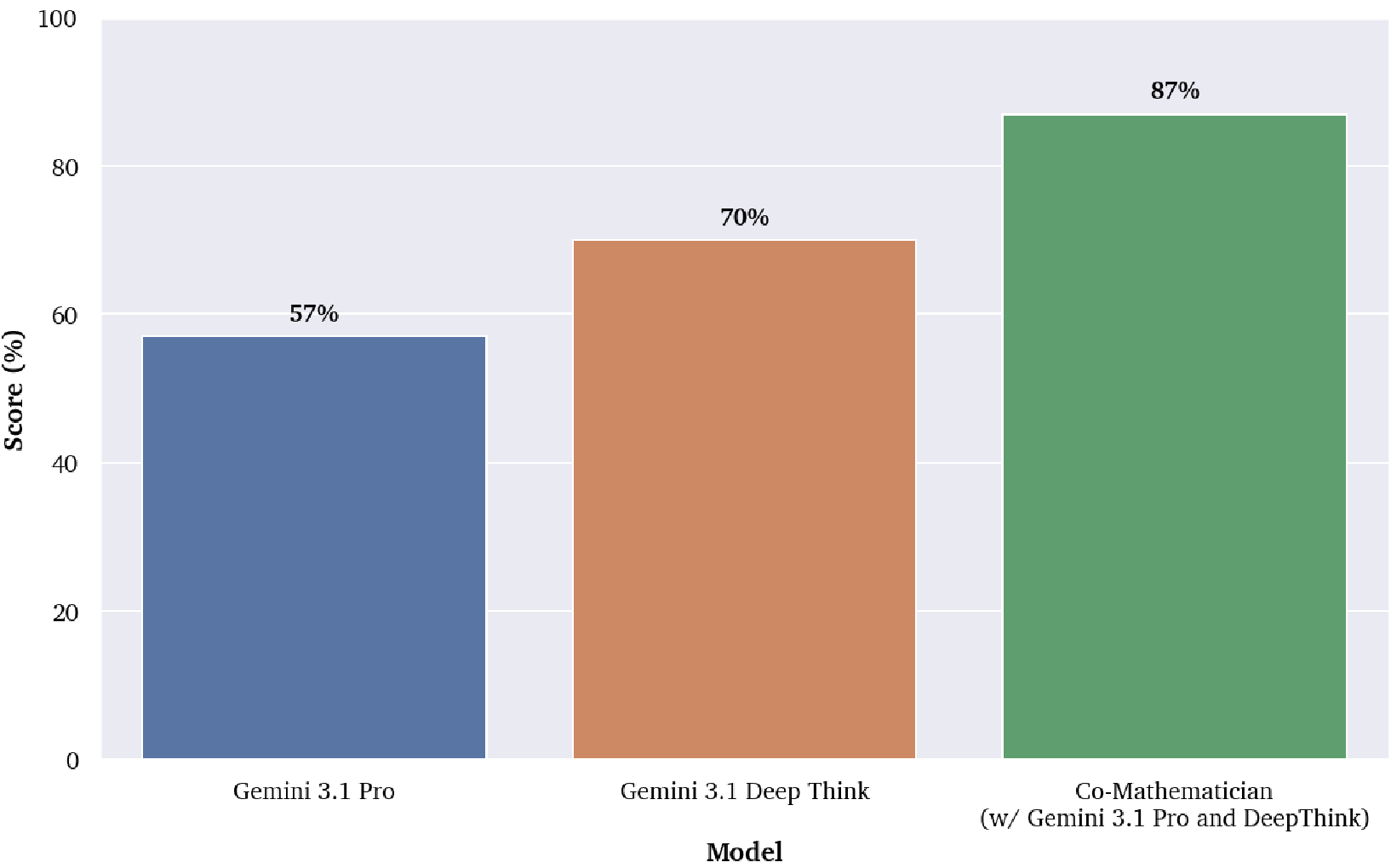
- Accuracy: 48% (23/48 problems).
- Context: This is a massive jump from the 19% achieved by the underlying Gemini 3.1 Pro model alone.
- The Advantage: The performance gain didn't just come from a better model, but from the system’s ability to "think" for 24-48 hours, branch into parallel sub-tasks, and self-correct via internal review loops.
Real-World Impact: Solving the Kourovka Problem
Perhaps more impressive than benchmarks are the case studies. Mathematician Marc Lackenby used the system to resolve an open question (Problem 21.10) from the Kourovka Notebook.
- The Synergy: The AI initially produced a flawed proof. However, it was a "really, really clever proof strategy."
- The Human Loop: Lackenby spotted a gap that he knew how to fill. He steered the agent, which then re-wrote the formal proof and successfully completed the review process.
This illustrates the paper's core philosophy: The AI doesn't need to be smarter than the mathematician in every aspect; it needs to be an effective collaborator that can handle the heavy lifting of formalization and literature search.
Critical Insight: The Risks of "Reviewer-Pleasing"
The authors are refreshingly honest about the system's limitations. They identify a "False Consensus" bias, where agents might converge on a flawed argument just to satisfy the Reviewer Agents' constraints. Additionally, "Death Spirals" can occur when agents get locked in infinite loops of revisions, leading to degraded reasoning.
Conclusion: A New Era of High-Stakes Collaboration
The AI Co-Mathematician signals a shift from Autonomous AI to Agentic AI. For the future of research, the goal isn't to replace the mathematician, but to provide a tool that captures the "entire research journey." As we move into an era where AI can generate 20-page proofs in minutes, the value of human intuition in judging "depth and significance" becomes more critical than ever.
The real victory here isn't just the 48% on a benchmark; it's the demonstration that AI can finally survive the "messy" reality of the scientific method.