
[Princeton/MSR] AI Scientist via Synthetic Task Scaling: Moving Beyond Plausible Ideas to Executable Science
AI Scientist via Synthetic Task Scaling
The paper introduces "AI Scientist via Synthetic Task Scaling," a pipeline that automatically generates diverse machine learning (ML) research tasks and environments to train AI agents. By synthesizing tasks from HuggingFace datasets and a self-debugging loop, the authors created 34,000 trajectories to fine-tune Qwen3 models, achieving SOTA-level improvements on the MLGym benchmark.
TL;DR
Researchers from Princeton and Microsoft have cracked a major bottleneck in AI research agents: the lack of training data for the process of doing science. By building an automated pipeline that generates 500+ unique machine learning tasks grounded in real-world HuggingFace datasets, they've created a "gym" for AI scientists. Fine-tuning models on the resulting 34,000 trajectories led to a double-digit performance boost (up to 12%) on complex ML benchmarks.
The Problem: The "Ideation-Execution" Gap
Most LLMs are excellent at talking about science but struggle at doing it. They can suggest a novel neural network architecture but often fail to write the boilerplate code, debug CUDA errors, or handle data loading issues.
The root cause? Data Scarcity. We have millions of finished papers, but we don't have datasets showing the messy, iterative process: "Step 1: Write code. Step 2: Fix error. Step 3: Iterate on hyperparameters."
Methodology: Scaling the Scientific Method
The authors propose a "Synthetic Task Scaling" pipeline that operates without human supervision. It follows three distinct phases to bridge the gap between static knowledge and active execution.
1. Environment Synthesis & Grounding
Instead of hallucinating tasks, the system samples 1,000 topics and uses the HuggingFace API to find real datasets. It then generates:
- Task Configs: Defining metrics (Accuracy, F1, etc.).
- Starter Code: A baseline script the agent must improve.
- Evaluation Scripts: Automated "judges" to score the agent's work.
2. The Self-Debugging Loop
To ensure the synthetic tasks aren't broken, the system uses a Teacher Model (GPT-5) to run the task. If the code crashes, the errors are fed back into the generator for a "self-debug" cycle. Only tasks that pass execution are kept.
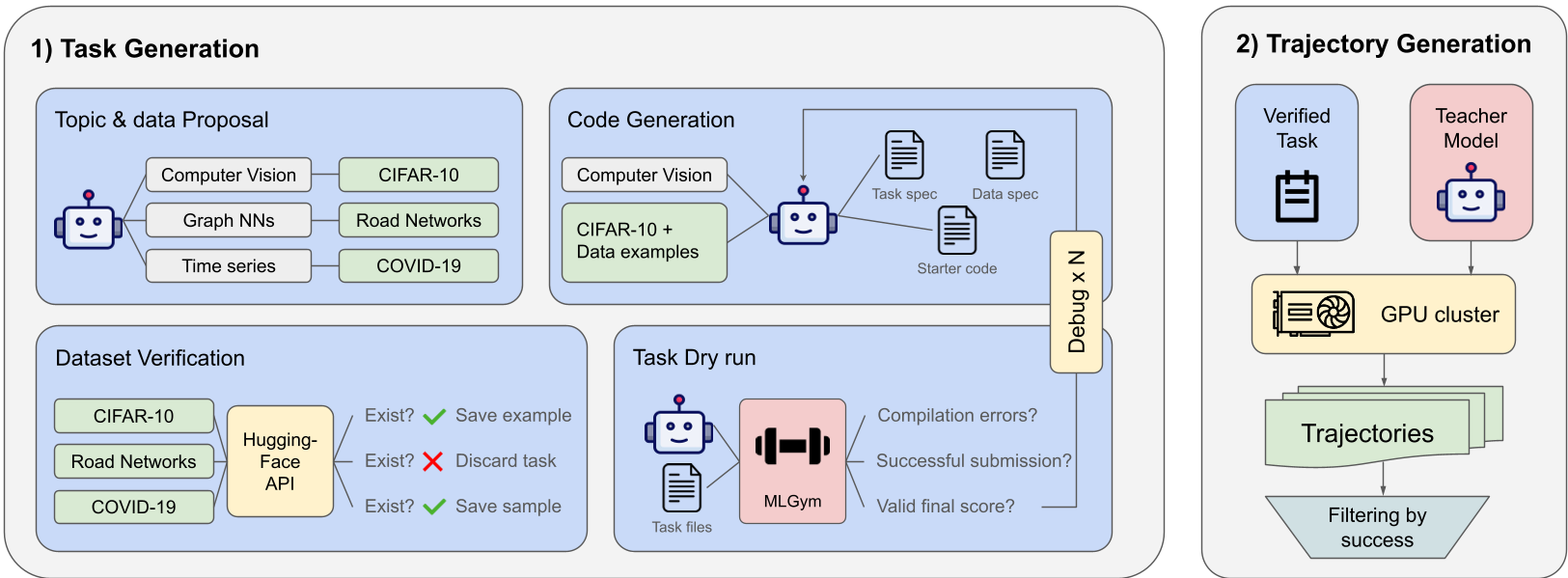 Figure 1: The pipeline scales task generation by combining topic sampling with automated verification.
3. Trajectory Collection
The validated tasks are deployed on an HPC cluster. The "Teacher" executes the tasks, and the full multi-turn interaction (Reasoning -> Action -> Execution Output) is recorded. This creates a high-fidelity dataset of how an expert model solves ML problems.
Experiments: Testing on MLGym
The researchers tested their approach on MLGym, a rigorous benchmark involving tasks like computer vision, RL, and language modeling.
Performance Gains
The "student" models (Qwen3-4B and 8B) were fine-tuned using Supervised Fine-Tuning (SFT) on the generated trajectories.
- Qwen3-4B: +9% AUP score.
- Qwen3-8B: +12% AUP score.
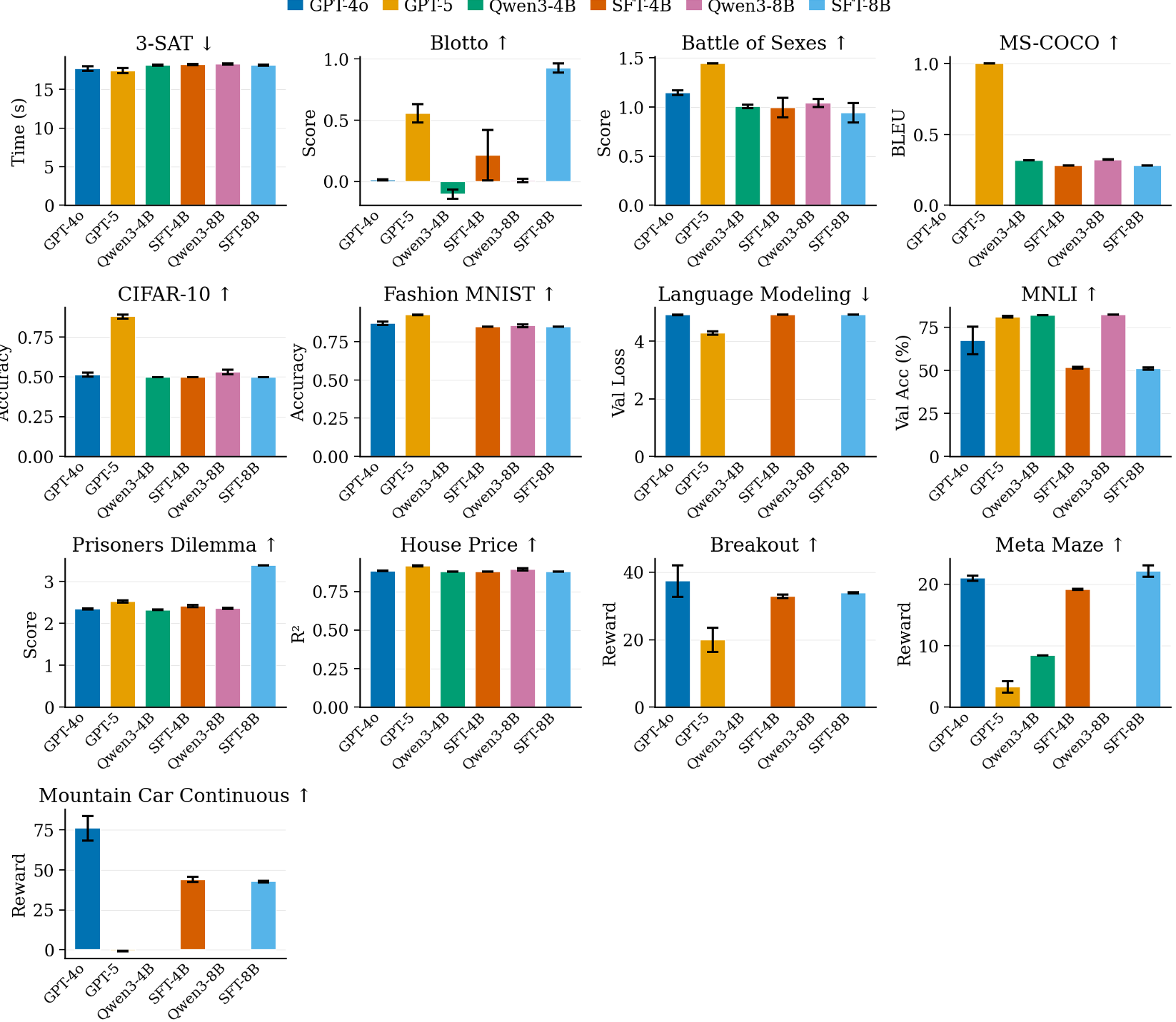 Figure 2: Violin plots showing the distribution of scores across 13 sub-tasks. The SFT-trained models (red/purple) consistently outperform their base versions.
Deep Insight: Why This Works
The magic isn't just in the volume of data, but in the alignment with the SWE-agent framework. By training models on the interaction loop (reading logs, editing files, running bash commands), the models learn the "language of action."
However, the authors stay humble about "Discovery." While the agents are better at optimizing existing pipelines (e.g., getting a higher score on HotpotQA), moving to genuine discovery (proposing entirely new paradigms like the Transformer) remains the "final boss" of AI research.
Critical Analysis & Limitations
- Benchmark Alignment: Does the model truly get smarter, or just better at using the MLGym interface? The authors admit that disentangling "format familiarity" from "research skill" is difficult.
- Teacher Bias: The students are capped by the quality of the teacher (GPT-5). If the teacher can't solve it, the student won't see it.
- Complexity Gap: The pipeline currently struggles with tasks involving massive codebases (like MS-COCO), suggesting a need for better grounding in complex, multi-file repositories.
Future Outlook: Reinforcement Learning
The ultimate goal is to move from SFT to Reinforcement Learning (RL). Since these synthetic tasks provide a clear numerical score (the reward), agents could theoretically "play" against the environment to discover strategies that even the teacher model couldn't find.
Science is no longer just about reading—it's about doing. And for AI, practice makes perfect.