
AnisoAlign: Deconstructing the Modality Gap as a Structured Anisotropic Phenomenon
Anisotropic Modality Align
This paper introduces AnisoAlign, an anisotropic geometric correction framework for aligning unpaired multimodal representations. It demonstrates that the "modality gap" in models like CLIP is not a simple global shift but a structured, anisotropic residual concentrated in low-dimensional directions, achieving SOTA performance in text-only MLLM training (Avg. +2.49% over previous methods).
TL;DR
Training Multimodal Large Language Models (MLLMs) usually requires massive paired image-text datasets. AnisoAlign challenges this necessity by proving that the "Modality Gap"—the geometric separation between image and text embeddings—is actually a highly structured, low-dimensional "anisotropic residual." By correcting this specific geometric structure using a novel phase-aware framework, the authors enable MLLMs to be trained on unimodal text data while achieving performance that matches or even exceeds traditional paired-data training.
The Geometric "Why": Beyond the Centroid Shift
For years, the modality gap was viewed as a nuisance—a simple systematic bias where image and text clusters were "shifted" away from each other. Previous solutions like C3 (Centroid Correction) or ReAlign tried to fix this by matching global statistics (means and variances).
However, this paper offers a deeper PhD-level insight:
- Compatible Backbone: Images and texts already share a "dominant semantic geometry." Their covariance spectra decay similarly, and their principal subspaces overlap significantly.
- The Residual is the Problem: If you just shift the means, ~89% of the distance remains. This residual isn't "noise"—it is anisotropic. It's concentrated in a few specific directions.
Think of it like two nearly identical maps of a city, but one map has been systematically stretched along the North-South axis by a specific wind pattern. Correcting the map requires more than just moving it; it requires "un-stretching" those specific directions while keeping the street layouts (semantics) intact.
Methodology: Precision Geometric Surgery
AnisoAlign operates via a two-stage process designed to perform bounded correction.
1. Fixed-Frame Subspace Decomposition
The model identifies the shared dominant subspace between modalities. It doesn't allow the correction to wander into "noise" dimensions, focusing only on the high-variance directions where semantic information lives.
2. Anisotropic Circular Decoupling (The "How")
The authors treat the embedding space like a radar system. They decompose representations into Radius (energy) and Phase (direction) in 2D blocks.
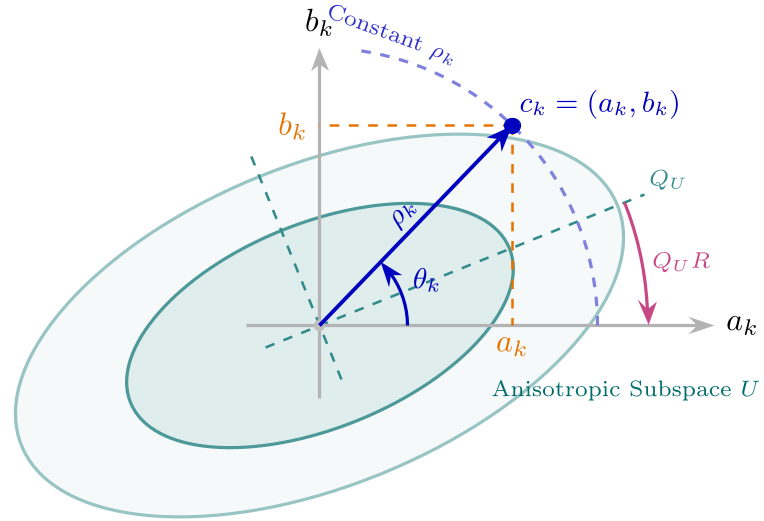
- Stage I: It pre-trains a "Phase Score Prior" using only target modality (image) samples. This captures the "internal rhythm" of how visual features are oriented.
- Stage II: It takes the source (text) embedding and applies a bounded refinement. Because the correction is "bounded" (using tanh constraints), the model can't hallucinate new semantics—it only adjusts the geometry to "look" more like an image feature.
Experimental Evidence: Surpassing Real Images
The most striking result is the "scaling" experiment. As shown in the performance tables, AnisoAlign bridges the gap between synthetic and real data.

When the scale of text-only data is doubled (2M), the model achieves an average score of 52.75, actually outperforming the baseline trained on real image-text pairs (52.72). This suggests that the quality of alignment is so high that "quantity of text" can compensate for "lack of visual supervision."
Critical Analysis & Takeaways
The "Semantic Preservation" Insight
The genius of AnisoAlign lies in its restraint. By proving that the modality gap is concentrated in a low-dimensional subspace, the authors show that you only need to fix a small part of the representation. Global distribution matching often "breaks" the delicate local neighborhood of the embeddings (where "cat" must stay near "kitten"). AnisoAlign's bounded refinement ensures that if two text embeddings were neighbors, their transformed visual substitutes remain neighbors.
Limitations
- Pre-trained Dependency: The method relies on the existence of a shared space (like CLIP). If the initial encoder is poor, there is no "geometric backbone" to preserve.
- Computational Overhead: The two-stage training (Phase Prior + Refinement) is more complex than simple linear shifts.
Conclusion
AnisoAlign shifts the paradigm from "data-hungry" multimodal training to "geometry-aware" unimodal adaptation. It proves that the modality gap is not a flaw in our models, but a structured phenomenon that, once understood, can be exploited to build MLLMs using the nearly infinite supply of unimodal text on the web.