
Architecting Quantum Advantage: Parallelizing Fault Tolerance in Neutral Atom Systems
Architecting Early Fault Tolerant Neutral Atoms Systems with Quantum Advantage
The paper proposes a new fault-tolerant quantum computing architecture tailored for neutral atom systems, introducing a teleportation-based parallel injection scheme to accelerate logical operations. By leveraging the reconfigurable connectivity of atom arrays, the authors achieve a 3× speedup over traditional extractor architectures and demonstrate quantum advantage in dynamics simulations using as few as 11,495 atoms.
TL;DR
Researchers have unlocked a path to "early" quantum advantage by redesigning how we perform fault-tolerant operations on neutral atom arrays. By utilizing idle qubits as "teleportation hubs," they’ve turned the slow, serial process of T-gate injection into a parallel powerhouse, achieving a 3× speedup and reaching the threshold for scientific discovery with only ~11,500 atoms.
The "Slow Measurement" Bottleneck
In the race for Fault-Tolerant Quantum Computing (FTQC), neutral atoms have emerged as a frontrunner due to their ability to move physical qubits (shuttling) and support high-rate QLDPC codes. However, they face a glaring physics hurdle: measurement is slow.
While gates take microseconds, catching a photon to measure an atom takes milliseconds. In existing "Extractor" architectures (which use QLDPC codes to save space), logical operations are forced into a serial queue. Most modules sit idle, "starving" for work while a single chain of T-gates—required for universal computation—is synthesized one-by-one.
Methodology: The Parallel Teleportation Gadget
The paper’s core insight is the Parallel Injection Scheme. Instead of letting modules stay idle during the synthesis of rotations, the architecture uses reconfigurable connectivity to turn these idle modules into parallel execution sites.
- Preparation: Idle ancillas are entangled via ZZ measurements to form an "execution bus."
- Teleportation: Using gate teleportation, the architecture injects magic states into multiple logical sites simultaneously.
- Teardown: Pauli corrections are applied, and the modules are returned to the pool for the next layer of computation.
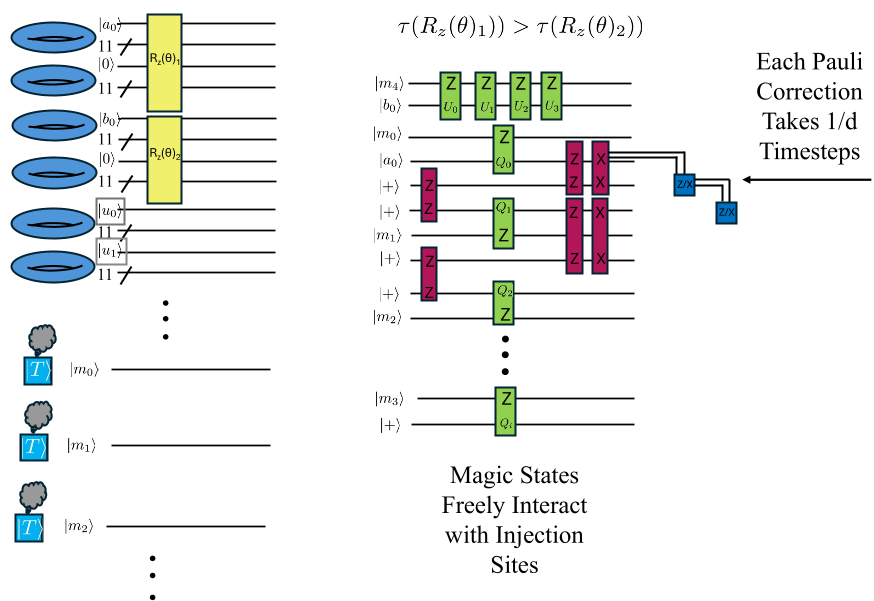 Figure 1: The gadget uses unutilized pivots (gray) to parallelize T-state injections, effectively speeding up the deepest synthesis layers.
Why Spacetime Efficiency Matters
Traditionally, researchers compared architectures based on Space (qubit count) or Time (depth). This paper argues for Spacetime Volume ().
By comparing Extractor, Transversal (Surface Code), and Hybrid (Load/Store) architectures, the authors reveal that:
- Transversal architectures are fast but spatially "wasteful," requiring massive qubit overhead.
- Hybrid architectures suffer from "thrashing"—wasting time moving data between memory and compute regions.
- Parallelized Extractors hit the "Goldilocks zone," maintaining the low qubit count of QLDPC codes while matching the speed of transversal designs.
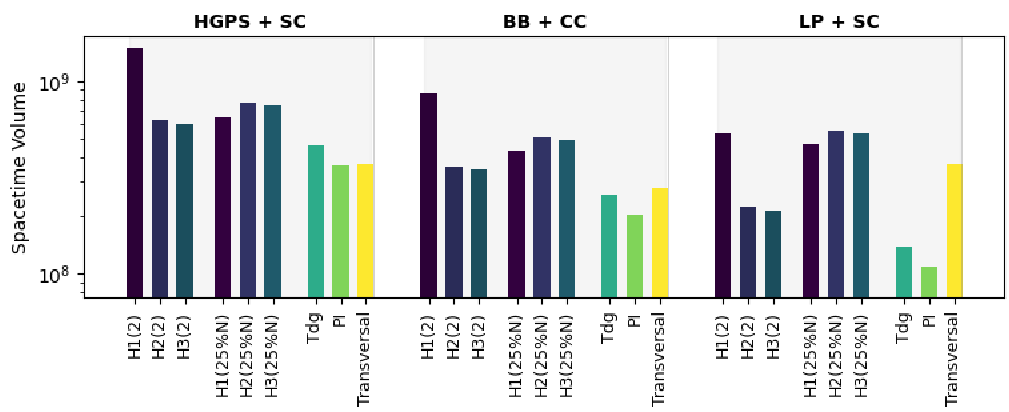 Figure 2: Benchmark results for the Fermi-Hubbard model demonstrate that the parallelized extractor surpasses transversal models in total timesteps as application size increases.
Results: Mapping the Path to Quantum Advantage
The authors didn't just stop at theory; they simulated end-to-end execution of four "Quantum Advantage" benchmarks, including the 2D Heisenberg Hamiltonian and the Fermi-Hubbard model.
They accounted for the gritty details:
- Atom Shuttling: Modeling the actual time it takes to move atoms across the array.
- T-Factory Nondeterminism: T-states aren't always ready; the simulation accounts for factory "stalls."
- Physical Error Rates: Assuming a realistic physical gate error.
The result? A 2D Long-Range Ising model simulation could show quantum advantage with 11,495 atoms and a success probability of over 94% in just 15 hours.
Critical Insight & Future Outlook
The most striking takeaway is the refutation of the need for fully addressable transversal gate sets. Many believed that to be fast, we needed a gate set that could touch every qubit at once. This work proves that with local reconfigurability and a clever "teleportation" compiler, we can achieve high-seed execution even on "passive" memory-heavy codes.
Limitations: The scheme relies heavily on the availability of T-state factories. As shown in the sensitivity analysis, if T-state production is too slow, the parallelization gains the scheme provides are "diluted." The future of this architecture depends as much on Magic State Distillation efficiency as it does on atom movement.
Conclusion
By architecting for the specific strengths (movement) and weaknesses (slow measurement) of neutral atoms, this work provides a concrete blueprint for the first generation of fault-tolerant computers that can actually solve problems classical computers cannot.
Key Takeaways:
- Speedup: ~3× over previous qLDPC architectures.
- Resource Efficiency: Quantum advantage with qubits.
- Hardware Fit: Optimizes specifically for the Rydberg blockade and AOD-based shuttling of neutral atoms.