
ArtifactNet: Decoding the Physical "Fingerprint" of AI Music Through Forensic Residuals
ArtifactNet: Detecting AI-Generated Music via Forensic Residual Physics
ArtifactNet is a lightweight (4.0M parameters) framework for detecting AI-generated music by extracting "forensic residuals" caused by Residual Vector Quantization (RVQ) in neural audio codecs. Utilizing a bounded-mask ArtifactUNet and HPSS-based features, it achieves a SOTA F1-score of 0.9829 on the new multi-generator ArtifactBench, significantly outperforming heavy representation-learning models like CLAM.
TL;DR
ArtifactNet moves away from "learning what AI music sounds like" and instead focuses on "why AI music is physically impossible." By targeting the hardware-like signatures left by neural audio codecs (specifically the RVQ bottleneck), this 4.0M-parameter model achieves near-perfect detection (0.98 F1) across 22 different AI generators, outperforming models 49x its size.
Executive Summary
The industry is currently flooded with AI-generated tracks, making it increasingly difficult for streaming platforms to distinguish between human artistry and machine output. Most existing detectors use "Representation Learning" (e.g., CLAM, SpecTTTra), which are prone to over-fitting on specific generation styles. ArtifactNet introduces a paradigm shift: Forensic Physics. It treats AI music detection as a signal processing challenge, identifying the "quantization gap" that current AI architectures simply cannot avoid.
The Core Problem: The Generalization Wall
Current SOTA models often boast 99% accuracy on their own datasets but fail catastrophically when a new generator (like Suno v4 or Udio) is released. Why?
- Style Dependency: They learn patterns in the melody or texture, which change as AI evolves.
- Codec Confounding: They confuse standard MP3 compression artifacts with AI generation signatures.
- Parameter Inefficiency: Models like CLAM use nearly 200M parameters, making them expensive to deploy at scale.
Methodology: The Physics of "Residual Amplification"
The fundamental insight of ArtifactNet is the Residual Vector Quantization (RVQ) bottleneck. Whether an AI uses Diffusion or Transformers, it almost always uses a neural codec (like EnCodec) to turn latent vectors into audio. This process creates a "quantization gap"—a tiny, irreversible loss of information.
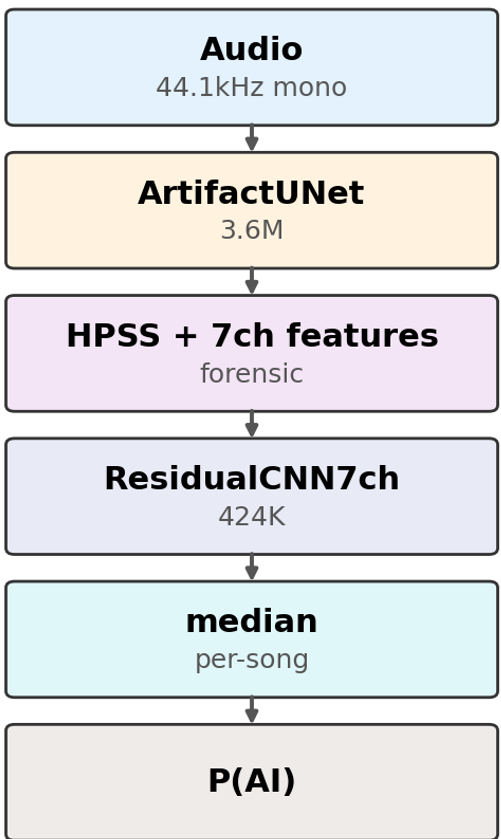
1. ArtifactUNet (Residual Extraction)
Instead of analyzing the raw audio, the authors use a Bounded-Mask UNet to extract only the residuals (the "error" parts of the signal). By bounding the mask to [0, 0.5], they force the model to look at the subtle artifacts rather than the main musical content.
2. HPSS Forensic Features
The extracted residual is decomposed via Harmonic-Percussive Source Separation (HPSS).
- Harmonic component: Catches pitched content leaks caused by failed neural separation.
- Percussive component: Highlights transient energy errors. This creates a 7-channel "forensic feature" map that makes the AI's physical footprint obvious to even a tiny CNN.
Experimental Results: David vs. Goliath
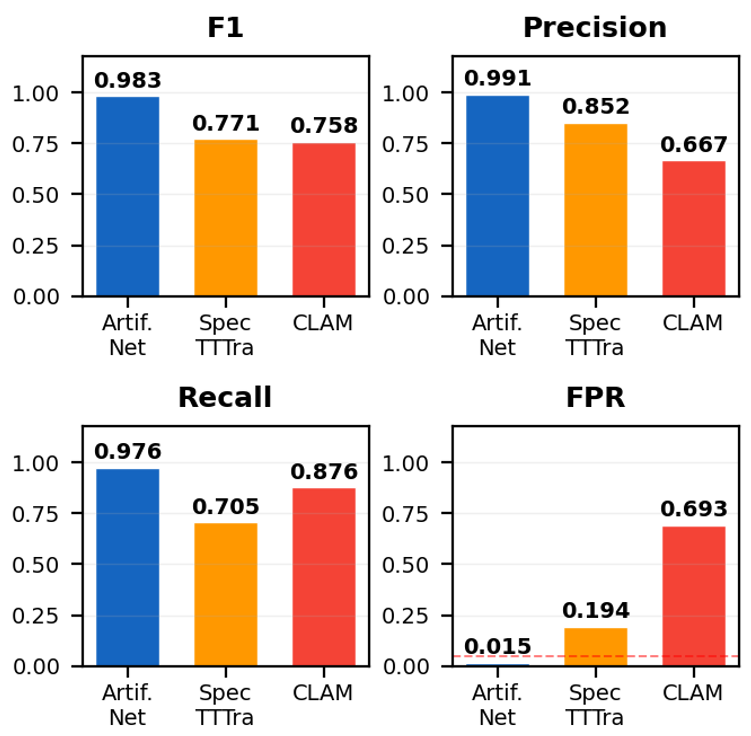
The authors tested ArtifactNet against heavyweights on ArtifactBench (a new benchmark with 22 generators).
| Model | Params | F1-Score | Precision | Recall |
|---|---|---|---|---|
| ArtifactNet (Ours) | 4.0M | 0.9829 | 0.9905 | 0.9755 |
| CLAM | 194M | 0.7576 | 0.6674 | 0.8761 |
| SpecTTTra | 19M | 0.7713 | 0.8519 | 0.7046 |
ArtifactNet is not just more accurate; it is transparent. By measuring "Effective Bandwidth," the researchers found that AI residuals cluster around 291 Hz, while human music residuals average 1,996 Hz. This 6.9x difference provides a "smoking gun" for detection.
Overcoming the "MP3 Trap"
A common failure in AI detection is that an MP3-compressed file is often flagged as AI. ArtifactNet solves this through Codec-Aware Training. By training the UNet to see the same audio through four different codecs (WAV, MP3, AAC, Opus), it learns to ignore standard compression and focus purely on the neural-codec artifacts. This reduced "probability drift" by 83%.
Critical Insight & Conclusion
ArtifactNet proves that in the cat-and-mouse game of AI detection, Physics wins over Pattern Matching. By focusing on the quantization gap—an information-theoretic limit of current neural audio codecs—the model gains an inherent advantage that is likely to hold even as AI generation becomes more "musically" advanced.
Future Outlook: While highly effective, the model currently requires high-bandwidth audio. As AI generators improve their "harmonic-percussive ratios" (like the latest Udio updates), forensic tools will need to integrate even more granular scalar features to maintain this edge.