
[Interspeech 2024/2025] ARTT: Breaking the Limits of Unsupervised Monaural Speech Dereverberation
ARTT: Augmented Reverberant-Target Training for Unsupervised Monaural Speech Dereverberation
The paper introduces Augmented Reverberant-Target Training (ARTT), a two-stage unsupervised framework for monaural speech dereverberation. By combining a novel "Reverberant-Target Training" (RTT) strategy with a self-distillation mechanism based on the mean-teacher algorithm, it achieves state-of-the-art performance on the WSJ0CAM-DEREVERB benchmark, reaching an SI-SDR of 7.3 dB.
TL;DR
Monaural speech dereverberation has long been the "holy grail" of audio signal processing—extremely difficult because we only have one channel and no "clean" ground truth for real-world recordings. ARTT (Augmented Reverberant-Target Training) solves this by using a clever two-stage unsupervised strategy: first, it makes the signal even more reverberant to learn a cleanup mapping, and then it uses a "Teacher-Student" distillation loop to sharpen the results and suppress noise. The result? A massive 10.9 dB SI-SDR improvement over the raw mixture, outperforming even some supervised methods.
Problem & Motivation: The "Clean Signal" Paradox
In supervised learning, we train models to map "Reverberant A" to "Clean B." But in the real world, "Clean B" doesn't exist. If you record in a cathedral, you only have the echoic sound.
Existing unsupervised tools like WPE (Weighted Prediction Error) use math to subtract late echoes but ignore the rich "speech priors" that deep learning can capture. Newer neural methods like USDnet try to solve this but often need 8-channel microphone arrays to work well. The authors of ARTT asked: Can we train a top-tier neural network using only a single-channel, reverberant recording?
Methodology: The Two-Stage Breakthrough
The core innovation of ARTT lies in its transition from a simple surrogate task to a complex, self-correcting distillation loop.
Stage 1: Reverberant-Target Training (RTT)
The authors use the Noise2Noise logic but adapt it for convolution.
- Take a reverberant observation .
- Convolve it with a synthetic, exponentially decaying "tail" () to create a super-echoic signal .
- Train the network to recover the original reverberant signal from .
The Intuition: Since the network can't easily distinguish between the original room echo and the new synthetic echo, it tends to suppress both, effectively starting the dereverberation process without ever seeing a clean signal.

Stage 2: Online Self-Distillation
Stage 1 is a bit "blurry." To fix this, the authors introduce a Mean-Teacher setup:
- Teacher: A temporal ensemble of the student (via EMA weights). It sees the original signal (plus some noise) and provides a "stable" target.
- Student: Sees a "hard" version of the signal, augmented with realistic RIRs () from a room simulator.
- Asymmetric Learning: The student must match the teacher’s output. Because the teacher has an easier job, the student is forced to work harder to "invert" the room acoustics, refining the fine spectral textures (like harmonics and formants) that Stage 1 missed.
Experimental Results: SOTA Performance
Tested on the WSJ0CAM-DEREVERB dataset, ARTT delivers a masterclass in unsupervised performance:
| Method | Unsupervised | SI-SDR (dB) | PESQ |
|---|---|---|---|
| Unprocessed Mixture | - | -3.6 | 1.64 |
| USDnet (Monaural) | Yes | -2.1 | 1.76 |
| BUDDy (Diffusion) | Yes | 2.1 | 2.49 |
| ARTT (Stage II) | Yes | 7.3 | 2.61 |
| Supervised DNN-WPE | No | 2.8 | 2.16 |
Key Insights from Results:
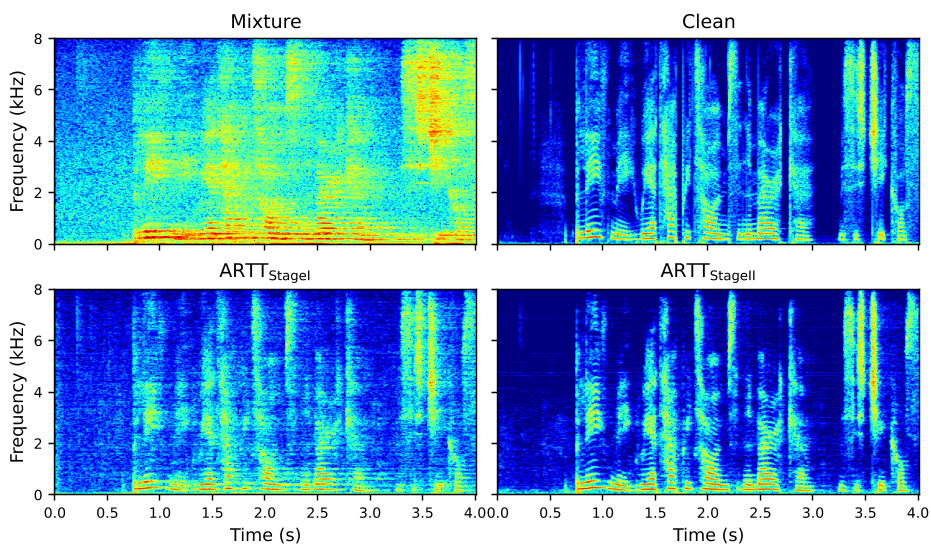
- Stability: As shown in the performance graphs, Stage II (Distillation) is significantly more robust to background noise than Stage I.
- Visual Fidelity: Spectrogram analysis shows that while Stage I reduces "smearing," Stage II is what actually restores the sharp harmonic bars essential for clear speech.
Critical Analysis & Conclusion
Takeaway
ARTT proves that the "Noisy-Target" principle can be successfully expanded to "Reverberant-Target" tasks. By adding a physical-consistency layer (Stage II), the authors bridged the gap between purely statistical noise reduction and the complex physics of room acoustics.
Limitations
- Computational Cost: Training a TF-GridNet with an EMA teacher and online RIR simulation is more heavy than simpler unsupervised filters.
- Domain Gap: While it works well on WSJ0CAM, its performance on extremely long T60 (reverberation times) beyond 1.3s or in highly non-stationary noise remains an area for future exploration.
Future Work: The ARTT framework could potentially be integrated into real-time communication systems, where "on-the-fly" unsupervised adaptation to a user's specific room would provide a massive leap in audio quality.