
AOPD: Solving the "Exploration Black Hole" in On-Policy Distillation
Asymmetric On-Policy Distillation: Bridging Exploitation and Imitation at the Token Level
This paper introduces Asymmetric On-Policy Distillation (AOPD), a novel token-level training framework that bridges Reinforcement Learning (RL) and Supervised Learning. By replacing ineffective negative reinforcement with localized forward KL-divergence minimization, AOPD achieves state-of-the-art performance on mathematical reasoning benchmarks, outperforming standard distillation methods especially under weak model initialization.
TL;DR
The quest to compress the reasoning power of giant models (like Qwen3-32B) into smaller ones often hits a wall: standard reinforcement learning-based distillation is unstable. Asymmetric On-Policy Distillation (AOPD) fixes this by selectively switching from "Reinforcement" to "Imitation" at the exact tokens where the student model gets confused. This results in a massive 8.34% performance boost in mathematical reasoning and prevents the model from forgetting old skills when learning new ones.
The "Neutral Zone" and "Black Hole" Problem
On-Policy Distillation (OPD) is the current gold standard—the student generates its own answers, and a teacher model grades each token. However, the authors identify a fatal flaw in the math:
- High Variance: Negative rewards can be mathematically "explosive," leading to unstable training.
- Zero-Advantage Stagnation: If the student and teacher roughly agree, the gradient vanishes, even if the teacher has a better secondary choice to offer.
- Exploration Black Holes: If a student assigns a near-zero probability to a correct token, RL won't help. It tells the student "don't do that," but since the student doesn't know what to do instead, it remains trapped.
Methodology: The Power of Asymmetry
The core insight of AOPD is that not all tokens should be learned the same way.
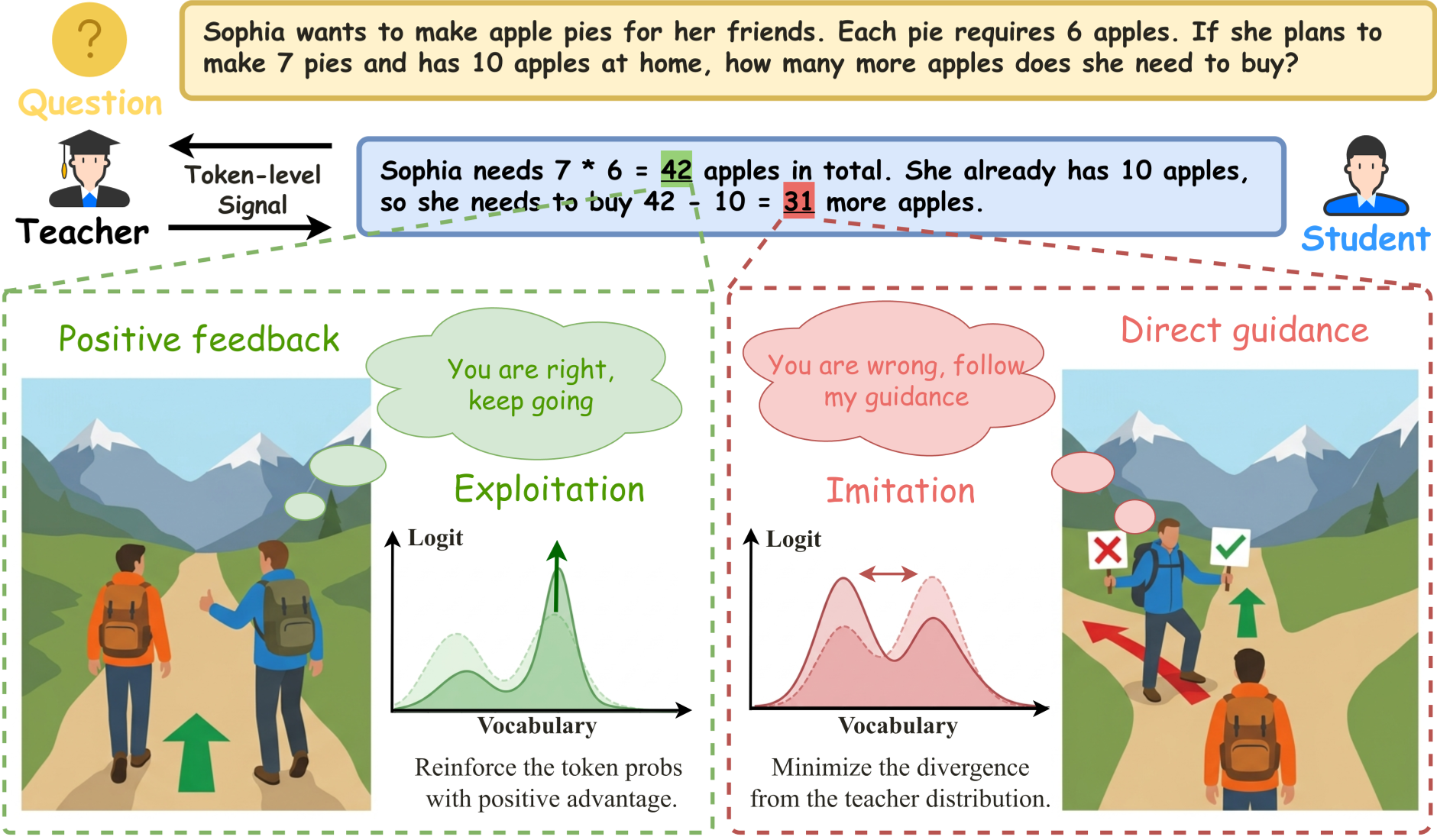
- Exploitation (Positive Advantage): If the student samples a token the teacher likes (Advantage > 0), keep using standard Policy Gradient. This reinforces successful self-discovery.
- Imitation (Non-Positive Advantage): If the token is wrong or mediocre (Advantage ≤ 0), stop guessing. The student instead minimizes the Forward KL-divergence against the teacher’s Top-K distribution.
By using Forward KL, the student receives a bounded, directional signal. Instead of just being told "this was wrong," the student is shown the "correct path" via the teacher's full probability distribution at that specific bottleneck.
Experimental Results: Stability Meets Performance
The researchers tested AOPD on grueling math benchmarks like AIME 2024 and 2025.
1. Robustness to Weak Initialization
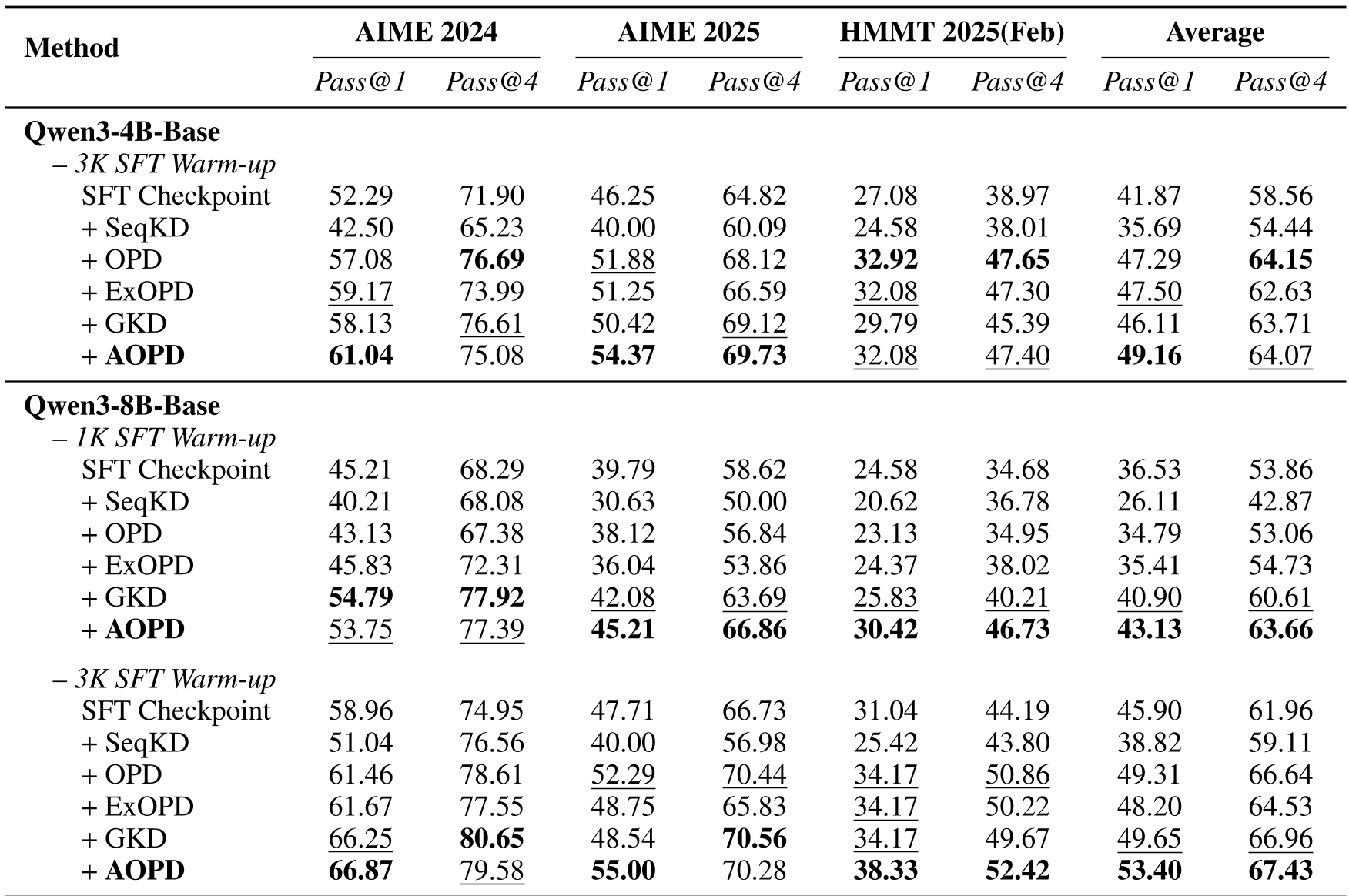
Most distillation methods fail if the student starts weak. AOPD, however, excels. When starting from a "weak" 1K-step warm-up, AOPD achieved an average Pass@1 of 43.13%, while standard OPD stayed stuck at 34.79%.
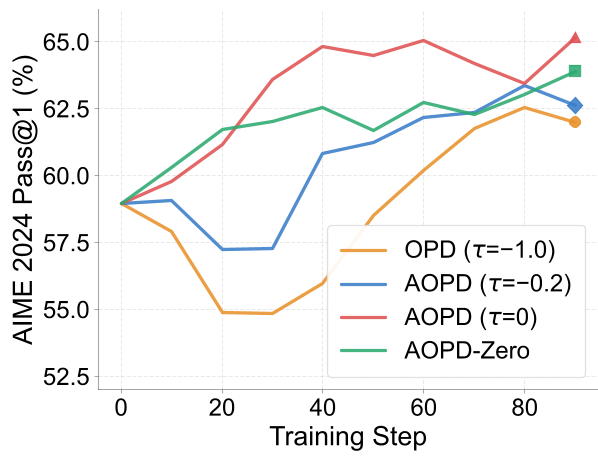 Figure 4a shows how AOPD maintains a significantly lower and more stable gradient norm compared to the chaotic spikes of standard OPD.
2. Preventing Catastrophic Forgetting
A key find was in Continual Learning. When models were taught "Tool Use" after math, AOPD actually improved its math scores (+0.61%) while others saw double-digit drops. This is because AOPD preserves "Policy Entropy"—it doesn't collapse the model's intelligence into a single narrow path.
Critical Insights & Future Outlook
The beauty of AOPD lies in its Local Intervention. It recognizes that a reasoning trajectory isn't all "good" or "bad." A student might move correctly for 10 steps and then stumble on 1 tricky logic jump. AOPD identifies that specific 11th token and provides surgical teacher guidance precisely where it's needed.
Limitations
- Teacher Dependency: AOPD requires a high-quality teacher model to provide token-level probabilities, which is computationally more expensive than simple label-based RL.
- Task Scope: While dominant in math, the impact on creative writing or open-ended dialogue remains to be seen.
Conclusion
AOPD moves the needle by proving that the "Reinforcement vs. Imitation" debate isn't a zero-sum game. By combining the best of both worlds—exploitation for what the model knows and imitation for where it's blind—we can build smaller, smarter models that don't just mimic, but truly reason.