
Asymptotic Charges as Detectors: Resolving the IR Structure of Gravity and QED
Asymptotic charges as detectors and the memory effect in massive QED and perturbative quantum gravity
The paper reformulates asymptotic charges in massive QED and perturbative quantum gravity using the language of light-ray detector operators. It demonstrates that Faddeev-Kulish (FK) dressed states diagonalize these charges, providing a rigorous link between IR-finite scattering theory and the physical memory effect.
TL;DR
This work bridges the gap between high-energy collider physics (detectors) and general relativity (asymptotic symmetries). By treating BMS charges as light-ray detectors, the authors prove that the "cloud of soft particles" surrounding any physical charge (Faddeev-Kulish dressing) is exactly what accounts for the gravitational and electromagnetic memory effects, correcting several long-standing discrepancies in the literature regarding IR-finite scattering.
Background: The IR Crisis and the Memory Effect
In 4D, both radiation and the "memory effect" (a permanent shift in the field after a wave passes) decay as . Standard Quantum Field Theory (QFT) often ignores the memory effect, leading to the infamous IR divergences in the S-matrix. To fix this, one must move from "bare" particles to "dressed" states—particles inseparable from their long-range fields.
The author's insight is to utilize Detector Operators—mathematical tools usually reserved for measuring energy flux at colliders—to rigorously define these charges at the boundary of spacetime.
Methodology: Charges as Detectors
The paper redefines the asymptotic charges () as integrals of field operators at future/past null infinity ().
1. The Detector Definition
For QED, the charge is split into a soft part (creating zero-energy photons) and a hard part (measuring the current of massive particles): In gravity, a similar split occurs, where the soft part corresponds to the "Bondi news" (gravitational waves) and the hard part to the "Bondi mass aspect."
2. The Role of the Dressing
The core of the paper lies in the Faddeev-Kulish (FK) dressing. Unlike previous works that used simplified "Chung states," this paper includes the full -dependence.
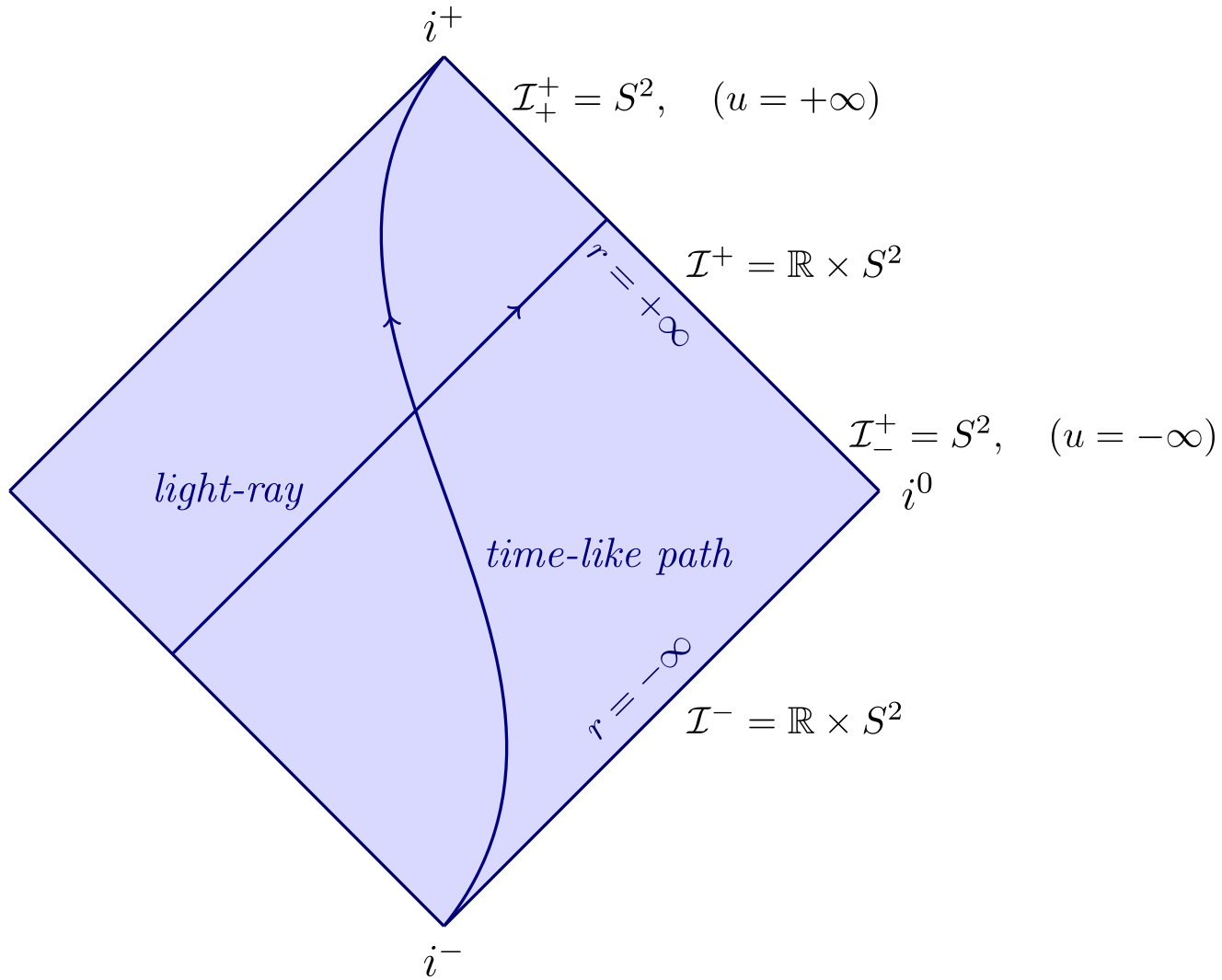 Figure 1: The Penrose diagram illustrating where these detectors are placed: Future Null Infinity () for massless fields and Timelike Infinity () for massive matter.
Methodology Highlights: Correcting the Literature
One of the paper's boldest moves is identifying a factor of error in standard soft-bracket commutators. They argue that the standard bulk commutation relations—when handled carefully as distributions—lead to a specific shift in the dressing that is half as large as typically assumed, but which is required for the conservation of in the dressed Fock space.
Experiments & Results: The Memory Eigenvalues
The authors prove that FK dressed states are actually eigenstates of the memory operator.
Key Result: Non-Zero BMS Charges
Contrary to earlier claims by Choi et al. (2018), which suggested BMS charges vanish for dressed states, this paper find a physical contribution:
- In QED: The eigenvalue is proportional to the total electric charge.
- In Gravity: The eigenvalue includes a monopole (energy) and a dipole contribution.
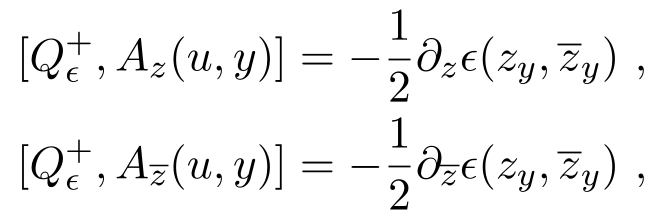 Figure 2: The corrected commutation relations that ensure conservation for dressed states.
These results align perfectly with the classical predictions of Bieri and Garfinkle, suggesting that the "quantum cloud" of the FK dressing is the microscopic origin of classical memory.
Deep Insights & Takeaways
- Physicality of the Dressed Space: The "Bare" Fock space (the one we use in grad school) is mathematically convenient but physically incomplete in 4D. The "Dressed" space is the one that actually diagonalizes the observables we care about at infinity.
- Symmetry and Memory: The conservation of asymptotic charges is not just a theoretical curiosity; it is the Ward identity of the memory effect. If you measure a gravitational wave displacement, you are seeing a BMS symmetry in action.
- Future Horizon: This framework provides a clean path forward for Celestial Holography, where these detector operators serve as the "basis" for the holographic dual theory.
Conclusion
By meticulously tracing factors of and insisting on distributional rigor, Moult et al. have successfully "debugged" the interaction between hard scattering and soft-background radiation. This work reaffirms that in gravity, you can never truly separate a particle from the spacetime it bends.