
Audio-DeepThinker: Eliciting "Deep Thinking" in Audio AI via Progressive Reinforcement Learning
Audio-DeepThinker: Progressive Reasoning-Aware Reinforcement Learning for High-Quality Chain-of-Thought Emergence in Audio Language Models
The paper introduces Audio-DeepThinker, a framework that leverages Reinforcement Learning (RL) to elicit high-quality Chain-of-Thought (CoT) reasoning in Large Audio-Language Models (LALMs). Using a progressive two-stage RL curriculum and a hybrid reasoning similarity reward, it achieves SOTA results on MMAR (74.0%), MMAU (78.5%), and MMSU (77.26%), winning 1st place in the Interspeech 2026 Audio Reasoning Challenge.
TL;DR
Audio-DeepThinker is a breakthrough framework that enables Audio Language Models to "think" before they speak. By using a two-stage Reinforcement Learning (RL) curriculum and a unique hybrid similarity reward, it transforms a standard instruction-tuned model into a reasoning powerhouse that achieves SOTA performance on major audio benchmarks. Most significantly, it proves that complex Chain-of-Thought (CoT) reasoning can emerge without any human-labeled reasoning data.
The "Thinking" Gap: Perception vs. Reasoning
Despite the rise of models like Qwen2-Audio and SALMONN, most current systems are "fast thinkers"—they jump straight from hearing a sound to providing an answer. While effective for simple identification, they fail at complex acoustic inference (e.g., "Why is this person likely at a train station?").
Existing attempts to fix this suffer from two issues:
- Supervised Limitations: SFT models merely imitate human reasoning and can't discover better logic paths.
- Semantic Decoupling: RL models often learn to output a structure that looks like reasoning but contains "hallucinated" logic that doesn't actually match the audio.
Methodology: The Architecture of Emergent Reasoning
Audio-DeepThinker solves these problems through two core innovations:
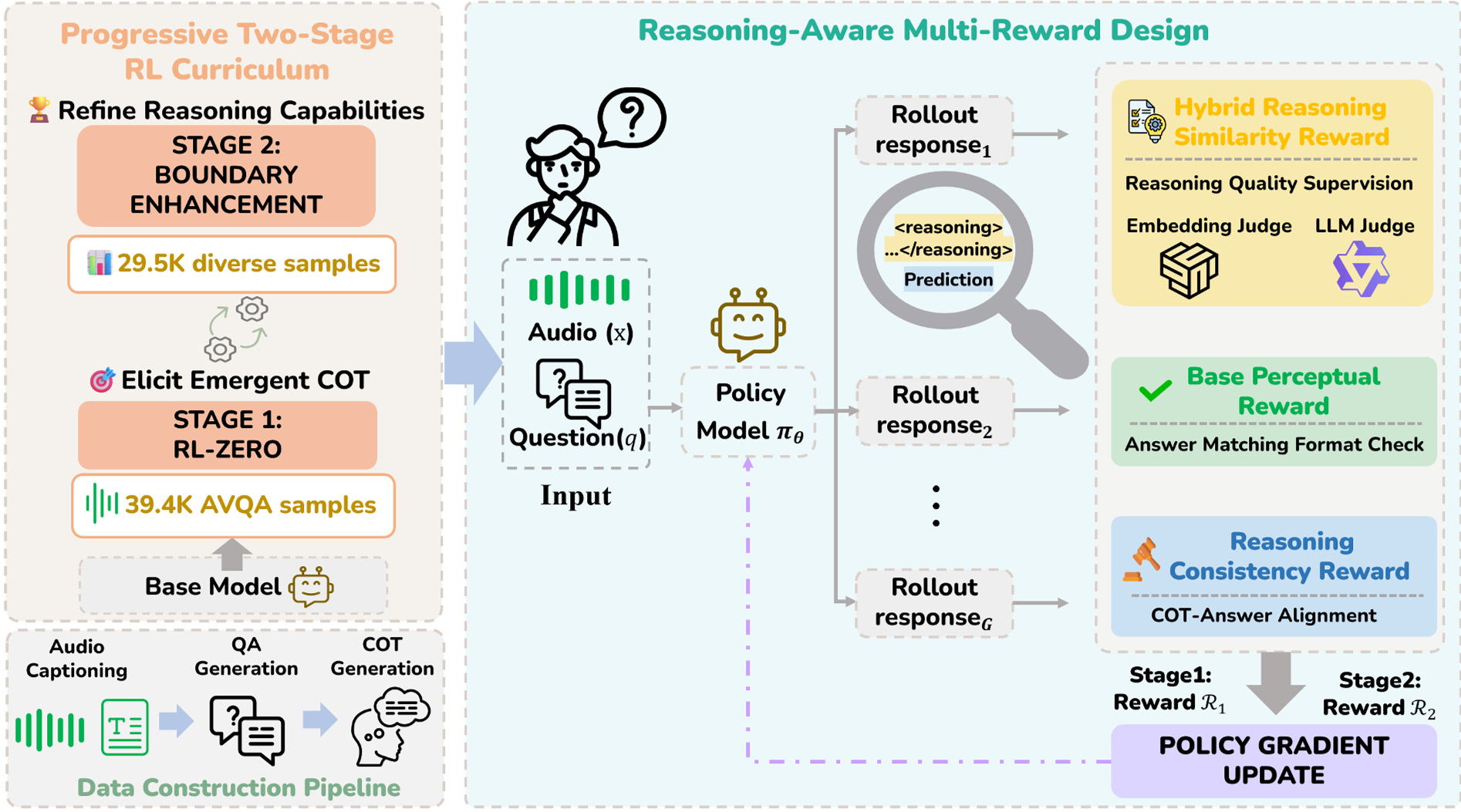
1. Hybrid Reasoning Similarity Reward
Unlike prior works that only reward the final answer, this framework rewards the quality of the thought process. It uses a dual-evaluation system:
- LLM Evaluator: Checks for logical path alignment and depth.
- Embedding Anchor: Uses BGE-M3 to ensure the semantic "meaning" of the generated thought stays close to a verified reference chain (derived from high-quality captions).
2. Progressive Two-Stage Curriculum
Reasoning is hard to learn from scratch. The authors employ a curriculum:
- Stage 1 (Elicitation): Focuses on foundational QA. The model "discovers" that generating a intermediate
<reasoning>tag leads to a higher reward. - Stage 2 (Enhancement): Focuses on difficult "boundary cases" (e.g., ambiguous sounds). The reward is streamlined to encourage more diverse and creative logic strategies.
Experiments and Results
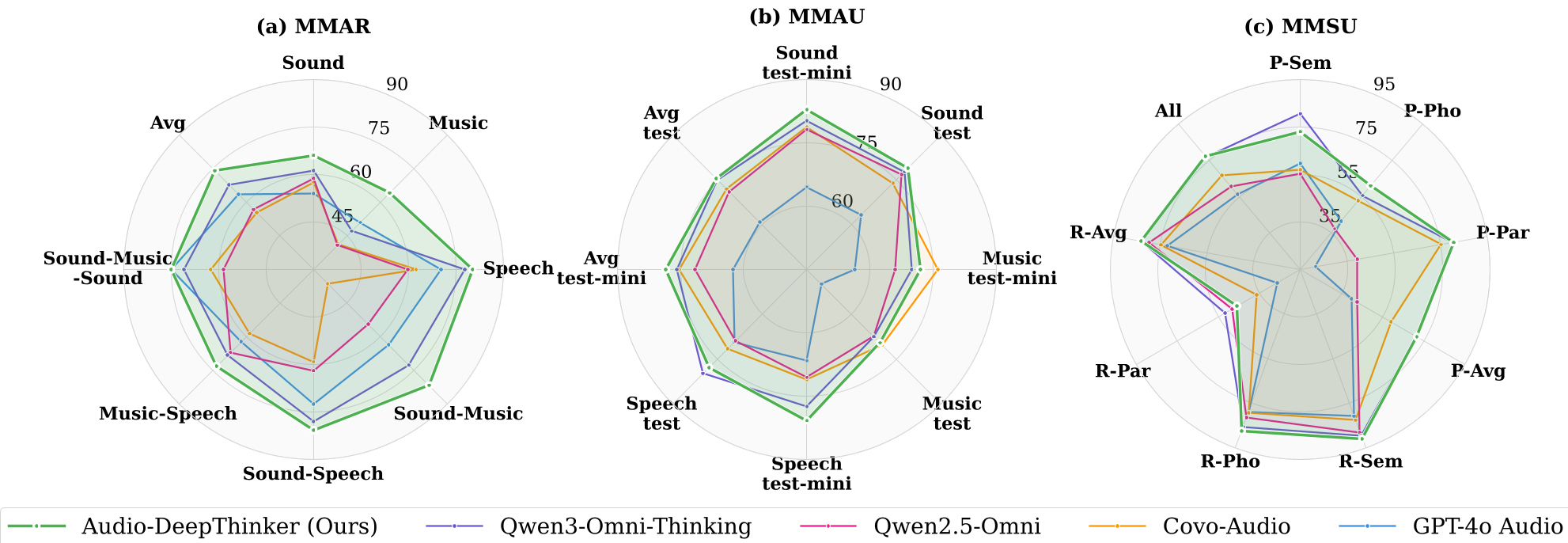
The model was tested on MMAR, MMAU, and MMSU, sweeping the floor with both open-source and heavyweight closed-source models like Gemini 2.0 Flash.
| Metric | Qwen3-Omni (Base) | Audio-DeepThinker | Improvement |
|---|---|---|---|
| MMAR Accuracy | 70.10% | 74.0% | +3.9% |
| Music Reasoning | 57.28% | 64.08% | +6.8% |
| MMAU Test-Mini | 77.80% | 78.50% | +0.7% |
The "Music" and "Phonology" categories saw the highest gains, indicating that CoT is most beneficial when the model has to decompose multi-layered acoustic signatures (like tempo, harmony, and stress patterns).
Mechanistic Insight: How Does RL Change the Brain?
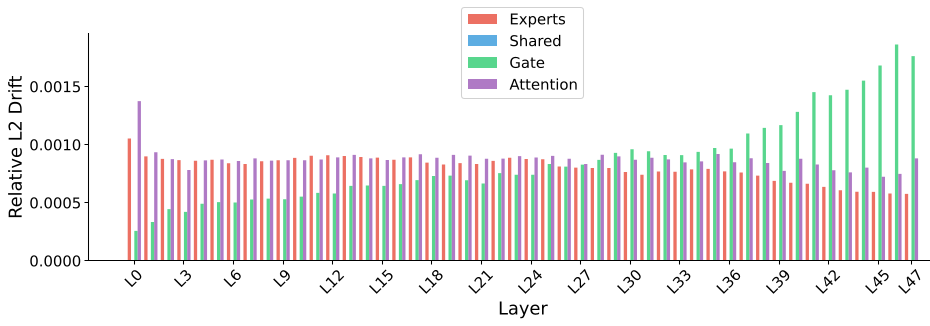
The authors used the "Logit Lens" to look under the hood. They found that RL training doesn't change the "knowledge" stored in the model's experts. Instead, it reprograms the traffic lights.
- Gating is Key: The "Gating" mechanism in the upper layers (L40-L47) showed the most change. RL teaches the model how to better route information between existing experts to construct a logical chain.
- Upper-Layer Concentration: Reasoning-related decisions "crystallize" in the very final layers of the transformer, while the lower layers remain focused on raw feature extraction.
Conclusion & Future Outlook
Audio-DeepThinker proves that LLM-style "Deep Thinking" (similar to OpenAI's o1 or DeepSeek-R1) is fully achievable in the audio domain through smart RL.
Key Takeaways for Practitioners:
- Frozen Experts?: Since most of the learning happens in the "Gating" networks, future RL could be much more efficient by only tuning the router parameters.
- Reasoning over Perception: The bottleneck in modern AI isn't hearing the sound—it's understanding what the sound implies. RL is the bridge to that understanding.
This work represents a massive step toward natively intelligent audio agents that can explain their surroundings with human-like precision.