
[Nature Communications/J. Chem. Inf. Model.] Beyond Scripts: Decoupling Reasoning and Execution for Computational Chemistry Automation
Automating Computational Chemistry Workflows via OpenClaw and Domain-Specific Skills
The paper introduces a decoupled agent-skill architecture for automating complex computational chemistry workflows using the OpenClaw framework. By separating high-level reasoning from domain-specific execution through "skills" and leveraging DPDispatcher for HPC grounding, it achieves end-to-end automation of multi-step tasks like reactive molecular dynamics.
TL;DR
Researchers have developed a modular automation framework that uses a general-purpose AI agent (OpenClaw) equipped with specialized "skills" to handle complex, multi-step chemistry simulations. By decoupling the "thinking" (reasoning/planning) from the "doing" (HPC execution/tool usage), the system can autonomously plan experiments, manage supercomputer jobs, and recover from failures in tasks like reactive molecular dynamics.
Positioning: This work moves beyond rigid workflow managers (like AiiDA or FireWorks) toward an "Agent-Skill" ecosystem that allows for dynamic decision-making and easier maintenance in the rapidly evolving landscape of AI-for-Science.
The Problem: Engineering Entanglement
In a typical computational chemistry project, a researcher must navigate a fragmented landscape:
- Preparation: Generating structures (Open Babel, RDKit).
- Calculation: Running Quantum Chemistry (Gaussian, VASP) or MD (LAMMPS).
- Infrastructure: Dealing with Slurm or PBS scripts, SSH transfers, and idiosyncratic file formats.
- Failure Handling: If a job crashes due to a bad geometry or a time limit, the researcher manually fixes and restarts it.
Prior automation efforts usually fall into two traps: they are either too rigid (hard-coded scripts that break easily) or too specialized (agents where the chemistry logic is buried deep in the prompt engineering). This "entanglement" makes it nearly impossible to upgrade a single component without breaking the whole system.
Methodology: The Decoupled Agent-Skill Design
The authors solve this by introducing a clean separation of concerns.
1. The General Agent (OpenClaw)
Instead of building a "Chemistry-LLM," they use a general-purpose agent framework. It maintains the "State" of the research and decides what to do next based on feedback.
2. Domain-Specific Skills
Capabilities are packaged into "Skills." If you want the agent to use a new software, you simply add a skill definition (schema and execution logic) rather than retraining the model.
- Planning Skill: Converts a vague request ("Simulate methane oxidation") into a structured "Agent Taskboard Manifest."
- DPDispatcher Skill: Acts as the bridge to the physical world, handling the "messy" parts of HPC submission and file tracking.
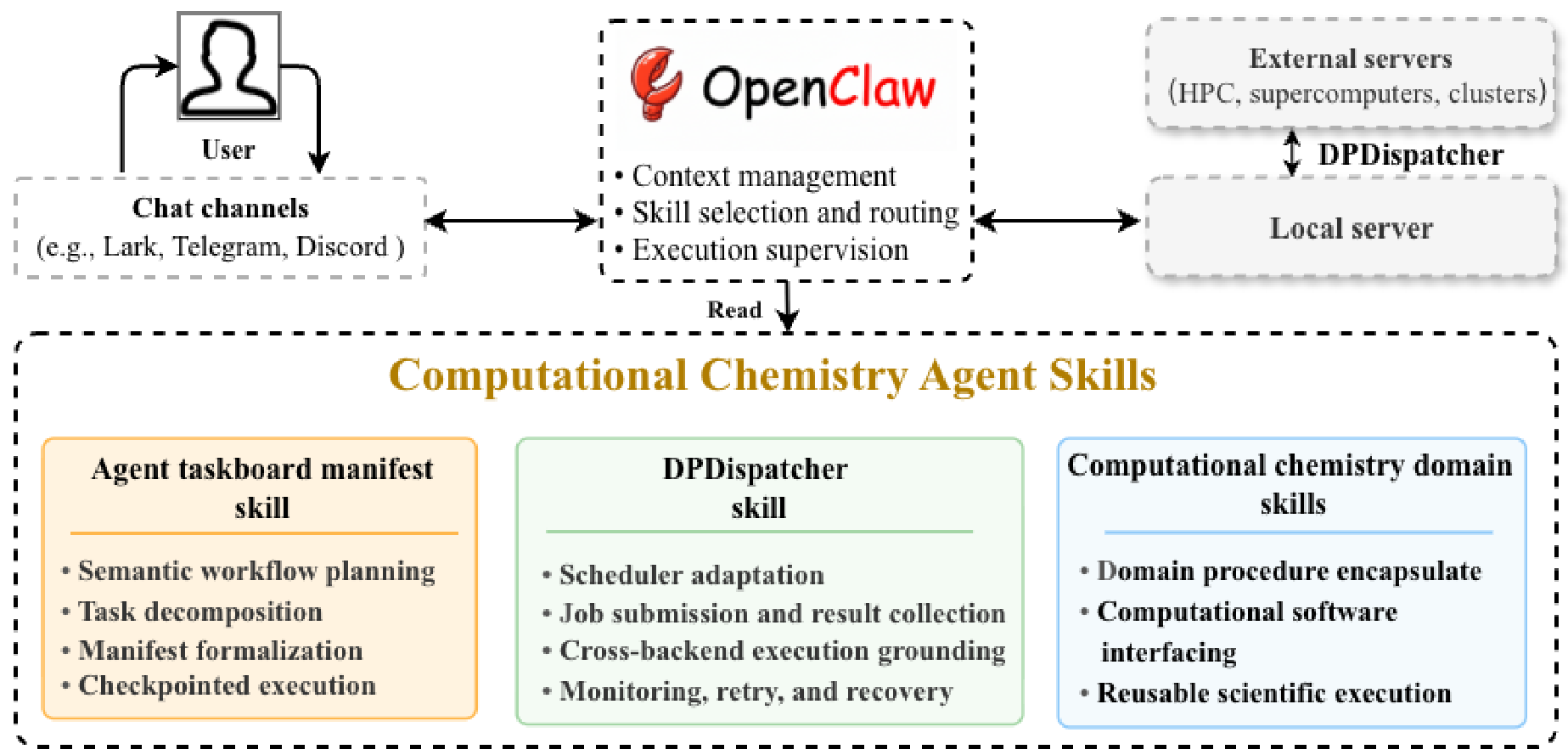 Figure 1: The architecture shows how the LLM interacts with skills to ground reasoning in physical execution.
3. Isolated Execution (The uv toolchain)
To avoid "dependency hell," each skill runs in its own isolated environment. This ensures that a quantum chemistry tool's Python dependencies don't conflict with a machine-learning potential's requirements.
Case Study: Methane Oxidation Reactive MD
The framework was tested on a high-stakes task: exploring combustion pathways of methane.
The Workflow:
- Optimization: Isolated molecules were optimized at the B3LYP/6-31G(d,p) level.
- System Building: Using
Packmolto reach a specific density. - Reactive Simulation: Running 1ns of MD at 3000K using a Deep Potential (DP) model.
- Analysis: Using
ReacNetGeneratorto extract the hidden reaction network from atomic trajectories.
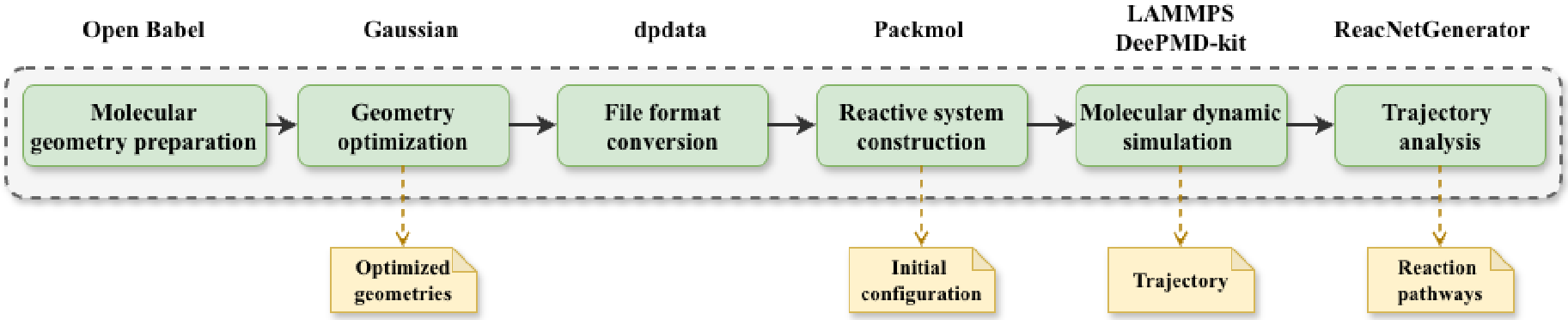 Figure 2: The automated pipeline from natural language to reaction network extraction.
Key Result: Bounded Recovery During the simulation, if a job failed (e.g., due to a cluster timeout or a convergence error), the agent analyzed the log files, diagnosed the issue, and submitted a corrected job. This "self-healing" capability is the holy grail of high-throughput science.
Critical Analysis & Takeaways
Why it works: The true innovation here isn't the AI's "intelligence," but the system architecture. By using a lazy-loading context (only feeding the agent documentation for the current sub-task), the authors bypass the context length limits of current LLMs and reduce "hallucinations" about software parameters.
Limitations:
- Stochasticity: Since LLMs are non-deterministic, two runs of the same task might take different paths, making strictly identical reproduction a challenge.
- Security: Autonomous agents with HPC access require rigorous sandboxing to prevent accidental data deletion or resource abuse.
The Future: The authors have open-sourced a library of Chemistry Agent Skills. This paves the way for a community-driven "App Store" for scientific automation—where researchers contribute skills for their favorite codes, and AI agents assemble them into novel discovery pipelines.
Conclusion
This work provides a blueprint for "Self-Driving Labs" in the digital realm. By treating scientific knowledge as a set of pluggable skills and leaving the coordination to flexible agents, we are one step closer to autonomous discovery platforms that can work 24/7 on the world's most complex chemical problems.