
Latte: Breaking the Structural Chains of Generative Recommendation
Expressiveness Limits of Autoregressive Semantic ID Generation in Generative Recommendation
Summary
Problem
Method
Results
Takeaways
Abstract
This paper investigates the expressiveness limits of Generative Recommendation (GR) models, specifically how autoregressive Semantic ID (SID) generation creates a structured decoding space that constrains model capacity. The authors propose "Latte," a method that injects latent tokens before SIDs to reshape the decoding tree into a forest, achieving a 3.45% relative improvement in NDCG@10.
## TL;DR
Generative Recommendation (GR) models use "Semantic IDs" (SIDs) to turn items into sequences of tokens. However, this paper reveals a fundamental flaw: the autoregressive nature of these models forces items with similar IDs to have nearly identical popularity scores for all users. The authors propose **Latte**, which adds a "latent token" before the ID to break this structural coupling, significantly boosting personalization and performance.
## The Curse of the Tree: Why GR Models Struggle to Personalize
In most GR models, if two items (like "Pokémon Scarlet" and "Pokémon Sun") share a long prefix in their Semantic IDs, they share the same initial probability terms in the model's calculation.
The authors find that this creates a **Decoding Tree** where:
1. **Rank Reversal is Impossible**: If the model thinks Alice likes Item A more than B, the tree structure forces it to think Bob *also* likes A more than B, even if Bob's history suggests otherwise.
2. **Forced Transitivity**: If Item 1 is similar to Item 2, and Item 2 is similar to Item 3, the tree forces Item 1 and Item 3 to be similar, failing to capture complex, real-world user behaviors where similarities aren't always transitive.
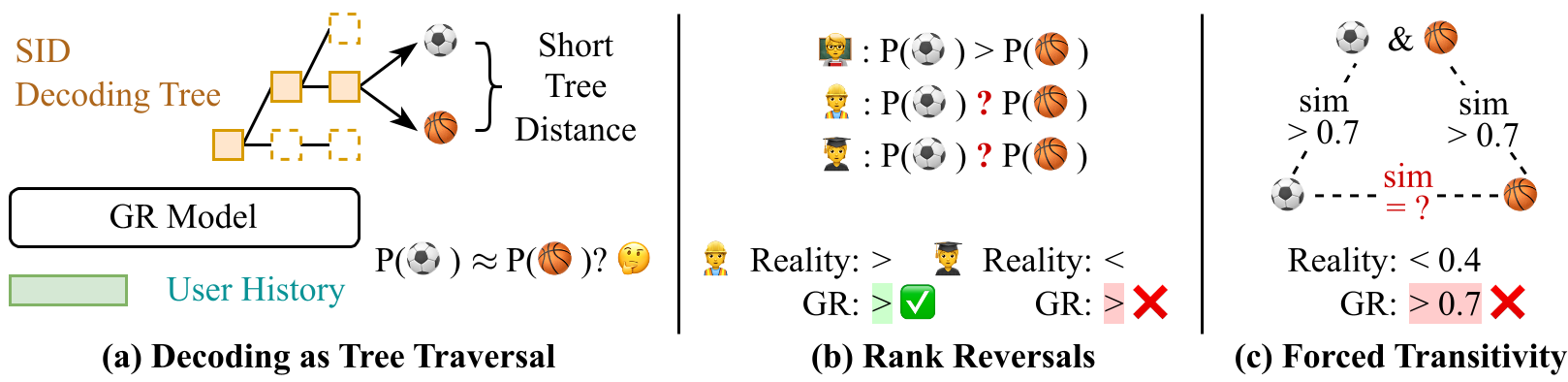
*Figure 1: (a) The decoding tree view. (b) and (c) demonstrate how the tree structure suppresses rank reversals and forces transitivity.*
## The Methodology: Latte (Latent-Token-Conditioned Generation)
To solve this, the authors don't change the IDs themselves. Instead, they change how the model *starts* the conversation.
By prepending a **latent token** ($l$) to the sequence, the model is no longer bound to a single tree. It effectively creates a "forest." For any given user, the model can choose a specific latent token that diverges the probability paths of two items early on, even if those items share a long SID prefix.
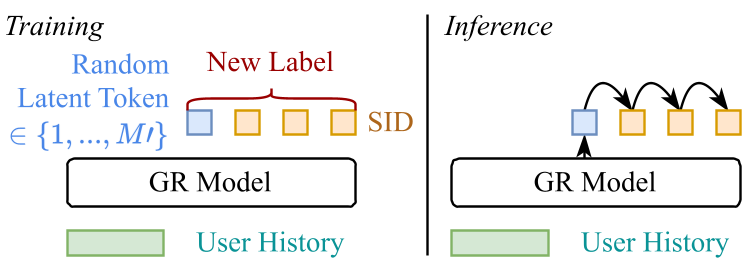
*Figure 2: The Latte framework. The injection of a latent token (L) reshapes the single tree into multiple latent-conditioned trees.*
The user-item preference score becomes an aggregation of these latent paths:
$$ \mathbb{P}(i_t \mid u) = ext{Agg}_{\ell \in \mathcal{L}} \left( \mathbb{P}(\ell \mid u) \cdot \prod \mathbb{P}(c_t^{(j)} \mid \ell, \dots) \right) $$
## Experiments & Results: More Than Just Noise
The authors tested Latte against a suite of SOTA models (SASRec, TIGER, PSID) on Amazon Review datasets.
### Key Findings:
- **Performance**: Latte achieved a **3.45% relative improvement** on NDCG@10.
- **Structural Decoupling**: Kendall’s correlation tests showed that Latte's item similarities were far less "anchored" to the tree structure than previous models.
- **Versatility**: The method works across different tokenizers (RQ-VAE, OPQ, RQ-KMeans).
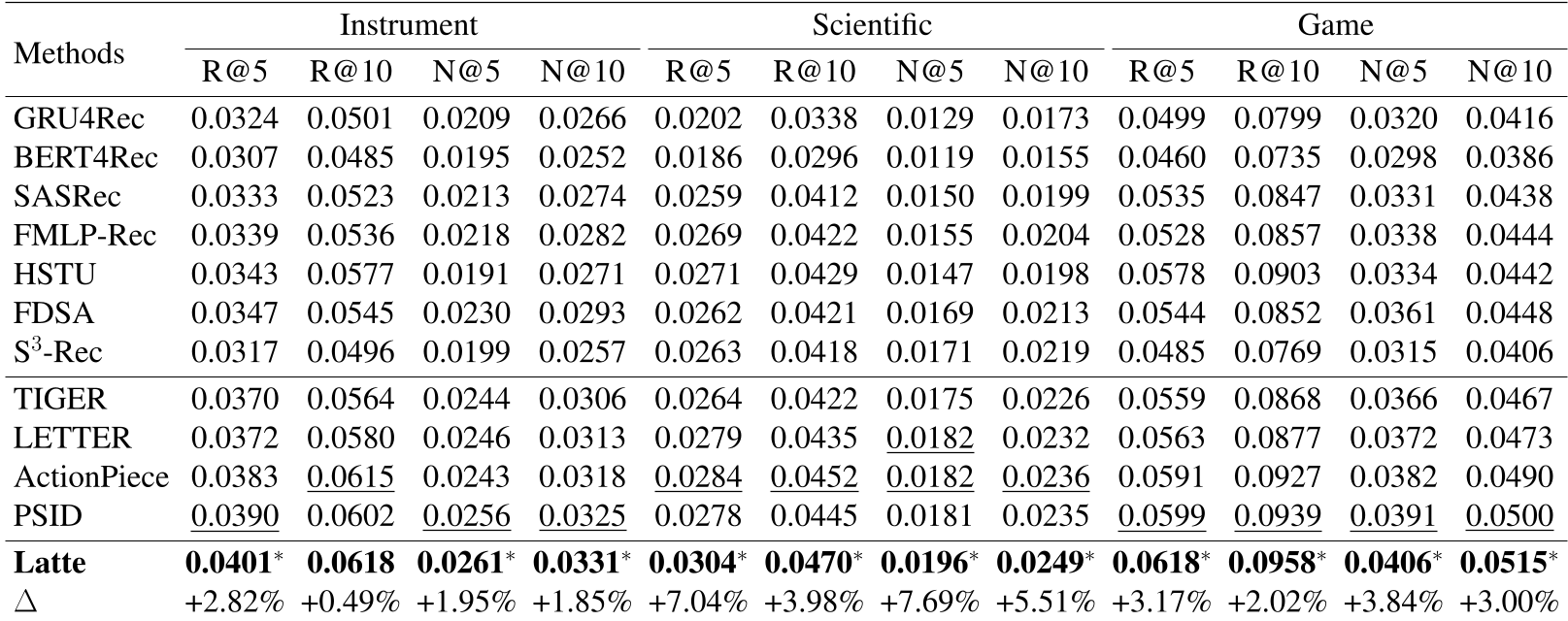
*Table 1: Main results. Latte consistently outperforms both ID-based and generative baselines.*
## Deep Insight: Beyond Random Sampling
The most fascinating part of the paper is the **Inductive Bias** experiment. The authors bound latent tokens to different **modalities** (e.g., text, genre, collaborative filtering). By letting the model "choose" which latent token to start with, the model automatically discovers which modality ordering (e.g., text then genre vs. genre then text) works best for a specific dataset.
## Conclusion & Future Outlook
Latte proves that the problem with Generative Recommendation isn't necessarily the complexity of the data, but the **rigidity of the decoding space**. By introducing a simple latent step, we can enjoy the efficiency of Semantic IDs without sacrificing the high-resolution personalization required for modern recommender systems.
**Limitations to watch**: While effective, Latte adds one extra decoding step, which might slightly increase latency in massive-scale production environments. Future research could focus on making this latent selection even more efficient or learning the latent tokens in a fully end-to-end differentiable manner.