
JoyAI-Image: Awakening Spatial Intelligence in Unified Multimodal Models
Awaking Spatial Intelligence in Unified Multimodal Understanding and Generation
JoyAI-Image is a unified multimodal foundation model developed by JD Joy Future Academy, integrating a spatially enhanced Multimodal LLM (MLLM) with a Multimodal Diffusion Transformer (MMDiT). It achieves SOTA performance across visual understanding, text-to-image generation, and instruction-guided image editing, specifically excelling in 3D spatial reasoning and high-fidelity long-text rendering.
TL;DR
JoyAI-Image is a pioneering foundation model from JD's Joy Future Academy that unifies Understanding, Generation, and Editing into a single framework. By focusing on "Spatial Intelligence," the model bridges the gap between seeing an image and understanding its 3D physical constraints. It achieves SOTA results in long-text rendering and complex 3D reasoning, effectively turning a generative model into a "world model" capable of imagining novel perspectives to solve reasoning tasks.
1. The Gap: Why "Seeing" Isn't "Understanding"
Current Multimodal Large Language Models (MLLMs) are adept at semantic recognition (identifying a cat on a mat), but they are notoriously "spatial-blind." They struggle with depth estimation, 3D relations ("behind," "between"), and camera-perspective consistency.
The authors identify two fatal flaws in the current SOTA:
- Weak Coupling: Perception and generation modules are often duct-taped together rather than mutually reinforcing.
- Geometric Amesia: Models lack a mental map of the 3D world, leading to "hallucinated" physics when editing or generating images from new angles.
2. Methodology: The Architecture of Spatial Awareness
JoyAI-Image employs a tripartite architecture designed to foster tight interaction between the "brain" (MLLM) and the "canvas" (MMDiT).
Core Components:
- MLLM Engine: Built on Qwen3-VL, this serves as the "Cognitive Brain," parsing instructions and providing spatially-grounded latent guidance.
- MMDiT (Multimodal Diffusion Transformer): A 16B parameter generative core that consumes MLLM priors to synthesize high-fidelity pixels.
- OpenSpatial Engine: A massive automated data pipeline that generates 3M+ spatially-grounded QA pairs using 3D Oriented Bounding Boxes (OBBs) to teach the model metric scale and orientation.
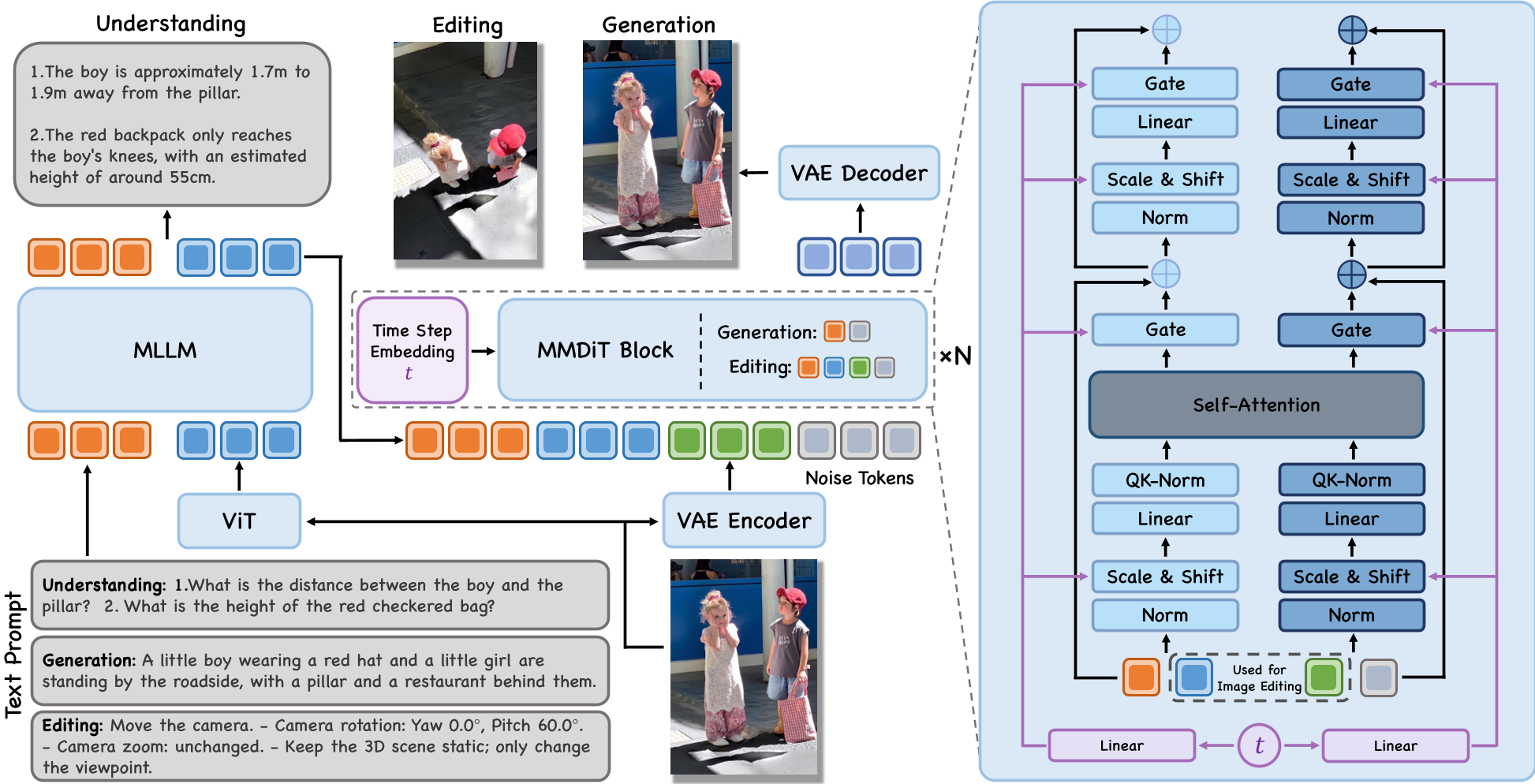 Figure: The JoyAI-Image framework integrates MLLM logic with MMDiT denoising for a seamless perception-generation loop.
3. Breaking Benchmarks: Spatial and Textual Dominance
The results highlights two areas of extreme performance:
A. Spatial Intelligence (SOTA)
On benchmarks like BLINK and CV-3D, JoyAI-Image didn't just improve; it dominated. By training on multi-view video data with 3D lifting, the model learned to maintain identity across viewpoint shifts.
- Camera Overall Error: Reduced from 0.743 to 0.429 (lower is better).
- Moving Score: More than doubled the performance of previous strong baselines.
B. Text Rendering (LongText-Bench)
One of the historical weaknesses of Diffusion models is "spelling" within images. JoyAI-Image introduces an OCR-aware captioning pipeline. It achieved 0.963 accuracy in both English and Chinese long-text rendering, outperforming models like FLUX.1.
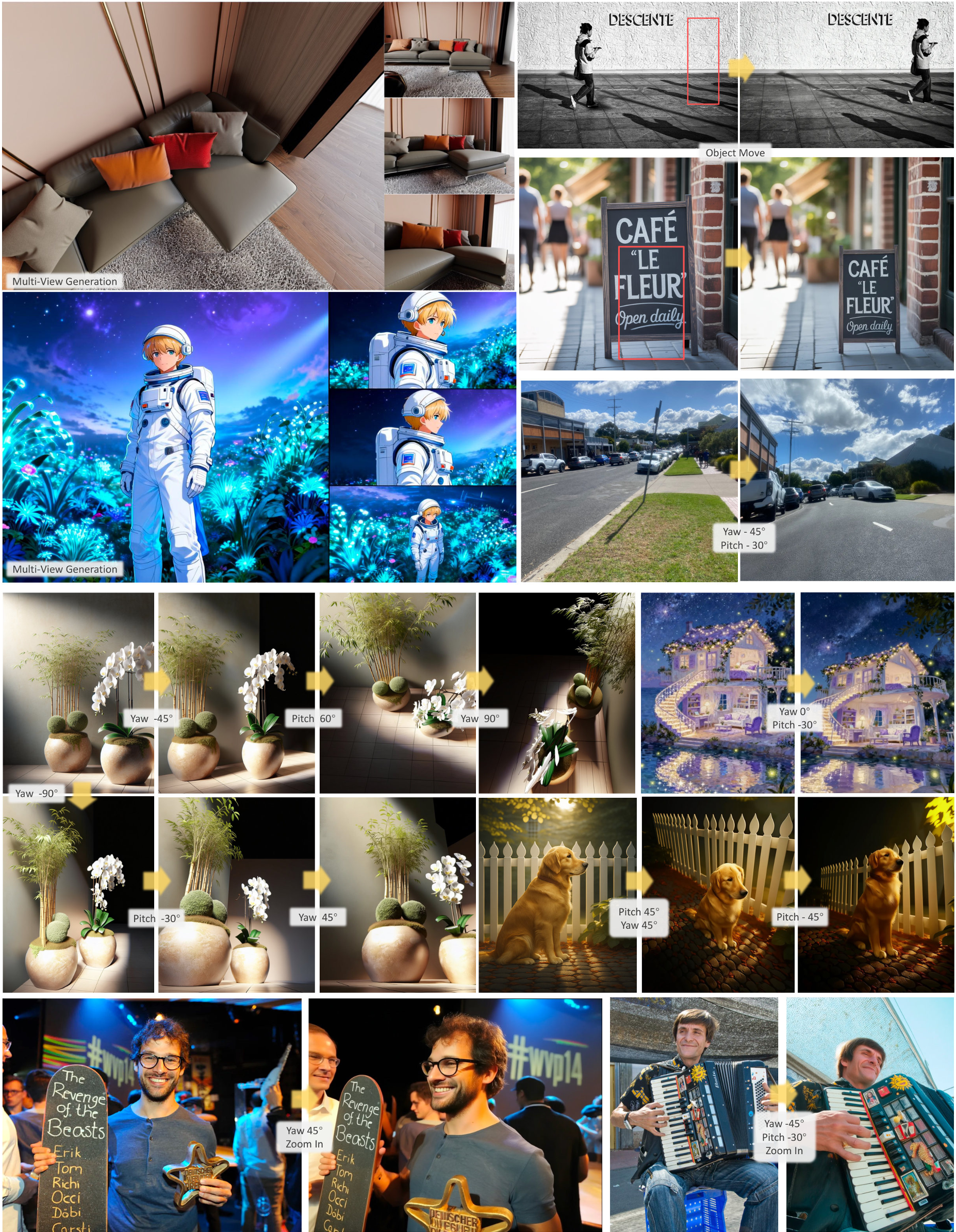 Figure: The model demonstrates precise control over typography and layout in both English and Chinese.
4. "Thinking with Novel Views": A New Reasoning Paradigm
Perhaps the most "intelligent" feature is TwNV. When the model encounters a difficult spatial question (e.g., "Is the traffic light above the umbrella?"), it doesn't just guess.
- Plan: It identifies that the current view is ambiguous.
- Synthesize: It generates a new image from a shifted camera angle.
- Reason: It looks at both the original and the "imagined" view to conclude the answer.
This "Small-Model Dividend" allows smaller backbones to achieve reasoning scores that rival massive proprietary models by using generation as a cognitive tool.
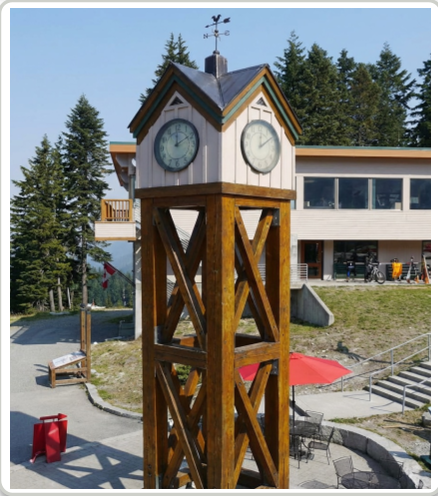 Figure: By generating a side-view, the model disambiguates vertical relations that were hidden in the front-view.
5. Critical Analysis & Future Outlook
Takeaway: JoyAI-Image proves that unified models are not just about convenience; they enable "Active Perception." By giving a model the ability to generate the evidence it needs to understand, we move closer to robotic systems that can navigate and manipulate the physical world.
Limitations: While the model excels at geometric consistency, human evaluation shows that "Naturalness" (perceptual polish) still trails some aesthetics-focused models like Nano-Banana. The next frontier will be merging this 3D spatial rigor with the cinematic quality of the latest creative AI models.
Future Work: The authors suggest this paves the way for World Models—systems that don't just predict the next pixel, but simulate the physics of the scene.