
Baby Universe in SYK: Slicing Spacetime with Chords
Baby Universe in a Coupled SYK Model
The paper investigates the emergence of topologically distinct spacetimes, including baby universes, within a Coupled Sachdev-Ye-Kitaev (SYK) model with Maldacena-Qi (MQ) interaction in the double-scaling limit. By deriving explicit chord rules and constructing a chord Hilbert space, the authors demonstrate that a closed universe cosmology can be microscopically realized and support a non-trivial Hilbert space entangled with external AdS regions.
TL;DR
Researchers have successfully modeled the birth of a "baby universe" using a coupled version of the SYK model. By treating the complex path integrals of quantum gravity as a combinatorial problem of "chords," they discovered that closed universes are not just mathematical artifacts but can support their own non-trivial quantum states, entangled profoundly with the "parent" spacetime.
The Problem: The AR Puzzle and the "Empty" Universe
In the study of quantum gravity, a recurring headache is the AR Puzzle. It asks: if a CFT state is pure, can it simultaneously describe a standard black hole and a disconnected baby universe? Some theorists argued that the Hilbert space of a closed universe must be trivial—containing only one possible state—to resolve this. However, this "triviality" makes it impossible for an observer inside that universe to perceive any semiclassical physics.
The authors of "Baby Universe in a Coupled SYK Model" use the Double Scaled SYK (DSSYK) model to provide a microscopic "YES" to the existence of non-trivial baby universe states.
Methodology: The Geometry of Chords
The SYK model is a collection of Majorana fermions with random interactions. In the "Double Scaling" limit, the correlation functions of this model can be visualized as chord diagrams.
The authors focus on a coupled MQ-SYK model, which represents two SYK sites (Left and Right) linked by an interaction. As the temperature drops, the system undergoes a "Hawking-Page" transition:
- Disks Phase: High temperature; two disconnected black holes.
- Cylinder Phase: Low temperature; a connected thermal AdS tube.
- AS2 Phase: Triggered by "heavy operators" (massive particles), which warp the cylinder to spawn a wormhole and a baby universe.
Architecture of the AS2 State
The key innovation is the derivation of Chord Rules. By "slicing" these diagrams, the authors define a Hilbert space not just for the boundaries, but for the "waist" of the wormhole—the baby universe itself.
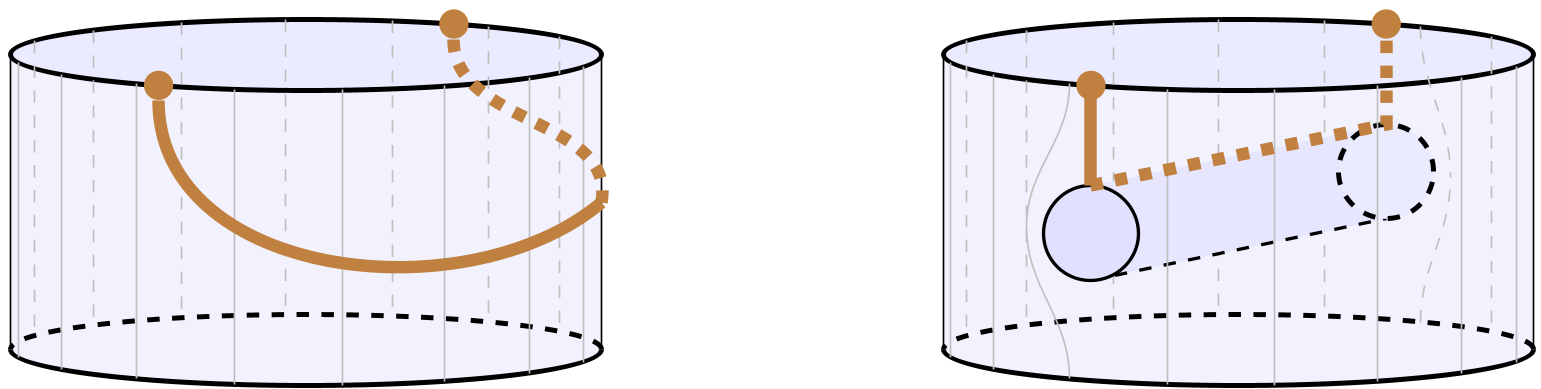 In the cylinder phase (left), a heavy chord faces massive suppression. To minimize this, the geometry "pinches" to form a wormhole (right).
Experiments: Tripartite Entanglement
The study calculates the Hartle-Hawking state for the AS2 geometry. Unlike simpler models, this state exhibits genuine tripartite entanglement between the Left sector (), the Right sector (), and the Baby Universe ().
The length of the wormhole throat is found to be:
This formula reveals that the "massive" nature of the operators () directly dictates the geometry of the throat. The authors used G, collective field plots to visualize these transitions.
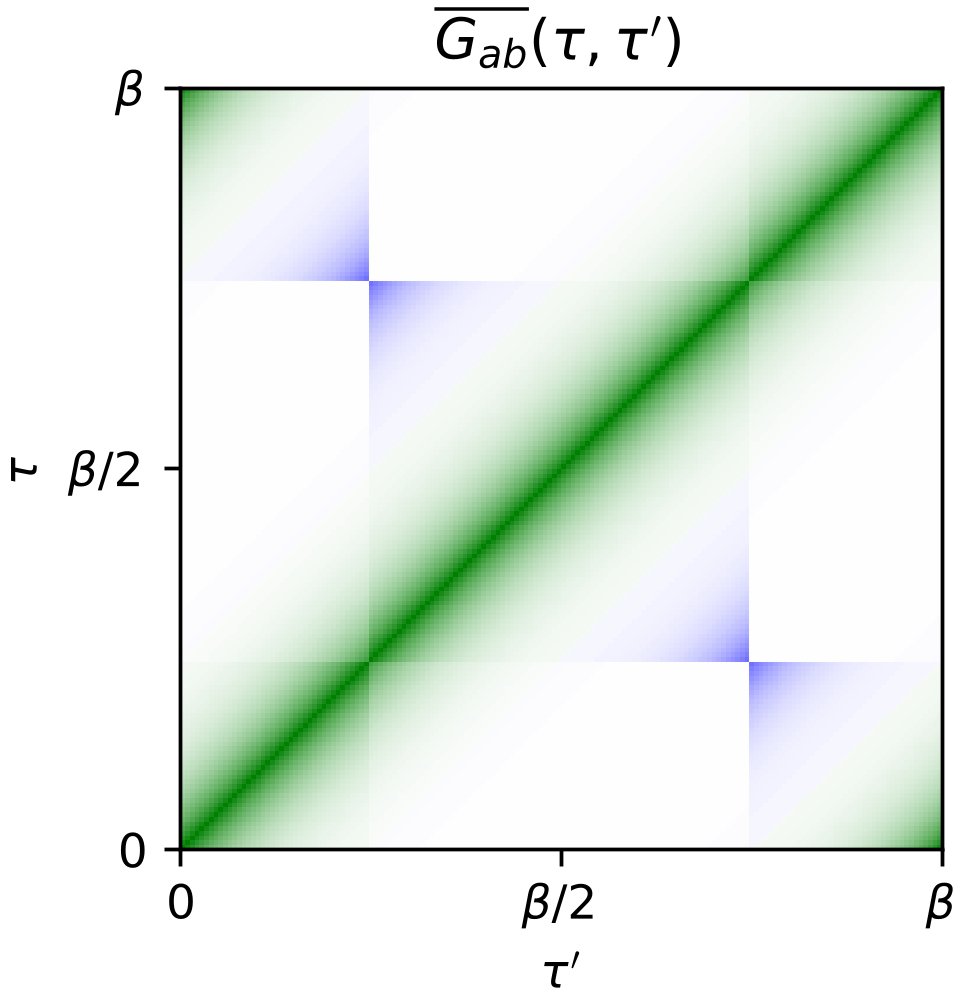 The "blue peaks" in the correlation plot indicate the presence of the wormhole, providing a gateway for Hamiltonian chords to travel between diametrically opposite points on the thermal circle.
Critical Insight: Entropic vs. Dynamical
Perhaps the most striking conclusion is that the emergence of topology is primarily entropic/combinatorial. The "baby universe" appears even at zero SYK coupling () as long as the MQ coupling is present.
The authors suggest that the baby universe's Hilbert space is spanned by all possible microscopic realizations of the random couplings. When we "coarse-grain" or average over these couplings, we perceive a smooth, semiclassical spacetime.
Conclusion & Future Work
This paper provides a robust microscopic foundation for baby universes. It suggests that:
- Closed universes have non-trivial Hilbert spaces.
- Spacetime topology can be understood as an organization of quantum correlations.
The next frontier is extending this "chord technology" to higher dimensions and more complex cosmologies, such as de Sitter space, where we might finally find a microscopic description of the very universe we inhabit.