
iWorld-Bench: A Comprehensive Benchmark for Interactive World Models
A Benchmark for Interactive World Models with a Unified Action Generation Framework
iWorld-Bench is a comprehensive benchmark designed to evaluate the physical interaction capabilities of interactive world models. It features a diverse dataset of 330k video clips across various perspectives and environments, a unified Action Generation Framework to standardize heterogeneous interaction modalities, and six specific task types to assess visual quality, trajectory following, and memory.
Traditional video generation models have come a long way, but the frontier of AI research is shifting toward Interactive World Models. These models don't just generate pretty videos; they simulate physical environments that respond to user inputs—crucial for applications in robotics, autonomous driving, and gaming. However, evaluating these models has been like comparing apples to oranges due to a lack of standardized benchmarks. Enter iWorld-Bench.
TL;DR
iWorld-Bench is a new, large-scale benchmark designed to rigorously test how "world-like" interactive models actually are. It introduces a massive dataset of 330,000 video clips, a unified framework to translate different control inputs (like text or camera coordinates), and new metrics to measure everything from visual quality to "memory symmetry."
The Challenge: A Fragmented Landscape
Until now, researchers faced three major hurdles when evaluating world models:
- Limited Diversity: Most datasets focused only on specific views (like dashcams) or single environments.
- Inconsistent Inputs: Some models take text ("walk forward"), others take keyboard keys, and others use complex camera matrices. There was no way to compare them fairly.
- Lack of "Memory" Testing: A true world model should remember where it was. If you move forward and then back, you should end up where you started. Current benchmarks didn't test this.
The Solution: Unified Action and Diverse Data
The authors solved these problems with a two-pronged approach. First, they built a massive, high-quality dataset by cleaning 12 existing open-source datasets and generating 100k new clips using 4 different simulators. This ensured coverage of diverse perspectives (drones, robots, pedestrians) and weather conditions.
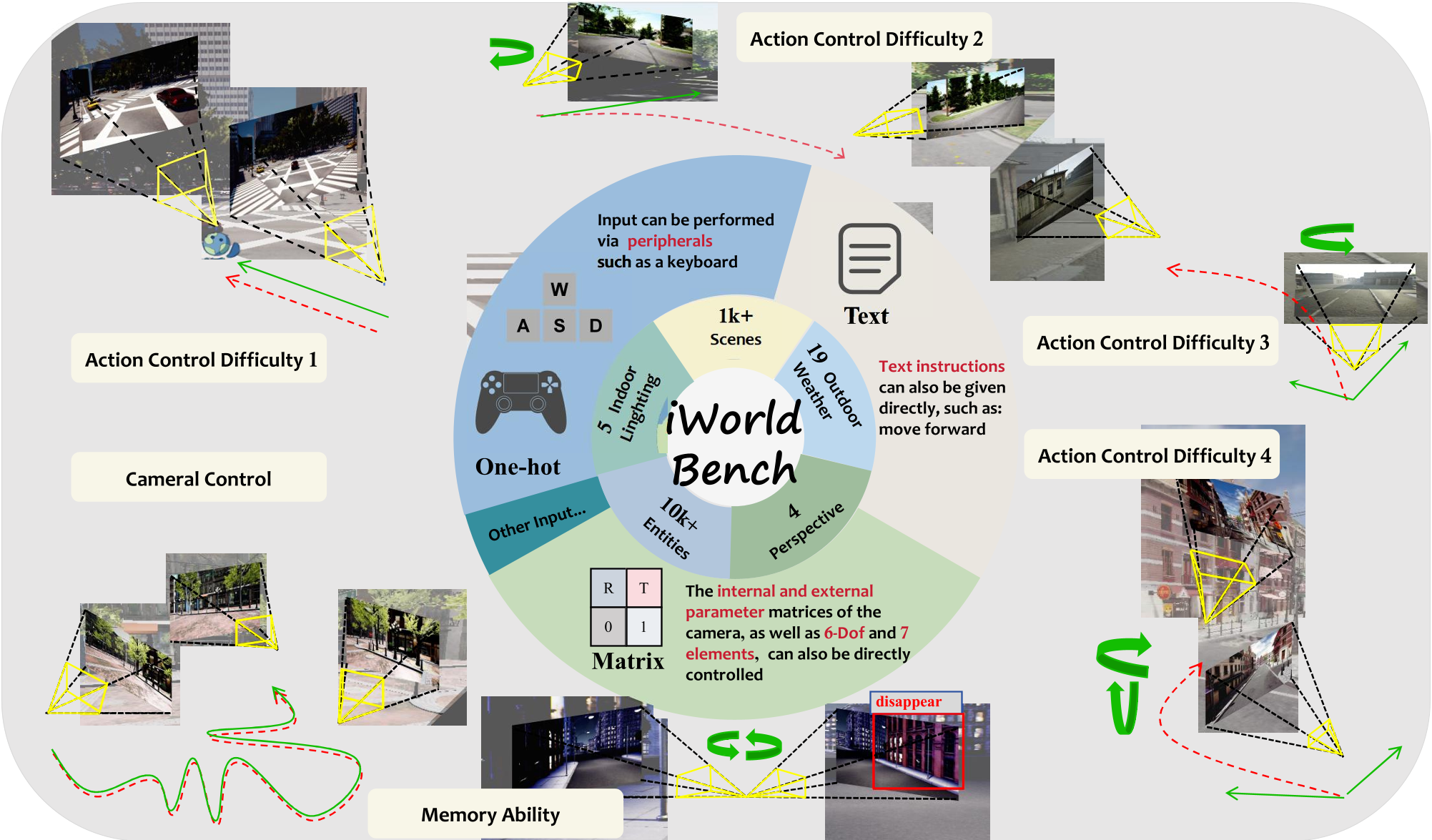
Second, they created the Action Generation Framework. This "universal translator" maps 81 basic movements (like "move forward while tilting up") into different control formats. Whether a model uses text, one-hot encoding, or camera matrices (extrinsics/intrinsics), it can now be tested on the exact same tasks.
Measuring What Matters
One of the most impressive parts of iWorld-Bench is its suite of 9 evaluation metrics. Beyond just "looking good," the benchmark measures:
- Trajectory Accuracy: How well does the model follow the path you gave it?
- Memory Symmetry: If the model goes forward and then backward, does the final frame look like the starting frame?
- Color/Brightness Consistency: Does the sun suddenly change color or the scene flicker?
Insights from the Leaderboard
The researchers tested 14 top-tier models, including NVIDIA Cosmos, HunyuanVideo-1.5, and AC3D.
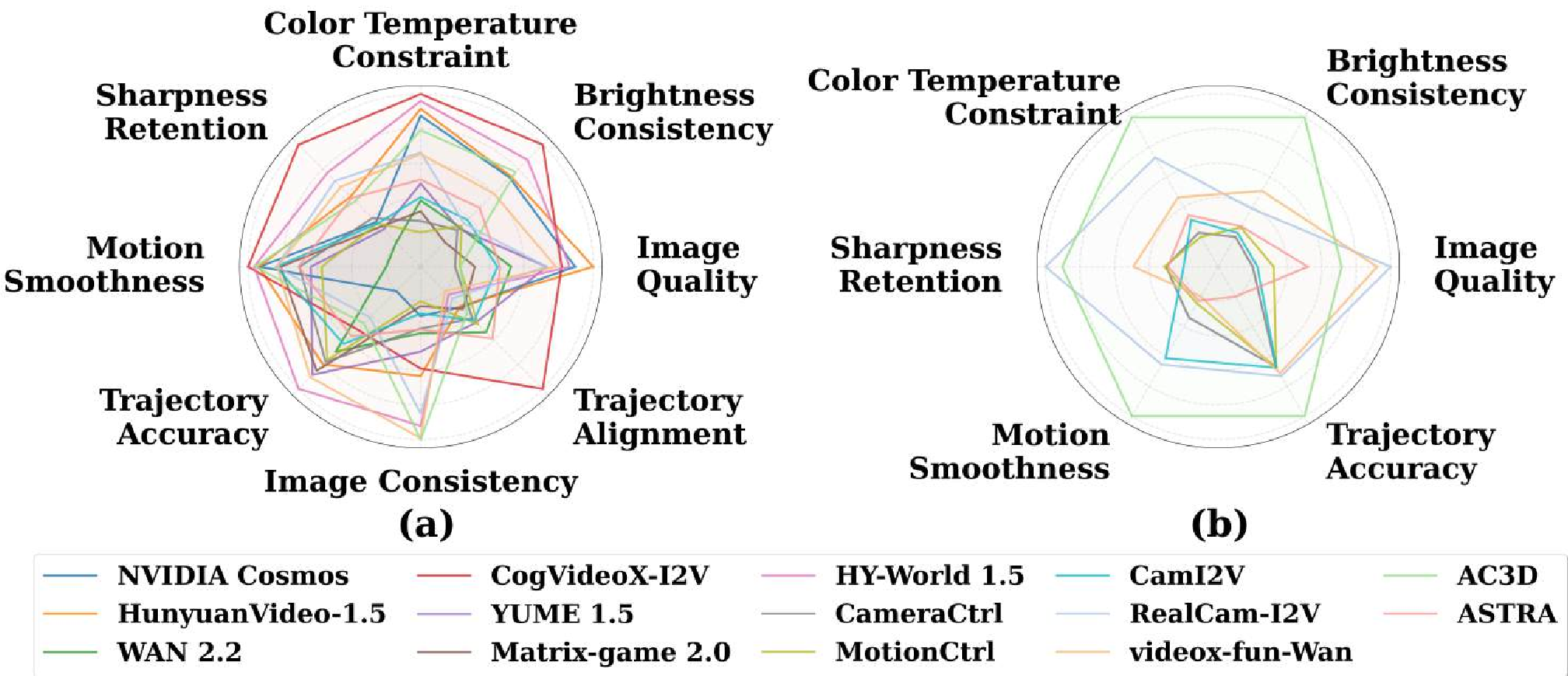
A few key findings emerged:
- Control vs. Quality: Highly controllable models often sacrifice some visual "finesse." For example, AC3D followed trajectories brilliantly but had lower image quality scores.
- The "Memory Gap": Most models struggle with "memory." In the "back-and-forth" test, many failed to return to the exact same starting point, showing a lack of true 3D spatial understanding.
- Winner: HY-World 1.5 currently leads the pack, offering the best balance of visual quality, trajectory following, and memory.
Why This Matters
For AI to truly understand our world, it needs to do more than predict the next pixel; it needs to understand the underlying physical laws and spatial relationships. iWorld-Bench provides the "ruler" we need to measure this progress. By standardizing how we evaluate interactivity and memory, it sets a new bar for the next generation of AI "world builders."
For a deeper dive, visit iWorld-Bench.com.