
BLADE: Breaking the Static Ceiling in LLM-based Recommendation
Beyond Static Best-of-N: Bayesian List-wise Alignment for LLM-based Recommendation
This paper introduces BLADE (Bayesian List-wise Alignment via Dynamic Estimation), a framework designed to optimize Large Language Models for Recommendation (LLM4Rec) using list-level metrics. It moves beyond static Best-of-N (BoN) distillation by using a Bayesian approach to dynamically update the target distribution, achieving SOTA results in ranking (NDCG) and complex objectives like fairness and diversity.
TL;DR
Current LLM-based recommenders (LLM4Rec) are stuck in a "static trap"—they align themselves to fixed reference models, which prevents them from ever becoming truly superior. BLADE (Bayesian List-wise Alignment via Dynamic Estimation) breaks this ceiling by treating recommendation alignment as a Bayesian inference problem. By dynamicly fusing prior knowledge with the model's own real-time discoveries, BLADE achieves sustained gains in ranking accuracy, fairness, and diversity, significantly outperforming traditional static Best-of-N alignment.
The Motivation: Why "Best-of-N" Isn't Enough
In the world of LLM4Rec, we want the model to generate a list of items that maximizes metrics like NDCG. However, these metrics are non-differentiable. The industry standard is Best-of-N (BoN): sample lists and pick the best one. But BoN is slow at inference time.
To fix this, researchers use BoN Alignment, trying to "distill" that search capability into the model. However, the authors of BLADE identified two fatal flaws in current static alignment:
- Indiscriminate Supervision: If your reference model's best score is 0.8, and your new model generates candidates with scores 0.9 and 0.95, a static system treats both as "perfect" (score = 1.0). The model loses the signal to prefer the 0.95 version.
- Gradient Decay: As the model gets better than its teacher, the learning signal vanishes. The "quantile reward" approaches zero, and optimization stalls.
Methodology: The Bayesian Self-Evolving Target
BLADE shifts the paradigm from a fixed anchor to a pursuit of a self-evolving target.
1. Bayesian Dynamic Estimation
Instead of a fixed lookup table for rewards, BLADE treats the reward distribution as a random variable modeled by a Beta Distribution.
- Static Prior: Knowledge from a pre-trained reference set.
- Dynamic Evidence: Real-time rollouts from the current training batch.
Using a power-scaled likelihood update, BLADE calculates the posterior distribution of the reward quantiles. This ensures that if the model finds a new "global best" list, the target distribution adapts to recognize it as the new gold standard.
2. The Shared Sampling Architecture
A major technical win for BLADE is efficiency. It uses Group Relative Policy Optimization (GRPO). The same batch of samples used to calculate the relative "Advantage" is also used as the "Dynamic Evidence" for the Bayesian update. This results in zero overhead compared to static methods.
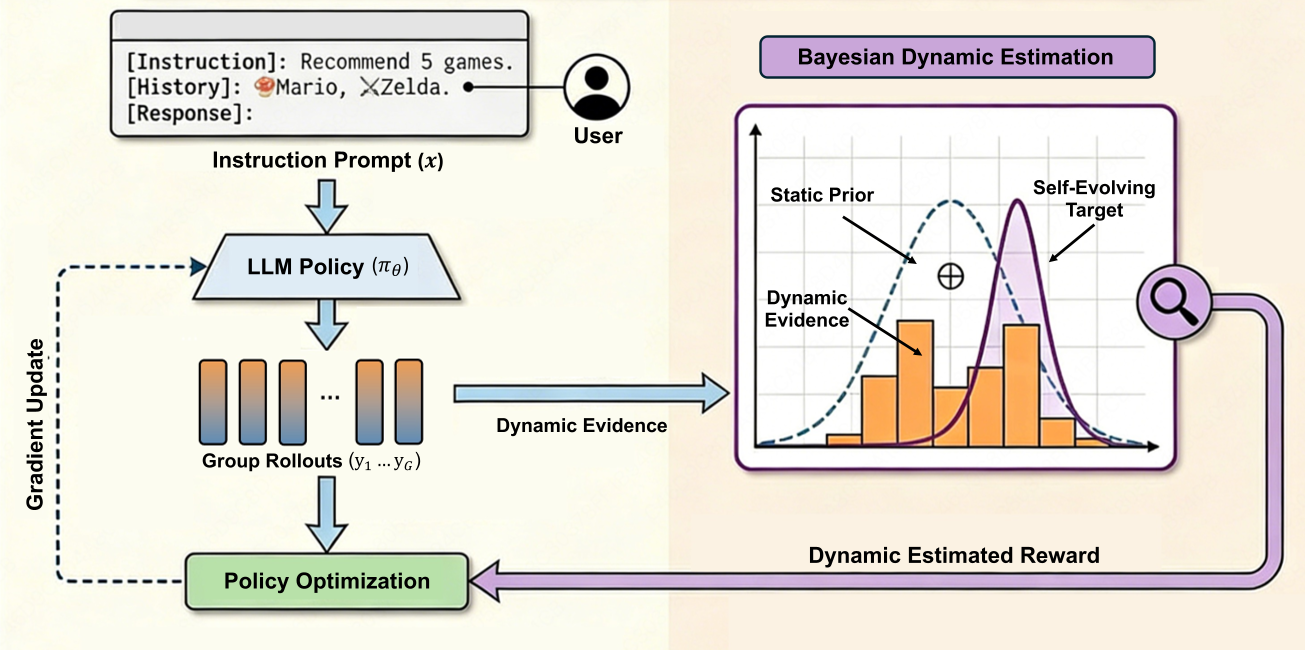 Figure 1: The BLADE framework—fusing static priors with dynamic rollout evidence.
Experimental Breakthroughs
BLADE was tested against high-caliber baselines like DPO and ReRe across three datasets (Steam, Amazon, Goodreads).
Breaking the Upper Bound
As shown in the training curves, static BoN alignment (where ) plateaus quickly. BLADE () continues to climb, effectively "breaking the ceiling" of the reference model.
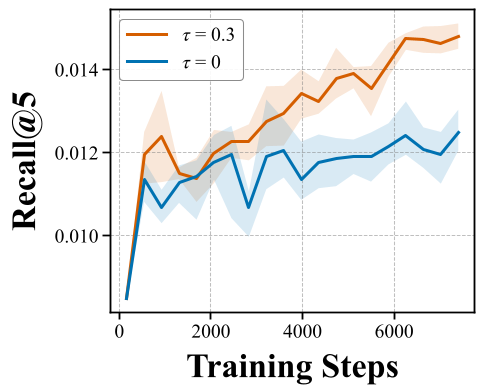 Figure 2: Performance improvement (Recall) over training steps. Note how BLADE sustains growth while the static approach stalls.
Beyond Accuracy: Fairness and Diversity
One of the hardest tasks in RecSys is the Accuracy-Fairness Trade-off. BLADE exhibits "Pareto Dominance," meaning it finds solutions that are both more accurate and more fair/diverse than the base model. This is achieved by incorporating non-differentiable fairness metrics directly into the Bayesian reward function.
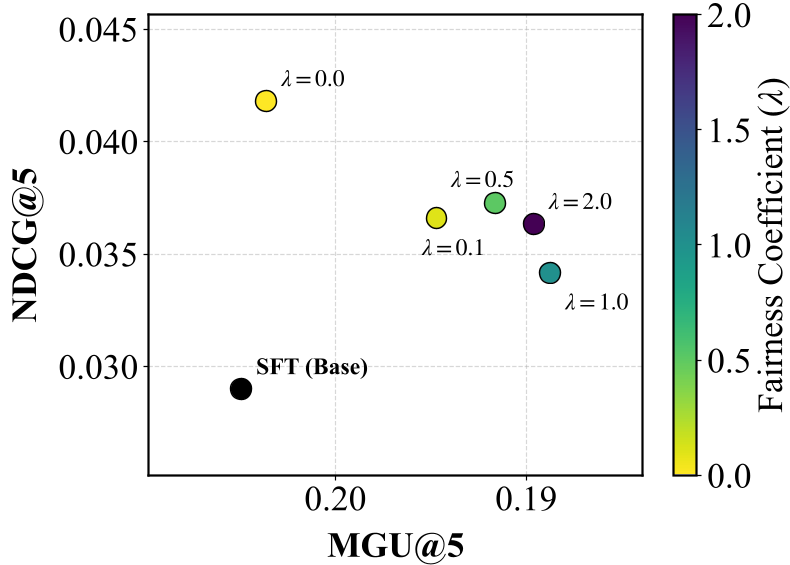 Figure 3: BLADE reaches the "Sweet Spot" in the top-right, outperforming the baseline on both axes.
Critical Analysis & Conclusion
Takeaway: BLADE proves that LLMs shouldn't just be taught to "imitate" a teacher; they should be given the framework to "surpass" the teacher by dynamically re-evaluating what "good" looks like as they improve.
Limitations:
- Hyperparameter Sensitivity: The dynamic coefficient requires tuning. Set it too high, and the model becomes unstable due to batch noise; set it too low, and you're back to the static ceiling.
- Metric Grounding: High optimization for diversity/fairness requires a "relevance grounding signal" (like NDCG) to prevent the model from drifting into irrelevant but "diverse" nonsense.
Future Work: This Bayesian list-wise approach isn't limited to recommendation. It could likely be applied to code generation (optimizing for test pass rates) or mathematical reasoning, where the evaluation metrics are equally discrete and hard to differentiate.