
S-trace: Beyond Uniform Credit Assignment in LLM Reasoning
Beyond Uniform Credit Assignment: Selective Eligibility Traces for RLVR
The paper introduces S-trace (Selective Eligibility Traces), a critic-free Reinforcement Learning with Verifiable Rewards (RLVR) method. It enhances the reasoning capabilities of Large Language Models by replacing the standard "uniform credit assignment" in algorithms like GRPO with a sparse, recency-based eligibility trace mechanism.
TL;DR
DeepSeek-R1 popularized GRPO, a critic-free RL algorithm for reasoning. However, GRPO suffers from a "uniform credit assignment" problem—it treats every token in a long chain of thought as equally responsible for the final success or failure. S-trace solves this by reviving Eligibility Traces for the modern LLM era. By selectively reinforcing high-entropy "pivot" tokens and using a recency-based decay, S-trace beats GRPO in accuracy and token efficiency across the Qwen3 model family.
The Problem: The Noise of Uniformity
In Reinforcement Learning with Verifiable Rewards (RLVR), the model gets a single "correct/incorrect" signal for a long reasoning trace. Standard algorithms like GRPO then broadcast this advantage to all tokens.
If a model writes 1,000 tokens of math and makes one critical error in the middle, uniform credit assignment might still reinforce the error if the rest was "good enough" or penalize the brilliant initial steps. This "coarse granularity" makes learning slow and vulnerable to overfitting.
Methodology: From P-trace to S-trace
The authors propose a two-step evolution:
1. P-trace (Proximal Policy Eligibility Traces)
P-trace reformulates the PPO gradient into an actor-only eligibility trace. Its "secret sauce" is the Eligible Importance Weight (EIW).
- The Intuition: Even if a current token's importance weight is clipped (meaning we stop learning from it to stay in the "trust region"), a subsequent token might still have a valid gradient. P-trace "salvages" these downstream signals to update ancestral tokens.
2. S-trace (Selective Eligibility Traces)
Dense traces (P-trace) can be unstable because they reinforce everything. S-trace applies the 80/20 rule: 80% of the cognitive work is done by 20% of the tokens.
- Entropy Masking: S-trace calculates the entropy of tokens and only maintains traces for those in the top fraction (high entropy). These are the "forking tokens" where the model is actually making a decision, rather than just outputting routine syntax.
Figure 1: Conceptual illustration of credit assignment. While GRPO broadcasts rewards uniformly, S-trace focuses on critical high-entropy transitions.
Experimental Results: Leaner and Smarter
The researchers tested S-trace on the Qwen3 series (1.7B, 4B, and 8B) across heavy-duty math benchmarks like MATH500 and AIME.
Key Metrics:
- Accuracy Boost: On Qwen3-4B, S-trace achieved a 3.16% average improvement over GRPO.
- Token Efficiency: S-trace didn't just get more questions right; it did so with shorter responses. By suppressing the "noise" of late-stage filler tokens, the model learned to be more concise.
- Scalability: On the 8B model, S-trace maintained its lead, particularly on the grueling BeyondAIME benchmark (reaching 27.84% vs 17.68% for GRPO).
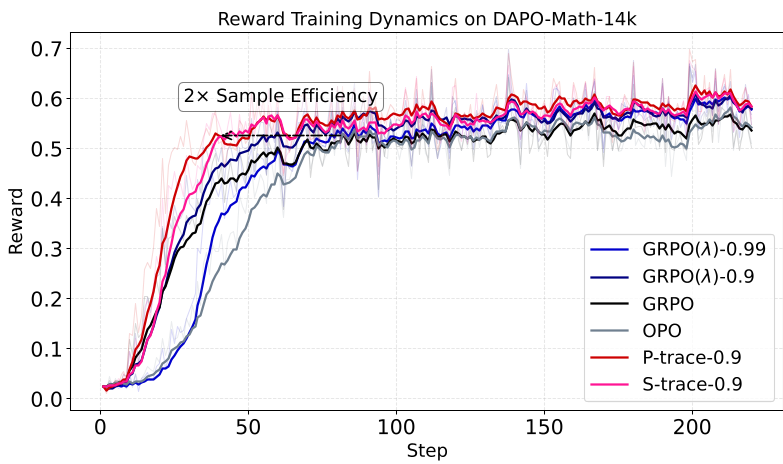 Figure 2: Reward dynamics and pass rate improvements show S-trace converging faster and higher than standard GRPO.
Deep Insight: Why Entropy?
The ablation studies are particularly revealing. When the authors replaced entropy-based masking with a random mask, performance tanked.
This confirms the "Synaptic Tagging" hypothesis: credits should only be assigned to tokens that represent true "logical bottlenecks." Reinforcing low-entropy tokens (like "The," "is," or simple algebraic steps) only adds variance to the gradient without providing useful information.
Conclusion
S-trace marks a shift from "brute force" reinforcement to "strategic" reinforcement. By recognizing that not all tokens are created equal, it provides a path for training large reasoning models that are more stable, more accurate, and more computationally efficient.
Limitations & Future Work
While S-trace improves efficiency, it still pushes the boundaries of "Trust Regions." Future work will likely look at technically proving the stability of these sparse traces for even larger (70B+) models and investigating why recency-based decay naturally leads to shorter, more efficient reasoning.