
BifrostUMI: Scaling Humanoid Intelligence via Robot-Free VR Demonstrations
BifrostUMI: Bridging Robot-Free Demonstrations and Humanoid Whole-Body Manipulation
BifrostUMI is a portable, robot-free data collection and hierarchical control framework for humanoid whole-body manipulation. It utilizes VR devices (PICO 4) and UMI-inspired handheld grippers to capture human demonstrations as sparse keypoint trajectories, enabling the training of diffusion-based visuomotor policies without requiring a physical robot in the loop.
TL;DR
BifrostUMI is a breakthrough framework that allows humanoid robots to learn complex whole-body manipulation—like bending under a table to discard trash—using data collected by a human wearing a VR headset, with no robot required during the demonstration phase. By using a "Keypoint-based" intermediate representation, it bridges the gap between natural human movement and robotic joint control.
Background: The Data Bottleneck
In the race toward embodied intelligence, data is the most valuable substrate. However, collecting humanoid data is a nightmare for researchers. You usually need the actual robot (which might cost $100k+), a trained operator to teleoperate it, and long hours of synchronization.
BifrostUMI asks a radical question: What if we could train humanoids just by watching humans move naturally, using nothing but off-the-shelf VR gear?
High-Level Motivation: Solving the Embodiment Gap
The reason we don't just "copy-paste" human motion onto robots is the Embodiment Gap. A human’s legs are longer, their center of mass is different, and their range of motion varies. Prior works like the original Universal Manipulation Interface (UMI) focused on single arms. BifrostUMI extends this to the Whole Body, ensuring that when a human bends their knees in VR, the robot understands it needs to maintain balance while lowering its pelvis.
Methodology: The Three-Stage Hierarchy
The core innovation of BifrostUMI is its modular architecture, which mimics the human motor system:
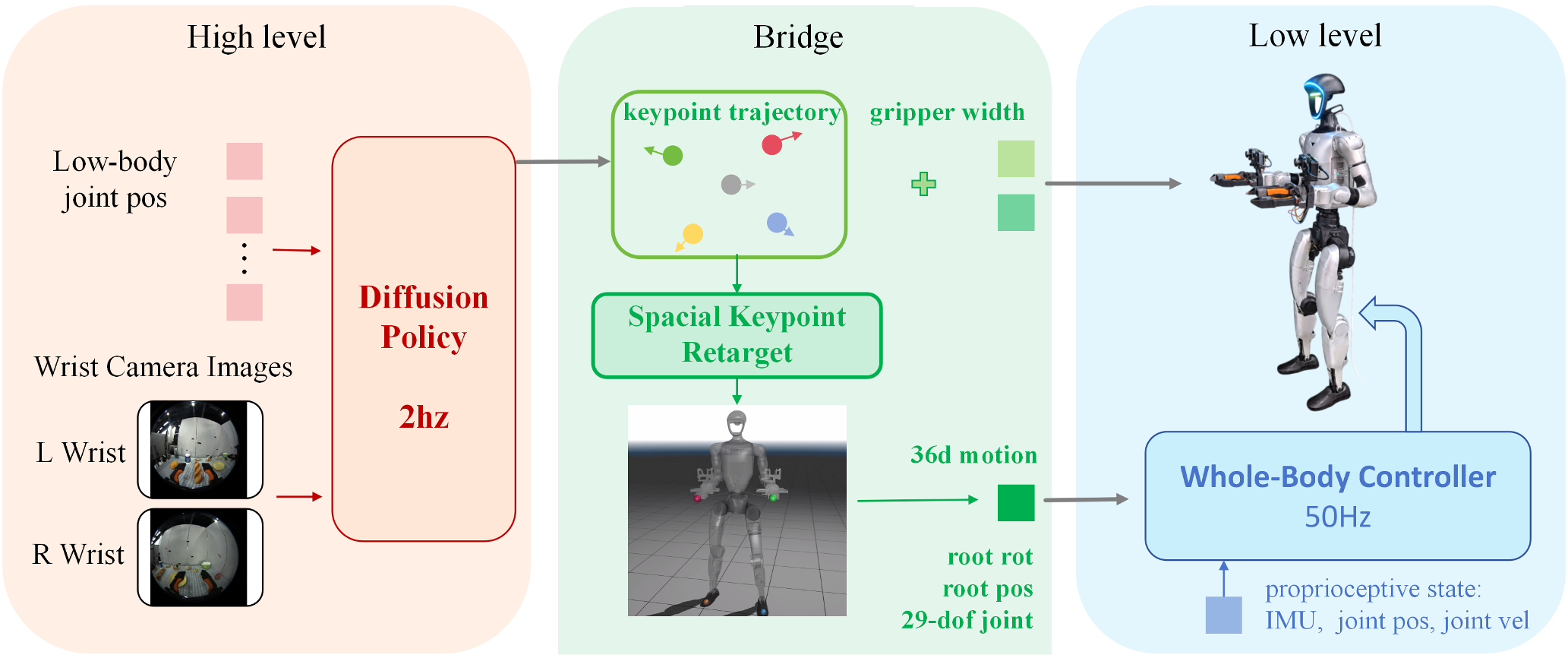
- The "Brain" (High-Level Policy): A Diffusion Policy that takes wrist-camera images and predicts where the robot's hands, feet, and pelvis should be in the next few seconds (Sparse Keypoints).
- The "Nervous System" (Spatial Keypoint Retargeting - SKR): This is the bridge. It takes those 5 keypoints and translates them into the robot's specific joint angles. Crucially, it only scales the vertical height (to match robot/human height) while keeping the horizontal "reach" distances consistent, preserving the task's geometry.
- The "Cerebellum" (Low-Level WBC): A learned controller that ensures the robot doesn't fall over. It tracks the joint references at 50Hz while managing gravity and balance.
The Hardware Setup
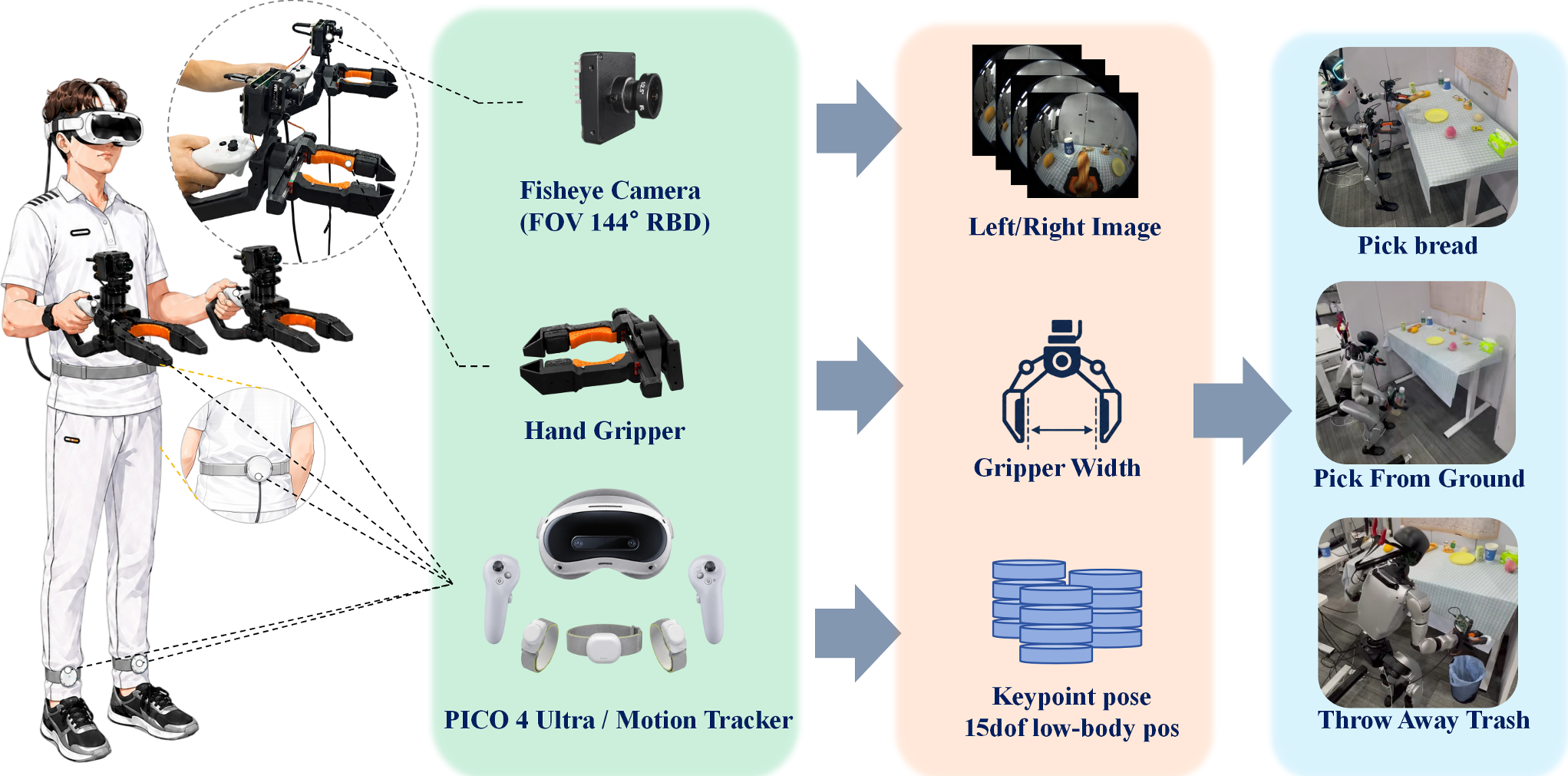
The authors used a PICO 4 VR system for body tracking and custom-built UMI Grippers equipped with fisheye cameras. This allows the system to record what the human sees (wrist-view) and what the human does (keypoint motion) simultaneously.
Experimental Results: Beyond the Tabletop
The BifrostUMI-trained Unitree G1 robot didn't just perform simple grasps. It mastered two distinct, high-difficulty scenarios:
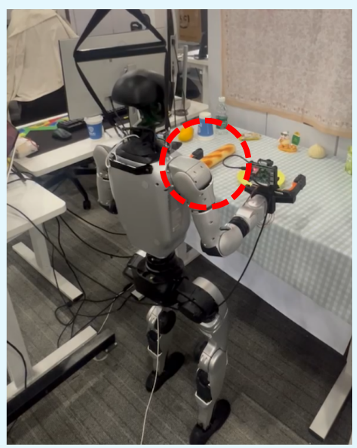
- Cluttered Pick-and-Place: Proved the vision system could handle distractor objects and precise depth estimation.
- Under-table Waste Disposal: This is the "Grand Prix" of the paper. The robot had to grasp a ball, step back, bend its knees and waist, and reach under a table. This requires high-level coordination of almost all 29 degrees of freedom.
Key Performance Win
By separating the Kinematic Bridge (SKR) from the Dynamic Tracker (WBC), the system is remarkably robust. The Diffusion Policy doesn't need to know how "heavy" the robot is; it only needs to know where the hands should go. The WBC handles the physics.
Critical Analysis & Future Outlook
Takeaway
BifrostUMI proves that Sparse Keypoints are the optimal language for human-to-humanoid skill transfer. They are dense enough to describe a task but sparse enough to ignore the messy differences in internal hardware.
Limitations
While the system is portable, it still relies on a "clean" retargeting of keys. In extremely cramped environments where the robot’s elbows might hit an obstacle, a 5-keypoint representation might be too simple. Furthermore, the system currently lacks force-feedback (haptics), meaning the robot might squeeze a delicate object too hard if the human demonstrator didn't account for it visually.
Future Work
The next frontier for BifrostUMI is In-the-Wild Scaling. Because the setup is so cheap and portable, one could imagine hundreds of people collecting data in their own homes, leading to a "Foundation Model" for humanoid manipulation.
Senior Editor's Note: This work successfully transitions Humanoid AI from expensive laboratory setups to "crowdsourceable" data collection. It is a pivotal step toward making general-purpose humanoid robots a household reality.