
[ECCV 2024] MoTok: Bridging Semantic and Kinematic Conditions with Diffusion-based Discrete Motion Tokenizer
Bridging Semantic and Kinematic Conditions with Diffusion-based Discrete Motion Tokenizer
The paper introduces MoTok, a three-stage Perception-Planning-Control framework for human motion generation. It features a diffusion-based discrete motion tokenizer that decouples high-level semantic planning from fine-grained kinematic reconstruction, achieving state-of-the-art performance on the HumanML3D and KIT-ML benchmarks.
TL;DR
MoTok revolutionizes controllable human motion generation by answering a fundamental question: Should discrete tokens carry the burden of fine-grained motion details? By offloading the "heavy lifting" of kinematic reconstruction to a diffusion-based decoder, MoTok achieves unprecedented trajectory accuracy (0.08 cm error) and motion realism (FID 0.029) using 83% fewer tokens than previous SOTA methods like MaskControl.
Background Positioning
In the landscape of 3D human motion generation, two worlds have historically collided:
- Discrete Token Modeling: Great at understanding "what" to do (semantics) but struggles with "how precisely" to do it without massive token overhead.
- Continuous Diffusion: Excellent at generating smooth, detailed motion but often computationally expensive when applied directly to raw data.
MoTok sits at the intersection, proposing a Perception–Planning–Control pipeline that treats tokens as "intent" and diffusion as "execution."
Problem & Motivation: The Tokenizer's Dilemma
Conventional VQ-VAE tokenizers are over-leveraged. To ensure a motion looks "real," they must encode every subtle joint vibration into discrete codes. This "entanglement" causes local kinematic details to interfere with high-level semantic planning. If you try to force a specific trajectory onto a traditional token-based model, the motion often breaks or looks robotic because the tokens aren't flexible enough to accommodate both the "text prompt" and the "trajectory."
The authors' Insight: Let the tokens be a semantic blueprint. Let a Diffusion Model be the master craftsman that fills in the details.
Methodology: The Three-Stage Masterstroke
The core of the paper is the MoTok tokenizer, which breaks the generation process into three logical steps:
- Perception: Encoding heterogeneous conditions. Text is treated as a global condition (), while trajectories are local conditions ().
- Planning: A token-space planner (either Autoregressive or Discrete Diffusion) predicts a sequence of compact discrete tokens.
- Control: This is where the magic happens. A Diffusion Decoder takes the tokens and the sparse kinematic constraints to reconstruct the final, high-fidelity motion.
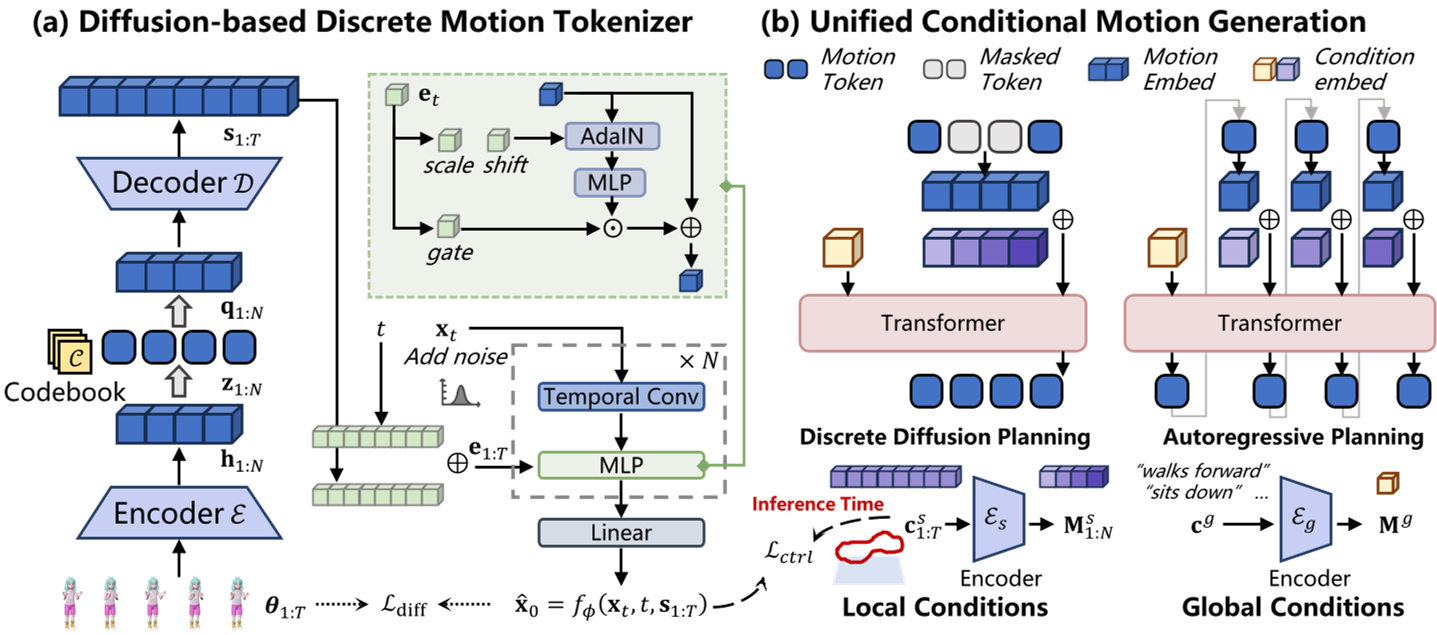
Coarse-to-Fine Condition Injection
One of the paper's most elegant designs is how it handles constraints. During Planning, trajectories act as "coarse hints" to help the model pick the right tokens. During Control (the denoising process), these same trajectories are enforced as "fine constraints" via gradient-based optimization. This prevents the "competing constraints" problem seen in prior works.
Experiments & Results: Breaking the Trade-off
The most striking result from the evaluation is that MoTok gets better as you give it more constraints.
In traditional models (like MaskControl), adding joint constraints usually hurts the FID (Fréchet Inception Distance) because the model struggles to balance reality with the coordinate requirements. MoTok flips this: its FID actually improves from 0.033 to 0.014 as more joints are controlled.
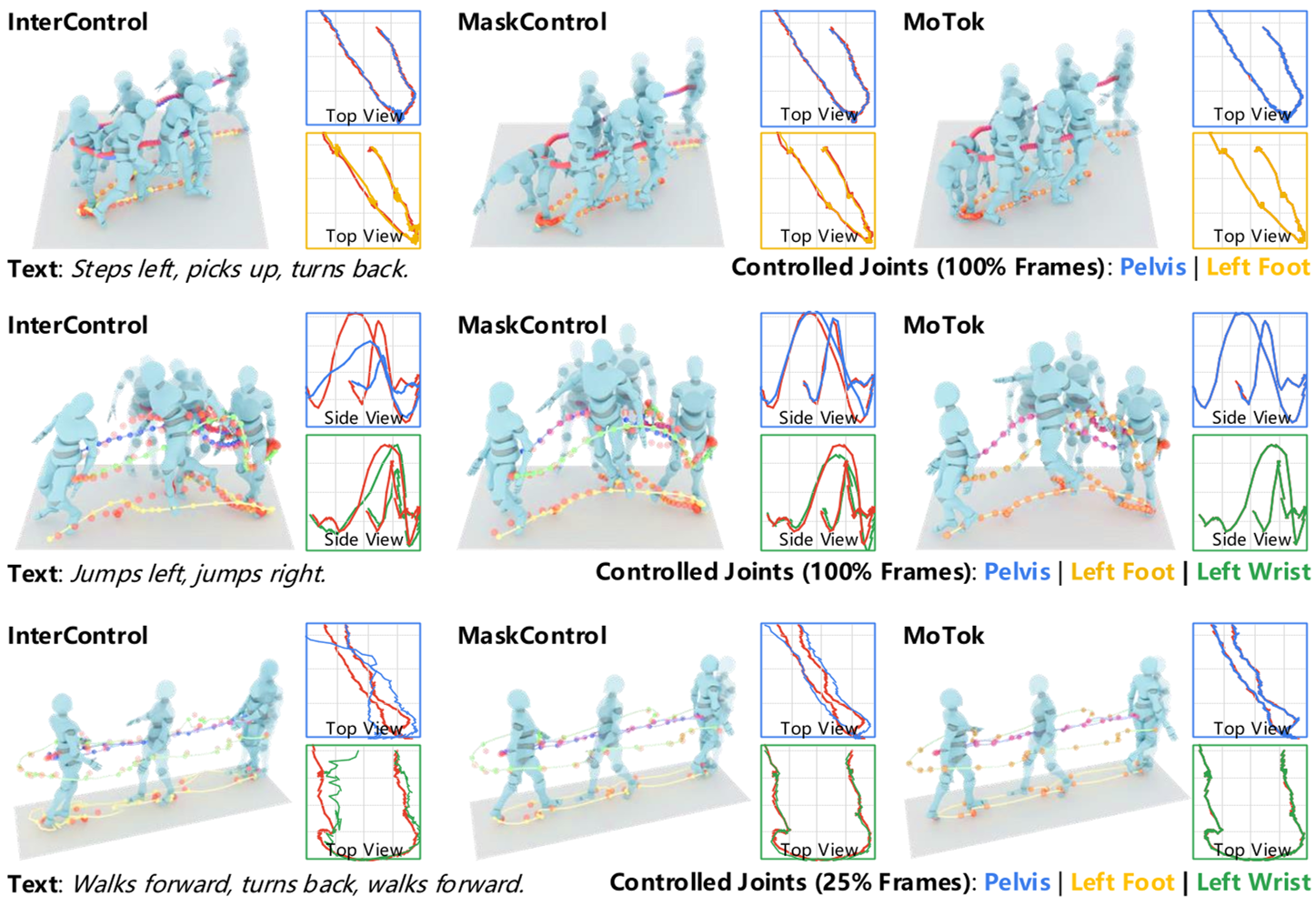
Quantitative SOTA
- Trajectory Error: Reduced from 0.72 cm to 0.08 cm.
- Fidelity: FID improved from 0.083 to 0.029.
- Efficiency: Achieved these results using only one-sixth of the token budget compared to competitive baselines.
Critical Analysis & Conclusion
Why it works
The diffusion decoder acts as a generative prior. Since it is trained to reconstruct motion from clean tokens, it implicitly "knows" what natural human movement looks like. When we inject trajectory constraints during denoising, the model isn't just "shifting coordinates"; it's finding the most natural motion manifold that satisfies those coordinates.
Takeaway
MoTok proves that the "Semantic vs. Kinematic" conflict is a design flaw, not a fundamental limit. By delegating reconstruction to a powerful diffusion head, we can use much smaller, more efficient LLM-style planners for motion.
Limitations & Future Work
While the inference speed is improved by spaced diffusion (Fast27), it still requires multiple denoising steps. Integrating Latent Consistency Models (LCM) or Flow Matching could potentially bring MoTok closer to real-time, single-step generation for interactive applications like gaming or VR.