
CAPO: Mastering Credit Assignment in Sequential AI Teams
CAPO: Counterfactual Credit Assignment in Sequential Cooperative Teams
CAPO (Counterfactual Advantage Policy Optimization) is a critic-free policy gradient algorithm designed for sequential cooperative multi-agent teams. It utilizes Sequential Aristocrat Utility (SeqAU) to maximize per-agent learnability by decomposing team rewards into individual contributions and accounting for downstream "indirect effects" through fictitious sampling.
TL;DR
Attributing success to individual agents in a sequential pipeline (like a chain of LLMs) is notoriously difficult. CAPO (Counterfactual Advantage Policy Optimization) introduces a critic-free framework that uses "fictitious sampling" and reward decomposition to assign credit accurately without the exponential variance of traditional methods or the high cost of environment replays.
Background: The Credit Assignment Crisis
In modern AI, we often see sequential cooperative teams: Agent A produces a draft, Agent B refines it, and Agent C critiques it. They receive a single reward at the end. How much did Agent A's initial choice actually contribute to the final score?
This is plagued by two issues:
- Opacity: Teammate noise drowns out the signal of a single agent's action.
- Sequential Drift: If we update Agent A, the data we previously collected for Agents B and C is now "off-policy" because they are reacting to a version of Agent A that no longer exists.
Methodology: The CAPO Formula
The researchers move away from the "black box" centralized critic. Instead, they leverage the Sequential Aristocrat Utility (SeqAU), which is proven to be the unique signal that maximizes "learnability."
1. Additive Reward Decomposition
Instead of learning a complex value function, CAPO fits an additive model using a simple, closed-form ridge regression. This allows for nearly instant per-agent attribution.
2. Upstream Cancellation
By using the autoregressive nature of the policy, CAPO mathematically proves that an agent's advantage shouldn't care about what happened before them. The "upstream" noise simply cancels out, leaving only:
- Direct Effect: How the agent's action changed their immediate portion of the reward.
- Indirect Effect: How the agent's action "pushed" downstream agents into different behaviors.
3. Fictitious Sampling (The Secret Sauce)
To calculate the Indirect Effect without calling the environment (which might be an expensive LLM call or a human rater), CAPO performs "imaginary" rollouts using only the current agent policies. This bypasses the need for high-variance Importance Sampling.
(Note: The algorithm flow involves a ridge solve followed by inner PPO updates using fictitious advantages)
Experimental Results: Scaling to Large Teams
The authors tested CAPO against major baselines like MA-GRPO (shared baseline) and HA-GRPO (importance sampling).
- Statistical Stability: CAPO’s error (MSE) stays flat as the number of agents grows. In contrast, HA-GRPO’s error explodes due to the "product of importance ratios" problem.
- Optimization Prowess: On a team of 10 agents, CAPO achieved a significantly lower regret than all other methods.
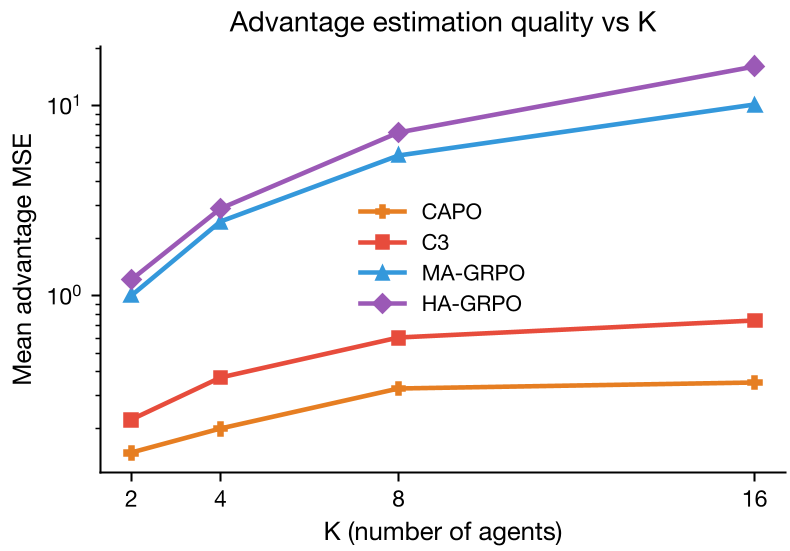 Figure 1: Comparison showing CAPO's MSE (Orange) staying low and stable across team sizes K, compared to the linear/exponential growth of baselines.
Critical Insights: When Does it Work?
An essential finding from the Ablation Study (Fig 3) shows that the "Indirect Effect" correction is only needed when agents are highly coupled (). If agents act independently, the direct effect is enough. However, in real-world pipelines (like a multi-step reasoning task), agents are always coupled, making CAPO's full machinery vital.
Limitations
- Additivity Assumption: If a reward is purely "multiplicative" (e.g., if any agent fails, the whole task gets a zero), the additive model might struggle, though the paper shows surprising robustness up to 50% non-additive variance.
- Bandit-centric: The current theory focuses on the "contextual bandit" setting. Extending this to long-horizon MDPs is the next frontier.
Conclusion
CAPO provides a mathematically grounded, computationally efficient bridge between simple shared-reward methods and complex centralized critics. For engineers building multi-LLM systems, it suggests that we can optimize individual steps in a chain more effectively by modeling their "counterfactual" impact on the steps that follow.