
Casimir-Induced Quintessence: Is Dark Energy a Shadow of the 5th Dimension?
Casimir-Induced Quintessence in Dark Dimension
Summary
Problem
Method
Results
Takeaways
Abstract
The paper explores a 5-dimensional "Dark Dimension" model where a sub-millimeter extra dimension generates dark energy via the Casimir effect of bulk fields. It demonstrates that a radion field, stabilized by specific bulk particle content (neutrinos, gauge bosons, and fermions), can act as a quintessence field that matches recent SOTA cosmological observations.
## TL;DR
Researchers have proposed a concrete realization of the **Dark Dimension** scenario, where the observed dark energy isn't a constant, but a dynamical "radion" field. By calculating the **Casimir energy** of bulk fields (including neutrinos and gauge bosons) in a 5D universe, they've created a model that not only explains why dark energy is so small but also fits the latest **DESI 2024** observations better than the standard $\Lambda$CDM model.
**Status**: SOTA Refinement / UV-Phenomenology Bridge.
## The Motivation: Escaping the Fine-Tuning Trap
The "Cosmological Constant Problem" is perhaps the greatest mismatch in physics—the observed vacuum energy is roughly $10^{120}$ times smaller than theoretical predictions. The **Dark Dimension** scenario (born from the Swampland Program) suggests a radical "Why": the smallness of dark energy is tied to a large extra dimension ($R \sim 1 \mu m$).
However, the "How" remained elusive. Previous minimal models failed because the quantum vacuum energy (Casimir energy) was negative, which would cause the universe to contract rather than accelerate. This paper seeks the "Goldilocks" particle content in the 5th dimension to flip the sign and flatten the potential.
## Methodology: Building the Radion Hilltop
The core of the paper lies in the dimensional reduction of a 5D Einstein-Hilbert action. The size of the extra dimension is represented by a scalar field called the **radion** ($\phi$).
### 1. Generating the Potential
The authors calculate the 1-loop Casimir energy for various bulk species. The total energy density $\rho_C$ is a sum of:
* **Bosons (Gravitrons/Gauge Bosons)**: Typically contribute negatively.
* **Fermions (Neutrinos/Extra species)**: Contribute positively when their masses are tuned.
### 2. The Einstein Frame Transformation
To analyze the cosmology, they move to the **Einstein Frame** via Weyl rescaling. This transforms the geometric size of the extra dimension into a canonical scalar field potential $V_{eff}(\phi)$.
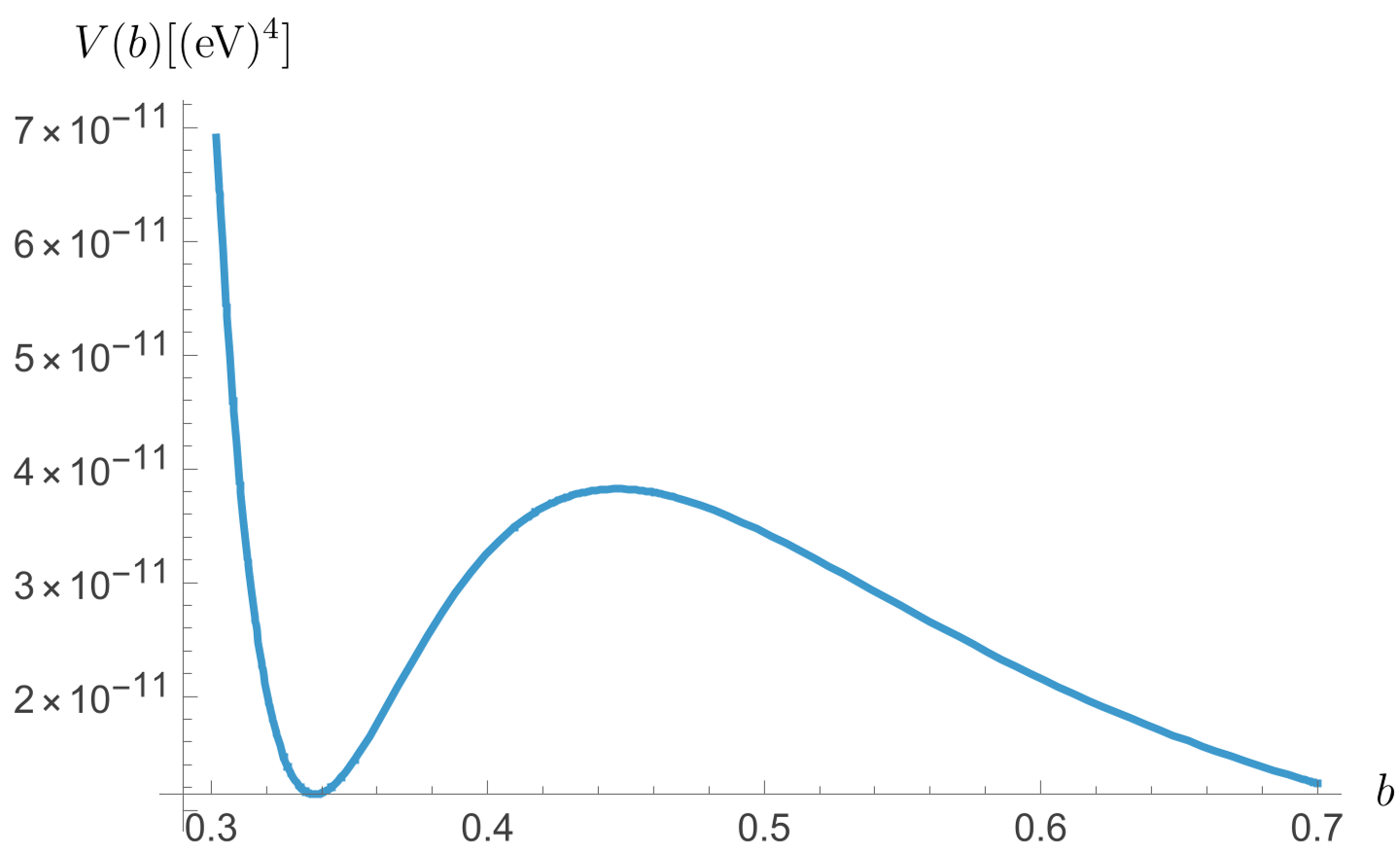
*Figure 1: The resulting "Hilltop" potential. The radion $\phi$ rolls slowly from the top, providing the "quintessence" needed for acceleration.*
## Experimental Results: Beating $\Lambda$CDM
The most striking part of this research is its alignment with the **Dark Energy Spectroscopic Instrument (DESI)** data.
### Phantom Crossing
Standard dark energy ($\Lambda$) has a constant equation-of-state $w = -1$. Recent DESI data hints at a dynamical $w$ that might even dip below $-1$ (the "phantom" regime). This model achieves **Phantom Crossing** naturally at redshift $z \sim 0.4$ due to the interaction between the radion and dark matter ($c \sim 0.005$).
### Statistical Fit
Using the Baryon Acoustic Oscillation (BAO) measurements ($D_H/r_d$ and $D_M/r_d$), the authors calculated the $\chi^2$ fitness:
* **$\Lambda$CDM**: $\chi^2 \approx 23.79$
* **Dark Dimension Model**: $\chi^2 \approx 19.97$
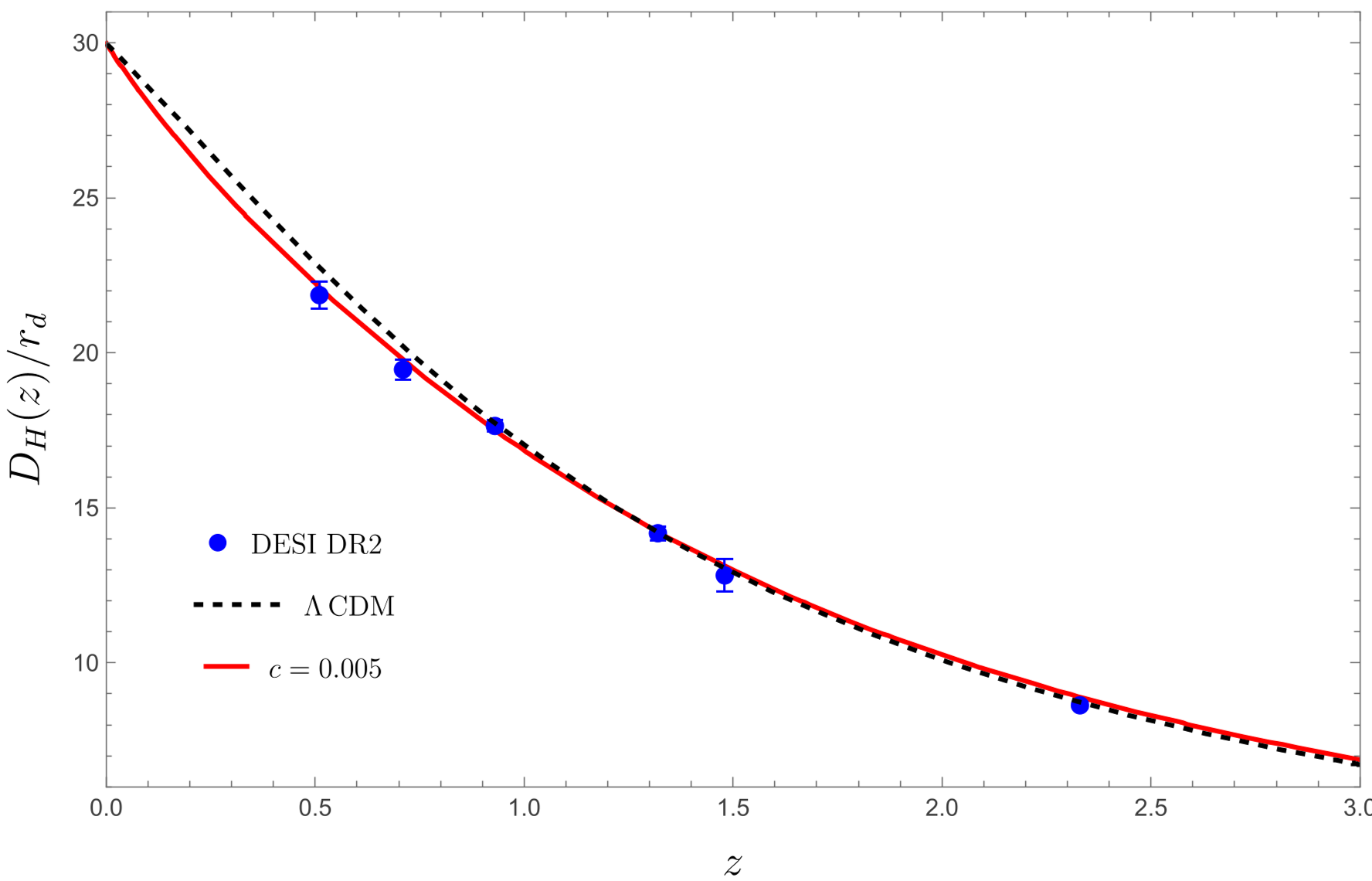
*Figure 2: The model (red line) tracks the DESI data points (blue) more accurately than the standard flat-line prediction of $\Lambda$CDM.*
## Critical Analysis & Conclusion
### Takeaway
The paper successfully transitions the Dark Dimension from a theoretical conjecture to a testable cosmological model. It proves that a micron-sized extra dimension with a fundamental scale of $M_5 \sim 10^9$ GeV is not just a mathematical curiosity but a viable candidate for our actual universe's architecture.
### Limitations
1. **Particle Guessing**: The "extra" bulk gauge bosons and fermions are added specifically to make the potential work. A more "natural" derivation from a specific String Theory compactification would be the next logical step.
2. **Fifth Force**: While the coupling $c$ is small, any interaction between the radion and matter must be carefully checked against local gravity tests (Inverse Square Law experiments).
**Future Outlook**: As DESI and future surveys (like Euclid) provide more precise data on the evolution of $w(z)$, this model will face its ultimate test. If $w$ continues to show dynamical behavior, the "Dark Dimension" might move from the fringes of string theory to the center of observational cosmology.