
Cited but Not Verified: The Illusion of Factuality in Deep Research Agents
Cited but Not Verified: Parsing and Evaluating Source Attribution in LLM Deep Research Agents
The paper introduces a novel source attribution evaluation framework for LLM deep research agents, utilizing a deterministic AST parser and an LLM-as-a-judge pipeline. It benchmarks 14 models, revealing that even frontier LLMs like GPT-4 reach high link validity (>94%) but fail significantly in factual accuracy (39–77%).
TL;DR
As LLMs transition from simple chatbots to "Deep Research Agents" that browse hundreds of websites, a dangerous gap has emerged. We trust them because they provide citations, but are those citations actually true? This paper from PwC’s Innovation Office reveals a sobering reality: while AI-generated research reports look professional and include working links (94%+ validity), the actual factual claims are unsupported up to 60% of the time. Shockingly, the more the AI "searches," the worse its accuracy becomes.
The "Veneer of Verifiability"
We have entered the era of the Deep Research Agent. Whether it's Perplexity AI, OpenAI's Operator, or Google Gemini, these systems promise to do the heavy lifting of gathering sources and synthesizing reports.
However, the authors argue that we are suffering from a "veneer of verifiability." Traditional RAG (Retrieval-Augmented Generation) evaluations are often too shallow—they check if a document was retrieved, but not if the specific sentence attributed to it is actually supported by the text. This paper moves the goalposts from simple attribution to Multidimensional Verification.
Methodology: Closing the Loop
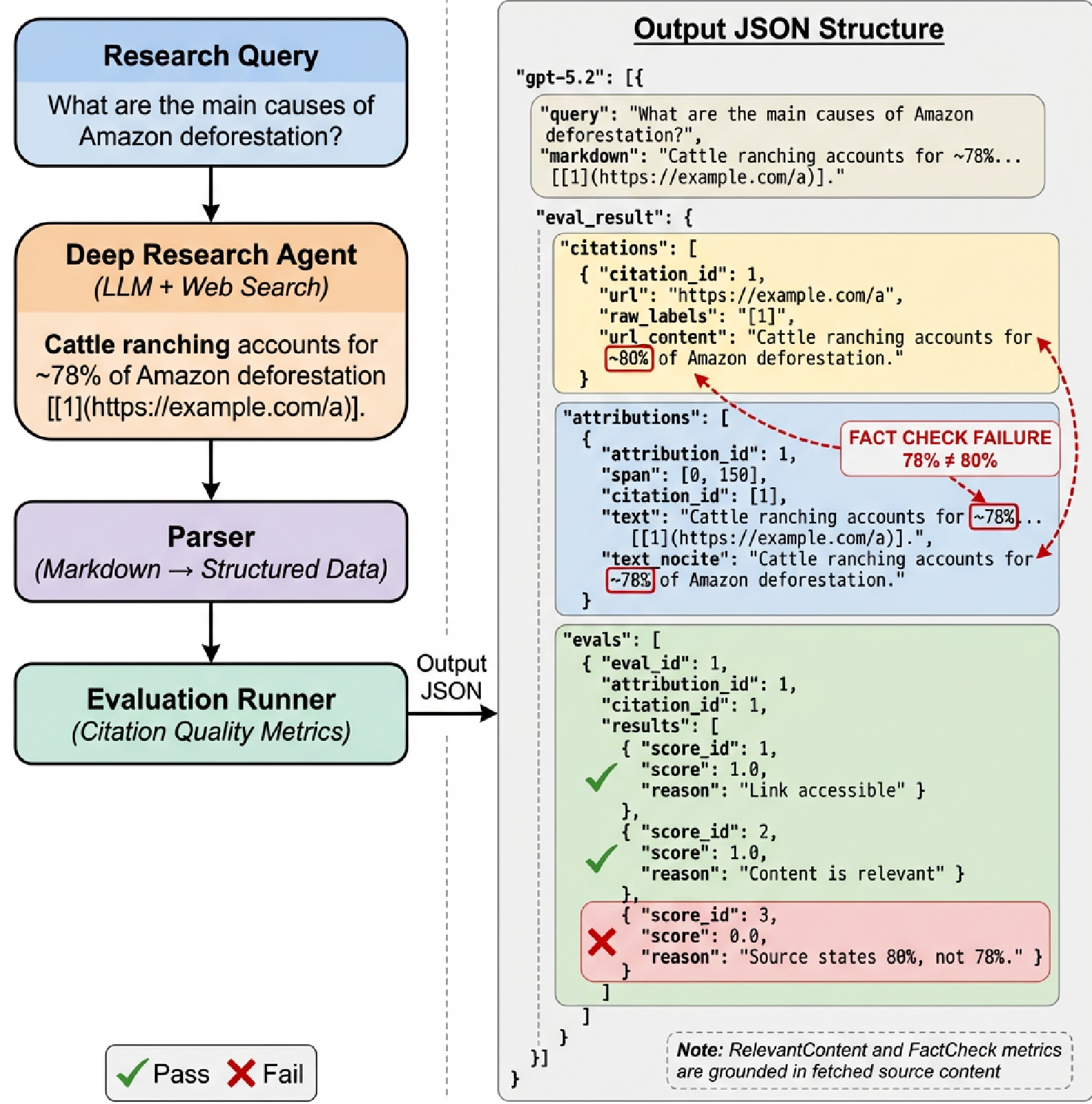
The researchers built an end-to-end evaluation pipeline that doesn't just ask an LLM "is this right?" but actually reconstructs the evidence chain:
- Strict Extraction: Using a Markdown AST (Abstract Syntax Tree) parser, the framework extracts citations deterministically. This avoids the "self-report bias" where an LLM might claim it cited something correctly when it didn't.
- Live Web Retrieval: The system actually visits the cited URLs to see if they are live, paywalled, or redirected.
- The 3-Tier Rubric:
- Link Works: Is the URL dead?
- Relevant Content: Is the page actually about the topic?
- Fact Check: Does the source explicitly support the claim?
Key Finding: The Information Overload Paradox
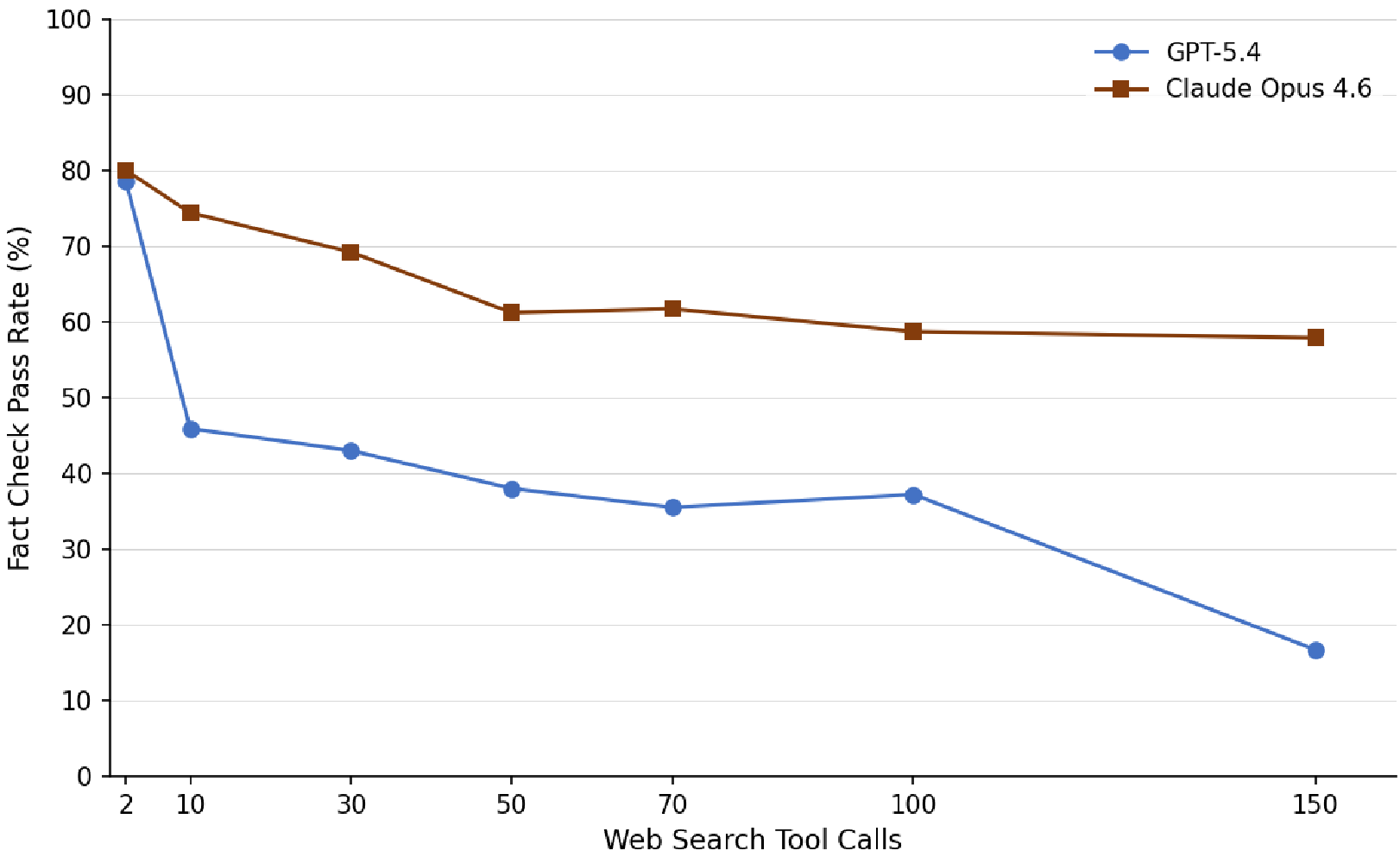
The most counter-intuitive finding of this research is the Information Overload Effect. Common sense suggests that an agent that makes 150 tool calls (searching more sites) should be more accurate than one that makes only 2.
The data proves the opposite. As the search depth increases, Fact Check accuracy drops by approximately 42%.
- The Intuition: When an LLM is flooded with hundreds of snippets of information, its "attention" is diluted. It begins to conflate facts from different sources, leading to a high rate of misattribution even though the links it provides are topically relevant.
Benchmarking the Titans
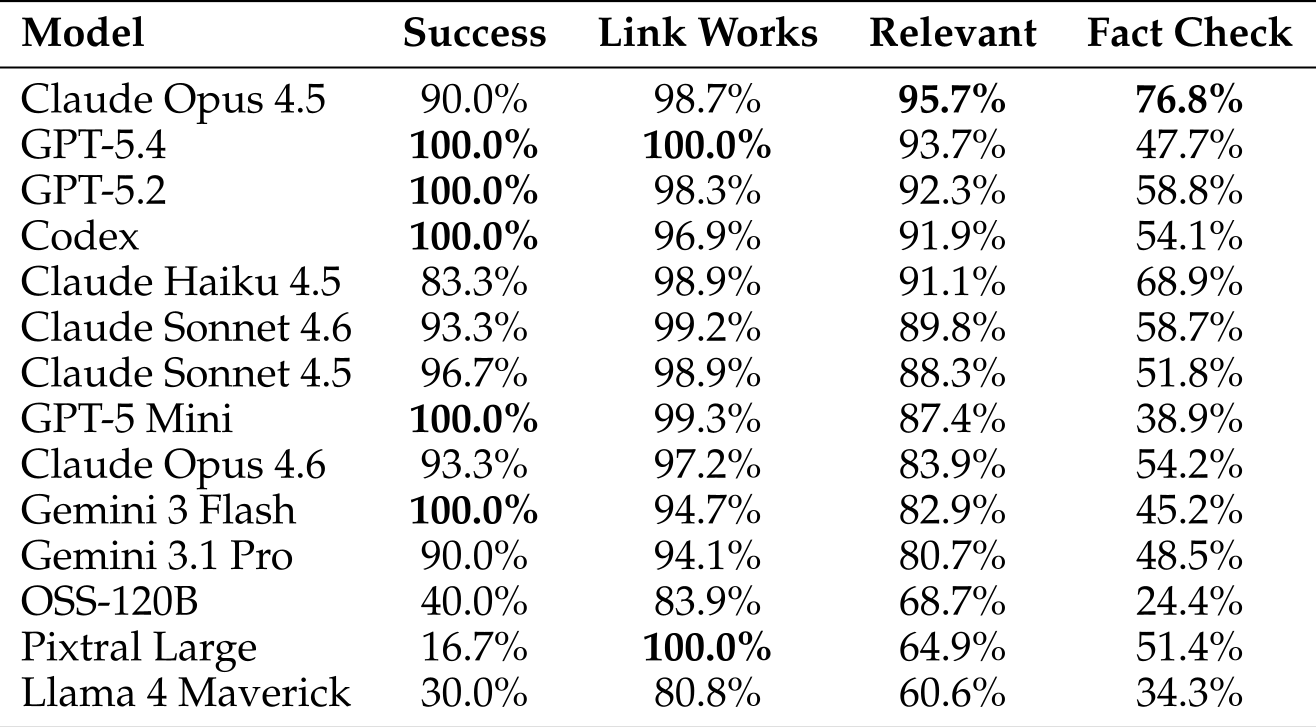
The paper benchmarks 14 models, including the latest from OpenAI, Anthropic, and Google:
- Anthropic's Claude Opus 4.5 emerged as the leader in factual integrity (77% accuracy), likely due to a more conservative citation strategy.
- OpenAI models (GPT-5 series) generated the most citations but suffered from lower accuracy (39-59%), suggesting a "quantity over quality" trade-off.
- Open Source models (Llama 4, OSS-120B) struggled significantly, with success rates below 40% in even generating a cited report in a one-shot environment.
Critical Insight: Why This Matters for the Industry
This paper serves as a vital warning for enterprise AI adoption. In fields like legal, medical, or financial research, a 50% "Fact Check" failure rate is catastrophic.
The takeaway for developers is clear: Retrieval is not a silver bullet for hallucinations. Simply connecting an LLM to the web doesn't make it a researcher. We need better "Synthesis Layers" that can handle high-volume information without losing the thread of factual truth. Future agents must move away from "Extensive Search" and toward "Iterative Verification."
Conclusion
The "Cited but Not Verified" framework provides the necessary infrastructure to hold AI agents accountable. As we move toward more autonomous research systems, the ability to deterministically parse and fact-check every claim against its live source will be the difference between a transformative tool and a high-speed hallucination engine.