
CKT-WAM: Bridging the Gap Between Heterogeneous World Action Models via Compact Contexts
CKT-WAM: Parameter-Efficient Context Knowledge Transfer Between World Action Models
CKT-WAM is a parameter-efficient framework for Context Knowledge Transfer between heterogeneous World Action Models (WAMs). It introduces a compact context interface using learnable-query cross-attention (LQCA) and sparse adapters, achieving an 86.1% success rate on LIBERO-Plus with only 1.17% trainable parameters.
TL;DR
CKT-WAM (Context Knowledge Transfer for World Action Models) solves the efficiency and compatibility issues of transferring robotic intelligence between different generative models. By compressing a large "Teacher" WAM's internal thoughts into a few "Context Tokens," it upgrades a lightweight "Student" model with only 1.17% extra parameters. It achieves SOTA zero-shot results (86.1% on LIBERO-Plus) and masters complex, multi-stage tasks in the real world.
Problem & Motivation: The Heterogeneity Hurdle
World Action Models (WAMs) are the new frontier of robotics, allowing agents to "imagine" the future before they act. However, we face a dilemma: high-performance WAMs are too slow for real-time hardware, while small WAMs lack the "physical intuition" of their larger counterparts.
Traditional knowledge transfer methods fail here:
- Logit Distillation is brittle because different models "talk" in different latent languages.
- Feature Matching is too rigid, forcing the student to mimic the teacher's internal structure layer-by-layer.
- Full Fine-tuning is computationally ruinous for many researchers and practitioners.
The authors' Insight: Knowledge doesn't need to be forced; it can be provided as context. If the teacher can summarize its understanding into a compact format that the student can "read" through its existing instruction-following pathway, we achieve transfer without rebuilding the student.
Methodology: The CKT Architecture
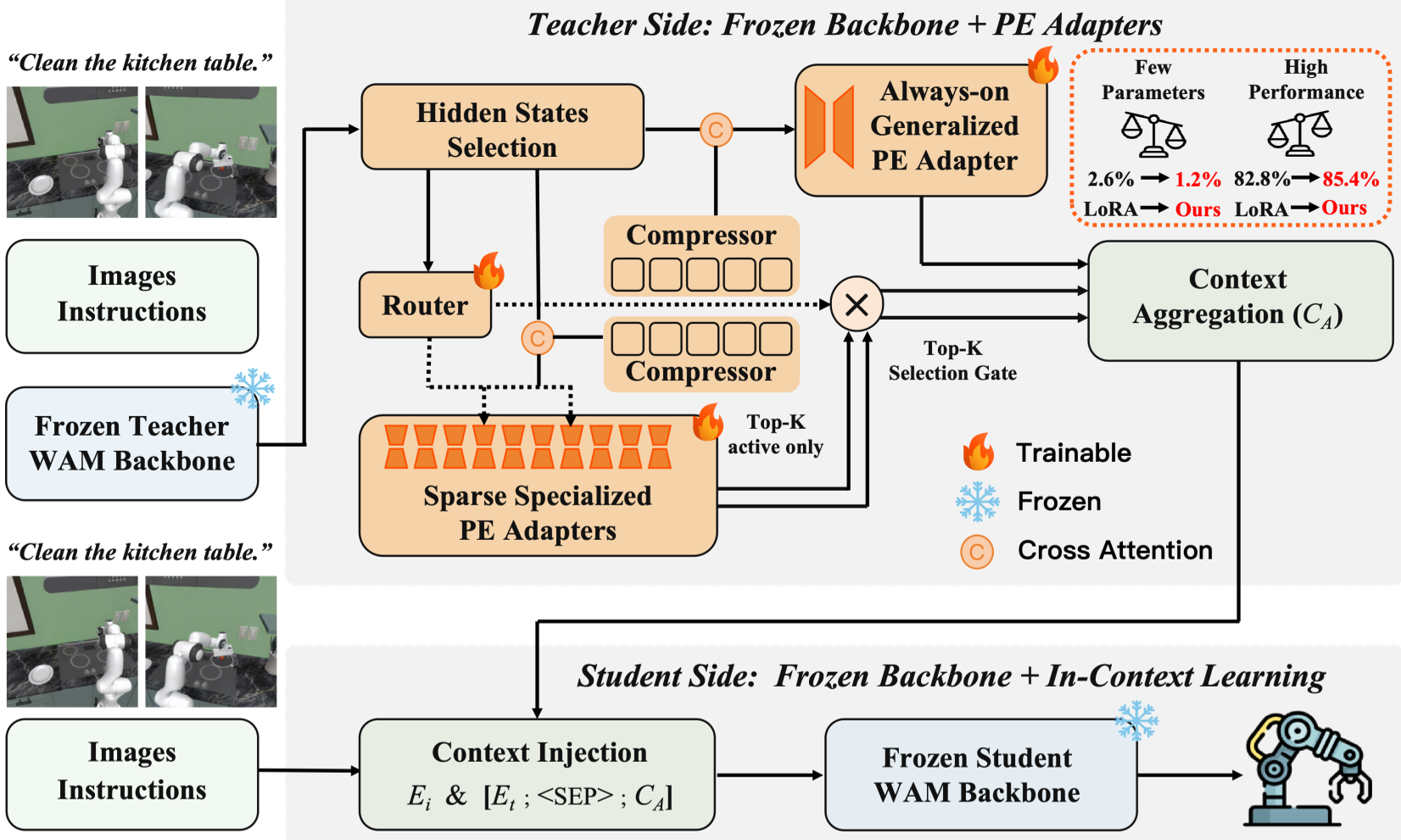
The CKT-WAM framework consists of a clever pipeline that treats the teacher as a "single-pass encoder" and the student as a "flexible consumer."
1. The Compression Bottleneck (LQCA)
Instead of passing thousands of tokens from the teacher, CKT-WAM uses Learnable-Query Cross-Attention (LQCA). It acts like a technical summary, condensing the teacher's dense intermediate states into a fixed set of 32 or 64 highly informative tokens.
2. Generalization vs. Specialization
The model employs a two-pronged adapter strategy:
- Generalized Adapter: An always-on branch that handles common robotic physics.
- Routed Specialized Adapters: A Sparse Mixture-of-Experts (MoE) setup. A router picks the best "expert" adapter for the specific task (e.g., "folding" vs. "picking") on the fly.
3. Context Injection
The resulting tokens are simply appended to the student's text prompt embeddings. Because Transformer-based students are designed to attend to their context, they naturally integrate this "teacher's advice" into their action generation without requiring any changes to the core denoising backbone.
Experiments & Results: Performance at a Fraction of the Cost
SOTA Zero-Shot Generalization
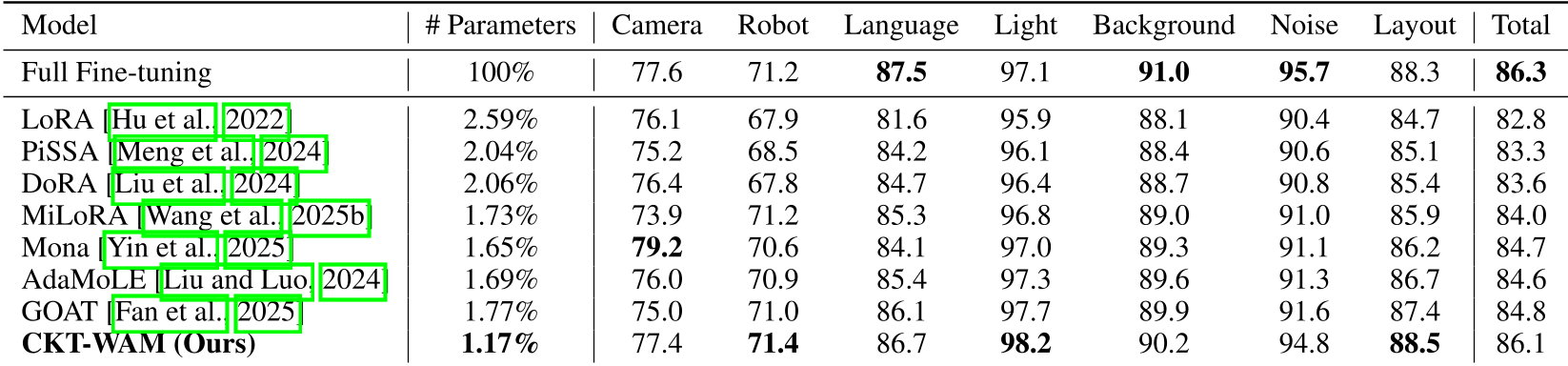
In the LIBERO-Plus benchmark—which tests a robot's ability to handle new cameras, lighting, and layouts—CKT-WAM reached a 86.1% success rate. This isn't just a marginal gain; it significantly beats standard PEFT methods like LoRA and approaches the performance of full fine-tuning.
Real-World Long-Horizon Tasks
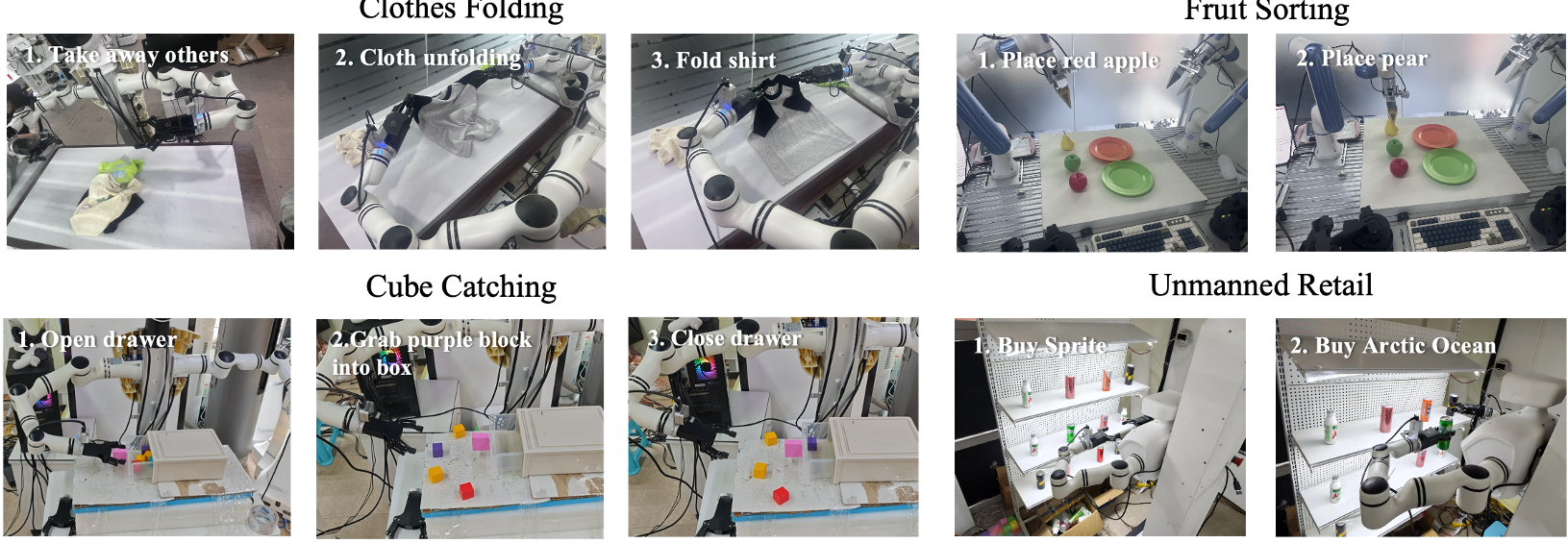
The framework was tested on four grueling real-world tasks, including Clothes Folding (3 stages: clear area, unfold, fold). CKT-WAM achieved a 83.3% average success rate, proving that provide-as-context transfer helps the student maintain focus over long operating horizons.
Efficiency Trade-off
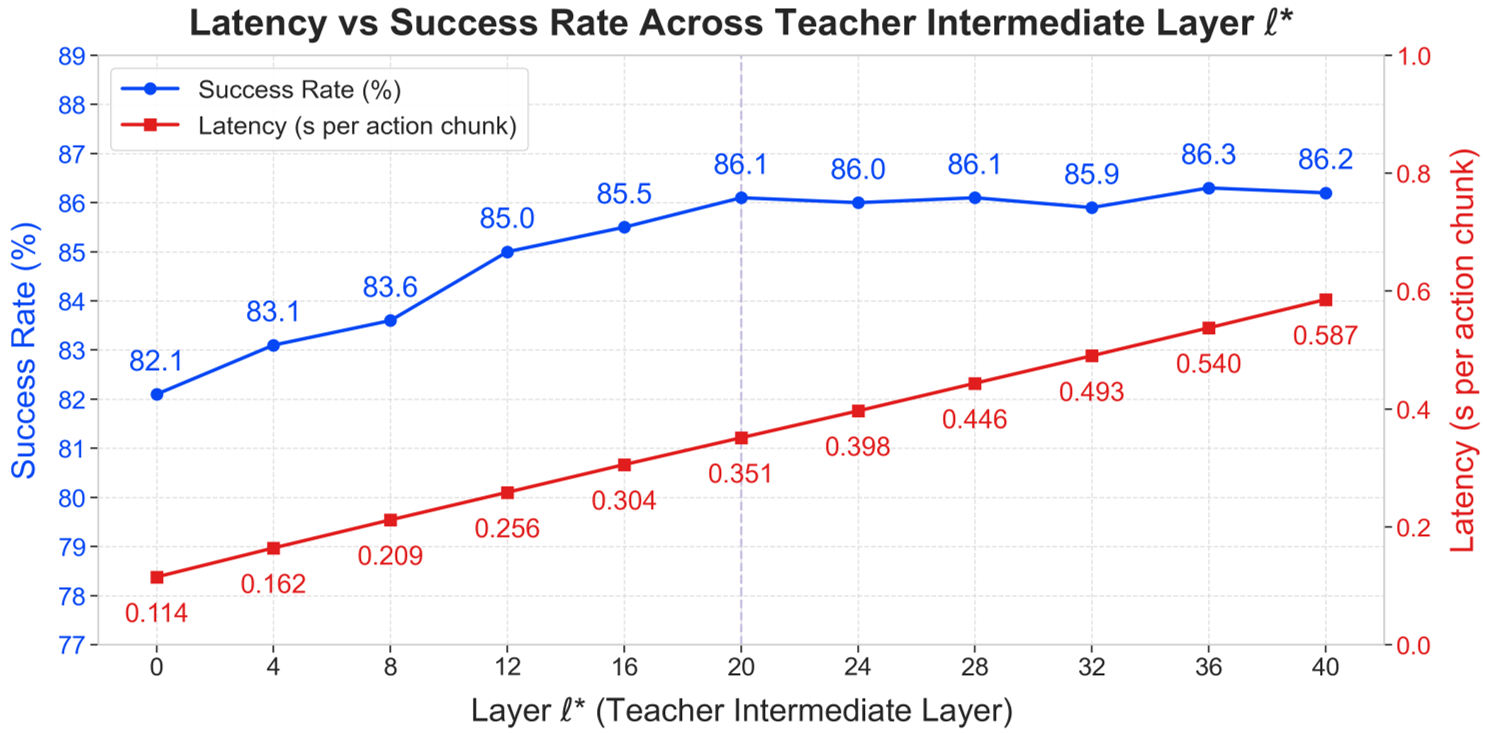
An ablation study on the teacher's layer depth (Figure 2) shows that extracting features from the middle layers (e.g., layer 20 of 40) provides the best balance between rich semantic knowledge and inference latency.
Critical Analysis & Conclusion
CKT-WAM is a masterclass in Minimalist Engineering. Instead of fighting architectural differences, it leverages the inherent flexibility of Transformer cross-attention.
Key Takeaways:
- Sparsity is Key: Sparse MoE adapters allow the model to handle diverse tasks without exploding the parameter count.
- Context is King: Treating "distillation" as "contextual prompting" is a path toward more modular AI systems.
Limitations: The study focuses strictly on WAM-to-WAM transfer. Future work should explore if this "Contextual Injection" works for non-robotic tasks, such as transferring knowledge from a 405B LLM to a 7B LLM without full weight alignment.
In conclusion, CKT-WAM provides a robust, low-cost recipe for scaling robotic intelligence, moving us closer to real-time, high-intuition embodied agents.