
ClawEnvKit: Escaping the Manual Bottleneck of Agent Evaluation
ClawEnvKit: Automatic Environment Generation for Claw-Like Agents
ClawEnvKit is an automated pipeline that generates diverse, verified environments for training and evaluating "claw-like" (CLI/API-driven) agents from natural language. It enables the creation of Auto-ClawEval, a large-scale benchmark of 1,040 environments across 24 categories, achieving 13,800x cost reduction compared to human curation.
TL;DR
The industry is moving from passive LLMs to autonomous "claw-like" agents that interact with APIs and file systems. However, we've been testing 2026-era agents with 2023-era manual benchmarks. ClawEnvKit changes this by automating the generation of verified, sandboxed environments from natural language, slashing costs by 13,800x while maintaining human-level quality.
The Scalability Crisis in Agentic AI
Modern agents (like OpenClaw or Claude Code) are evaluated on their ability to manage emails, fix code, or coordinate calendars. Until now, creating these test cases required hundreds of person-hours to write instructions, set up mock databases, and code specific graders.
The authors identify a critical "Asymmetry of Complexity": while the state space for an agent is effectively infinite (natural language), the implementation of the environment is finite. By focusing on Declarative Specification (P: What, M: Tools, C: Evaluation), the researchers proved that we can use LLMs to build the very labs they are tested in.
Methodology: The Three-Agent Pipeline
ClawEnvKit doesn't just "write a prompt"; it builds a world. The architecture is a multi-agent system designed to ensure that generated environments are actually solvable and meaningful.
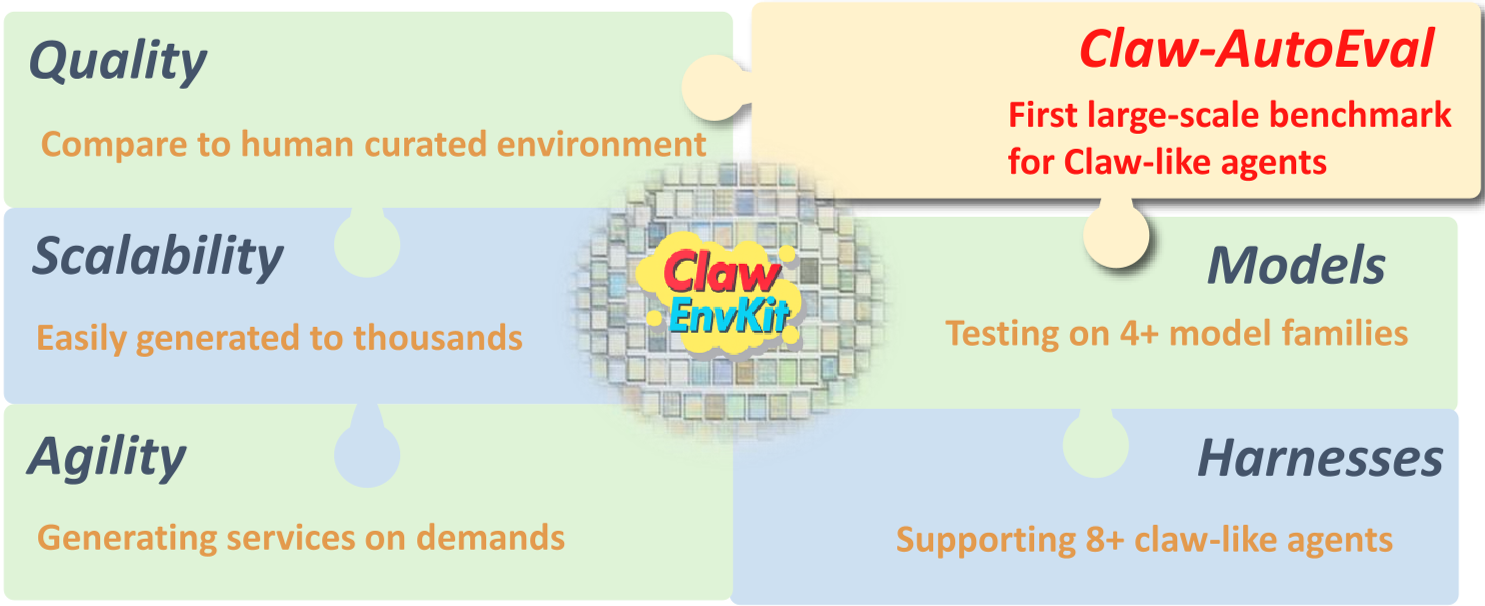
- The Parser: Dissects a user's request (e.g., "Test if the agent can handle urgent emails") into structured "intent units."
- The Generator: Creates the
task.yaml, pre-loads mock databases (Fixtures), and defines tools. If a service doesn't exist (like a specific CRM), it hallucinates and then builds a functioning FastAPI mock server for it. - The Validator: The "Internal Auditor" that checks if the task is a paradox (e.g., asking the agent to read an email that hasn't been created yet) and ensures scoring weights sum to 100%.
Evaluating the Evaluator: Auto-ClawEval
The researchers used ClawEnvKit to build Auto-ClawEval, a massive benchmark of over 1,000 tasks. They compared it against Claw-Eval (manual) and found that the AI-generated tasks were actually clearer and more coherent.
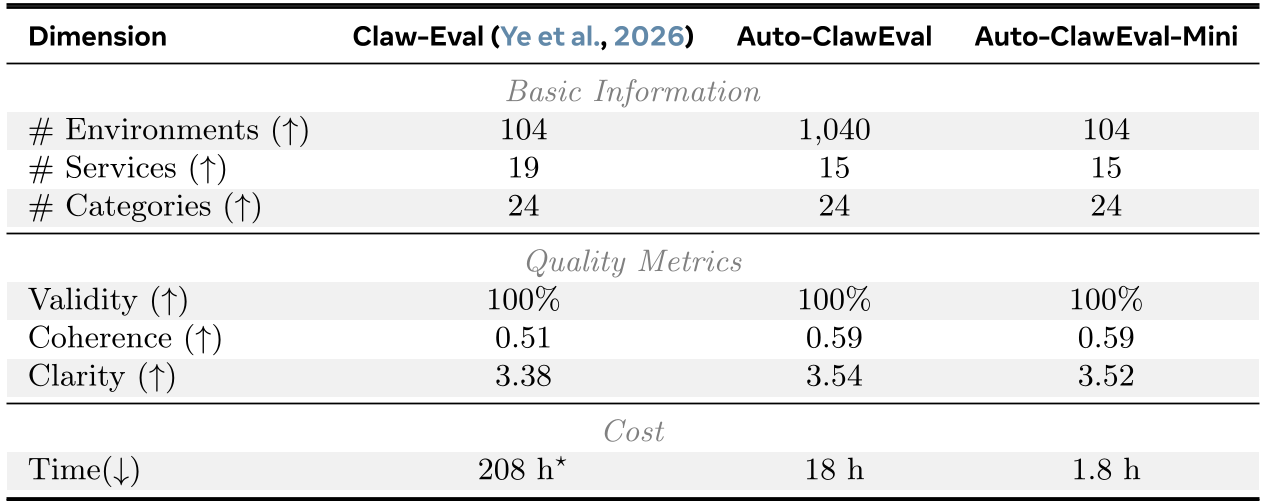
Key Experimental Insights:
- Harness Engineering Matters: Simply changing the "harness" (how the tool is presented to the agent, e.g., via MCP or SKILL.md) can swing performance by nearly 16%.
- The "Headroom" Effect: Even "Frontier" models like GPT-5-class systems are only solving ~50–70% of these tasks, proving that the benchmark is challenging enough for the next generation of AI.
- Safety Gates: By using server-side audit logs, ClawEnvKit ensures agents can't "lie" about what they did—they are graded on their actual API calls, not just their text responses.
Why This Matters: "Live" Evaluation
The most profound contribution isn't just a bigger benchmark—it's Live Evaluation. Because generation is cheap and automated, we can stop worrying about "benchmark leakage." If a model memorizes a test set, we simply generate a new one.
Users can describe a unique edge case in English, and ClawEnvKit will spin up a verified sandbox on demand. This shifts AI evaluation from a "static exam" to a "dynamic simulation," allowing environments to co-evolve with the agents living within them.
Critical Analysis & Future Outlook
While the use of mock services (FastAPI-based simulations) provides 100% safety and determinism, it misses some "real-world messiness" like OAuth authentication or unexpected API schema drift. Future versions will likely need to bridge this gap by grounding mock services in real OpenAPI specifications.
Takeaway: ClawEnvKit effectively kills the "manual curation" bottleneck. For the first time, our ability to evaluate agents can scale at the same exponential rate as the agents themselves.