
[SIGIR 2025 Prediction] ColBERT-Att: Why Explicit Attention is the Missing Link in Late Interaction
ColBERT-Att: Late-Interaction Meets Attention for Enhanced Retrieval
The paper introduces ColBERT-Att, an enhancement to the Late-Interaction retrieval framework that explicitly integrates query and document attention weights into the relevance score calculation. By weighting token similarities based on their contextual importance, it achieves superior retrieval accuracy, reaching SOTA-level performance on MS-MARCO, BEIR, and LoTTE benchmarks.
TL;DR
ColBERT-Att evolves the famous Late-Interaction paradigm by making a crucial observation: not all token matches are created equal. By explicitly integrating attention weights into the scoring function (), the authors provide a mechanism to "mask" unimportant matches and amplify critical semantic overlaps. The result is a more precise retriever that outperforms ColBERTv2 on several key benchmarks (MS-MARCO, BEIR, LoTTE) with zero additional inference cost.
Background: The Limits of Vanilla MaxSim
Since its inception, ColBERT has dominated the retrieval landscape through its "Late Interaction" mechanism, which computes the maximum similarity between query tokens and document tokens. However, the standard MaxSim operator is "importance-blind."
Consider a query: "Who is going to study?". In a standard model, the phrase "is going to" might match a document perfectly, generating a high similarity score. But semantically, those words are "noise" compared to the core intent: "study". Previous models relied on the embedding vector itself to pack this importance, but ColBERT-Att proves that explicitly using the attention weights generated during the encoding process provides a much cleaner signal for relevance.
Methodology: High-Fidelity Relevance Scoring
The core innovation lies in the reformulated scoring function. Instead of a simple sum of maximum similarities, ColBERT-Att introduces attention-based modulation:

Why This Works (The Intuition)
- Exponential Amplification: By taking the exponent of attention weights (), the model accentuates the gap between "heavyweight" tokens (nouns/verbs) and "lightweight" tokens (stop words).
- Attention Weight Regularizer (): Attention weights are sensitive to sequence length. A token in a 10-word sentence naturally has a higher weight than in a 500-word document. The authors introduce to normalize these values, preventing length bias from ruining the cross-domain performance.
- Compute-Free Gains: Since attention weights are a byproduct of the BERT/Transformer forward pass, they are "free" at inference time—making this a rare "free lunch" in architectural optimization.
Empirical Evidence: Breaking the SOTA
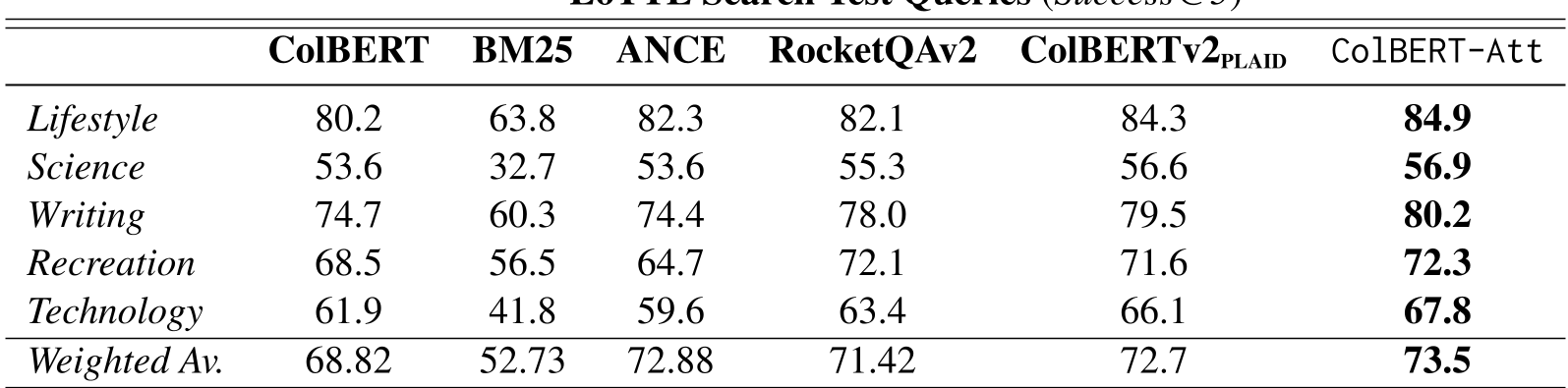
The researchers evaluated ColBERT-Att across three major benchmarks, revealing its strength in both in-domain and zero-shot (out-of-domain) settings.
Performance on LoTTE (Search/Forum)
The LoTTE dataset focuses on "long-tail" topics where keyword matching often fails. ColBERT-Att consistently beat the baseline ColBERTv2PLAID across all five categories (Lifestyle, Science, Writing, Recreation, Technology), showing a weighted average improvement of approximately 1%.
Ablation Study: The Power of Both Sides
An interesting finding from the ablation study is that the model performs best when both query and document attention weights are used. This suggests that the "importance" of a match is a mutual property—a query term must be important to the user's intent, and the document term must be important to the passage's context.
Critical Analysis & Future Outlook
While ColBERT-Att demonstrates clear gains, it currently relies on the ColBERTv2PLAID implementation. The authors suggest that integrating this objective into ModernColBERT (which uses newer techniques like Rotary Positional Embeddings/RoPE) could push the boundaries of neural retrieval even further.
Limitations: The model requires the storage of attention weights alongside token embeddings in the index. While this adds a small storage overhead, the retrieval accuracy improvement—especially on difficult tasks like ArguAna (+2.2%)—makes it a compelling trade-off for production-grade RAG systems.
Conclusion: A New Standard for Late Interaction
ColBERT-Att proves that we haven't yet exhausted the potential of Transformer-based retrievers. By simply "listening" to what the model's own attention mechanism says is important, we can achieve more human-like relevance ranking without the need for massive parameter increases or slower inference.