Colorful-Noise: Steering Diffusion via Low-Frequency Noise Manipulation
Colorful-Noise: Training-Free Low-Frequency Noise Manipulation for Color-Based Conditional Image Generation
Colorful-Noise introduces a training-free, lightweight method to control color and global structure in Diffusion models (SDXL, Flux) by manipulating the low-frequency components of the initial white Gaussian noise. By injecting structured color priors into specific latent frequency bands, it achieves precise chromatic and structural guidance without auxiliary networks or optimization.
TL;DR
Colorful-Noise is a breakthrough "training-free" technique that allows users to control the color scheme and global layout of generated images by simply modifying the initial noise latent. By injecting low-frequency information from a sketch or photo into the Gaussian noise starting point, the model "inherits" the color and structure while remaining free to generate high-frequency textures via text prompts.
Background: The Hidden Structure of "Random" Noise
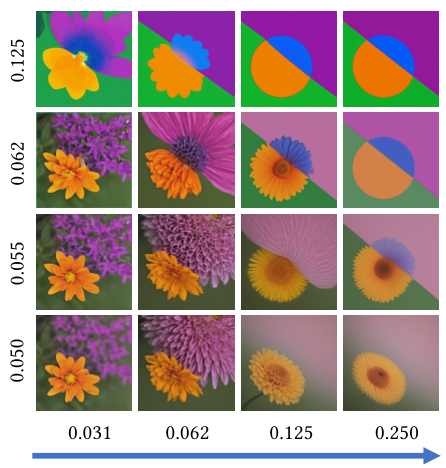
In the world of Latent Diffusion Models (LDM), we usually view the starting point—White Gaussian Noise—as a blank, information-free canvas. However, this paper challenges that notion. Through spectral analysis, the authors prove that even before the first denoising step, the low-frequency components of that "random" noise already contain the "DNA" of the final image's global structure and color distribution.
Prior works typically try to control output via ControlNet (adding side-networks) or Attention Manipulation (editing intermediate layers). While effective, these are computationally heavy or "late-stage" interventions. Colorful-Noise operates at "Step 0."
The Core Insight: Frequency-Selective Injection
The researchers observed a clear correspondence between latent frequency bands and semantic properties:
- Low Frequencies: Global structure, color composition, and spatial layout.
- High Frequencies: Fine details, textures, and sharp edges.
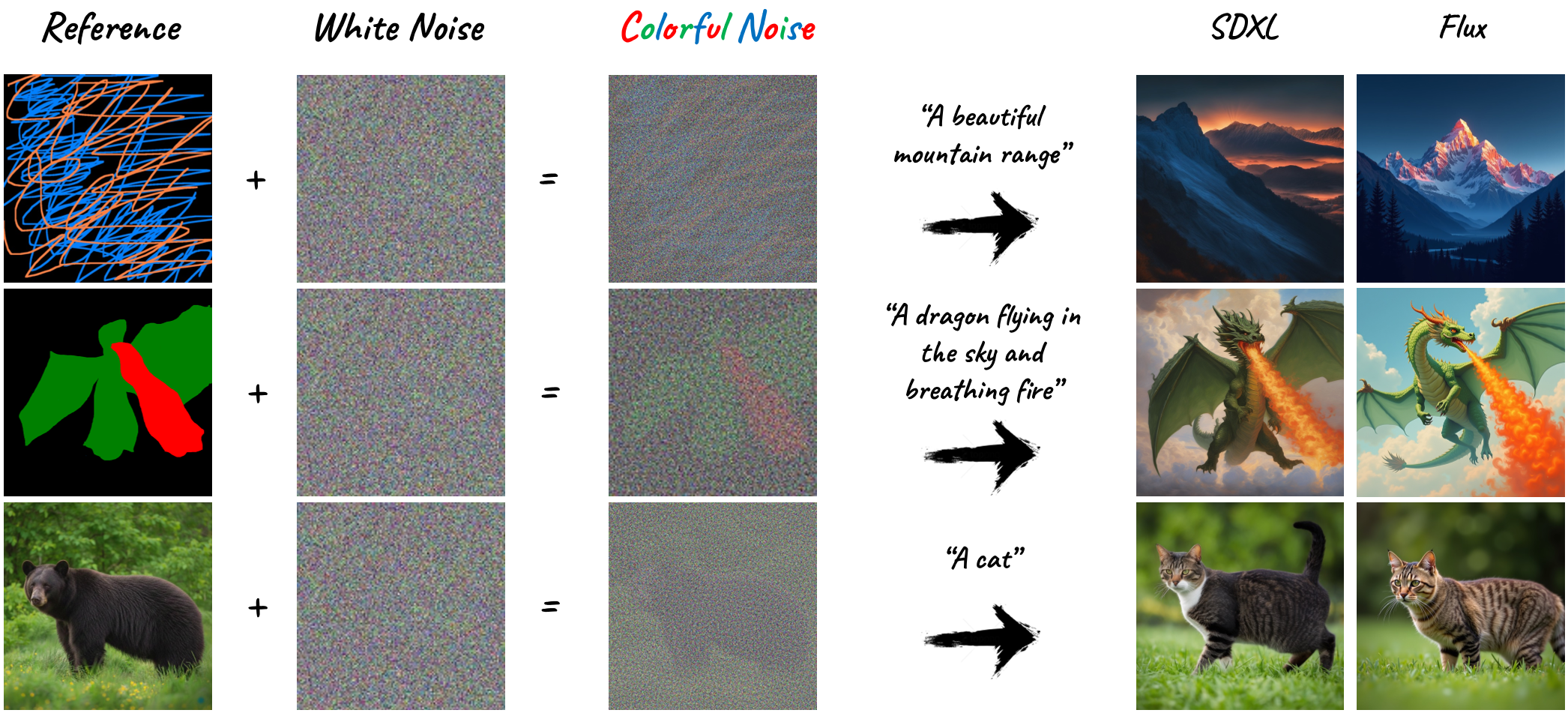
By applying a Fast Fourier Transform (FFT) to the initial noise , one can surgically remove the "random" low frequencies and replace them with the low-frequency components of a conditioning image (like a colorful doodle or a reference photo).
The Math of "Colorful" Noise
The methodology revolves around two hyper-parameters:
- (Cutoff): Determines how much of the spectrum is considered "low frequency."
- (Scaling): Controls the energy of the injected signal to prevent "distributional shift" (which would result in blurry or artifacts-ridden images).
The new latent is formed by:
This process creates a biased noise latent that looks like standard noise to a human but guides the Unet/Transformer toward a specific color palette.
Experimental Results: Precision without Training
The authors tested the method on SDXL and the flow-based Flux-dev1.0.
1. Sketch-to-Image
Even with crude, hand-drawn scribbles, Colorful-Noise forces the model to respect the color boundaries. Because the high frequencies remain "white noise," the model can still generate realistic textures and details that weren't in the sketch.
2. SOTA Comparisons
In the "Colorfield-to-Image" task, Colorful-Noise outperformed existing zero-shot methods in maintaining text alignment (CLIPScore) while significantly beating standard SDXL in local color consistency (Localized-EMD).
| Method | CLIPScore (↑) | Localized EMD (↓) |
|---|---|---|
| SDXL (Vanilla) | 34.84 | 20.08 |
| T2I-Adapter | 33.68 | 14.14 |
| Ours (Colorful-Noise) | 33.68 | 8.84 |
Critical Analysis & Applications
The beauty of this method lies in its compositionality. Because it only touches the initial noise, you can stack it with other tools:
- ControlNet + Colorful-Noise: Use ControlNet for edge detection (high frequency) and Colorful-Noise for color palette (low frequency).
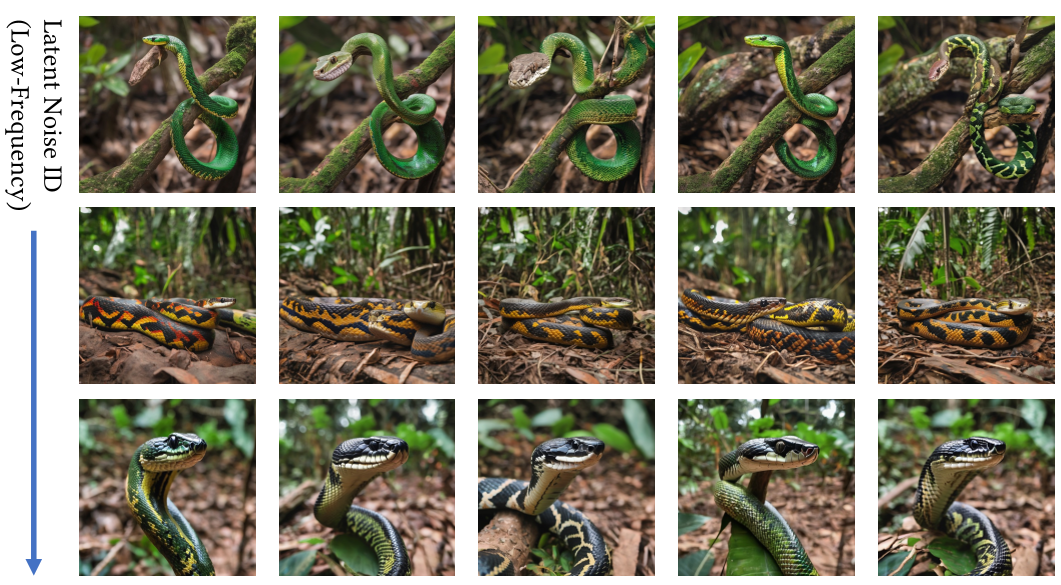
- Hierarchical Exploration: Fix the low-frequency noise (keep the layout) and randomize the high-frequency part to "re-roll" the textures of the same scene.
Limitations
- Parameter Sensitive: and often need manual tuning based on the input image's detail level.
- Resolution Constraints: Since manipulation happens in latent space (where 1024px becomes 128px), fine-grained masks are often blurred/downsampled.
Conclusion
Colorful-Noise proves that we don't always need complex neural adapters to control Diffusion models. Sometimes, a simple understanding of signal processing and the frequency domain is enough to unlock powerful, overhead-free creative controls.