
From Tools to Muscle Memory: The Rise of Agent Skill Ecosystems
A Comprehensive Survey on Agent Skills: Taxonomy, Techniques, and Applications
This paper provides the first comprehensive survey of "Agent Skills," defining them as reusable procedural artifacts that bridge the gap between high-level reasoning and low-level tool execution in LLM-based agents. It introduces a systematic lifecycle framework—covering representation, acquisition, retrieval, and evolution—positioning skills as the "muscle memory" essential for scalable, robust, and autonomous agent ecosystems.
TL;DR
Large Language Model (LLM) agents are evolving from passive text generators to proactive "action engines." However, even the most powerful models struggle with the procedural gap—the inability to reliably orchestrate tools over long tasks. This survey introduces Agent Skills: reusable, externalized "how-to" procedures that allow agents to bypass redundant reasoning and execute complex workflows with the precision of "muscle memory."
The "Procedural Gap": Why Reasoning Isn't Enough
In the early days of AI agents (circa 2023-2024), we focused on Tool Augmentation. Give an LLM an API, and it will figure it out, right? Wrong.
The "procedural gap" refers to the fact that knowing a tool exists is not the same as knowing how to use it safely and efficiently in context. Prior works relied on "from-scratch" reasoning—asking the LLM to plan every single tool call for every new task. This is:
- Brittle: One wrong step breaks the chain.
- Inconsistent: The model might solve the task differently every time.
- Expensive: High token usage for repeating planning logic.
The solution? Externalize that knowledge into a persistent "Skill."
Methodology: The Anatomy of a Skill
The authors formalize a skill not just as a prompt, but as a structured tuple: .
- (Main Instruction): The human-readable logic (e.g., an SOP or checklist).
- (Resources): The "meat"—executable scripts, code snippets, or reference templates.
- (Conditions): The "trigger"—metadata or embeddings that tell the agent when this skill is applicable.
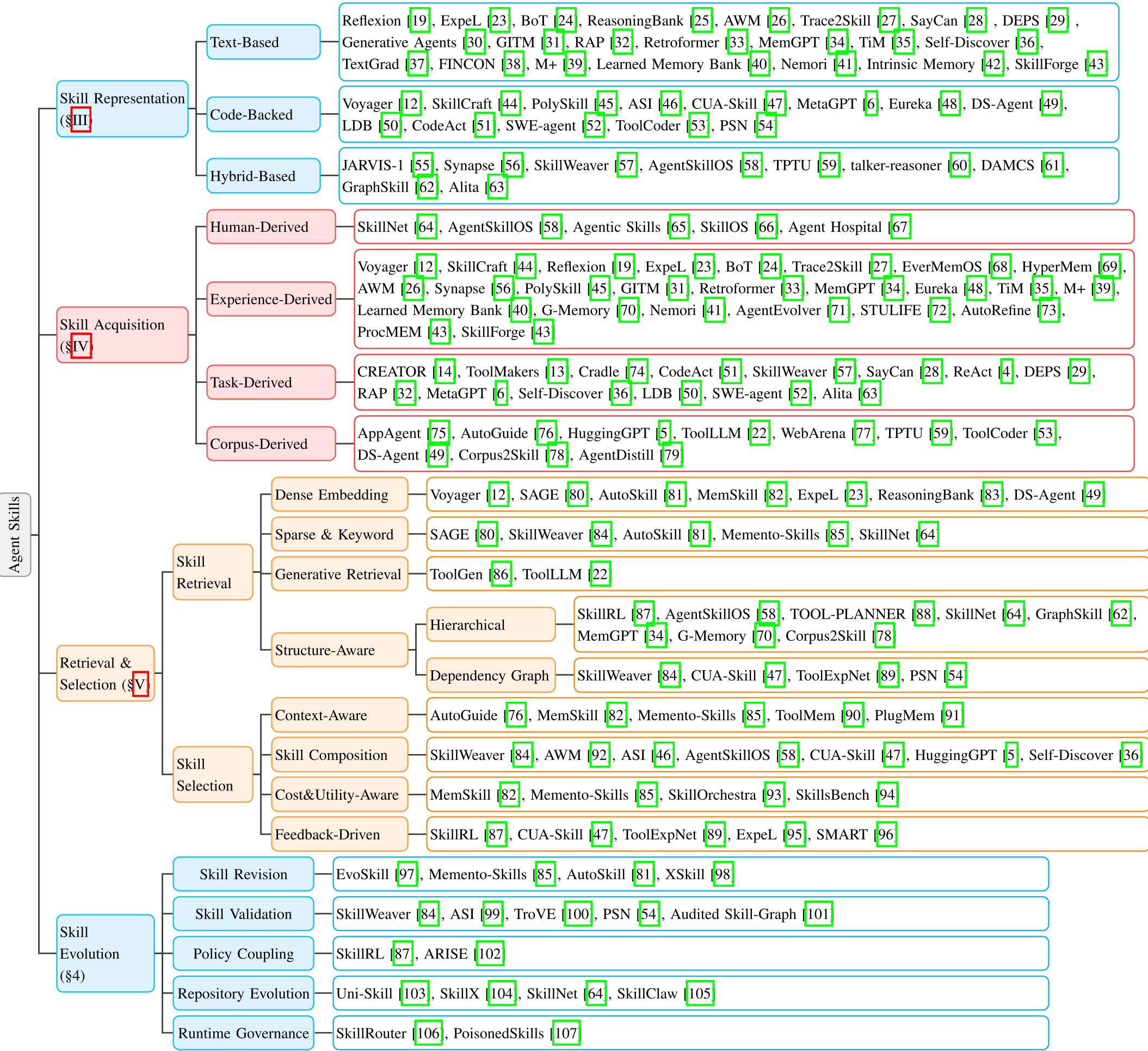
The paper organizes the entire field into a four-stage Lifecycle:
- Representation: Is the skill just text, pure code, or a hybrid?
- Acquisition: How do we get skills? (Human experts, mining past execution traces, or "Tool Making" by the LLM itself).
- Retrieval & Selection: Out of 100,000 skills, which one do we need now? (Dense similarity vs. structure-aware search).
- Evolution: How does a skill improve? (Self-correction after failure, pruning stale skills, and version control).
From Traces to Expertise: Skill Acquisition
One of the most exciting areas is Experience-Derived Acquisition. Systems like Voyager and Trace2Skill observe an agent’s successful (and failed) trajectories and compress them into reusable code modules.
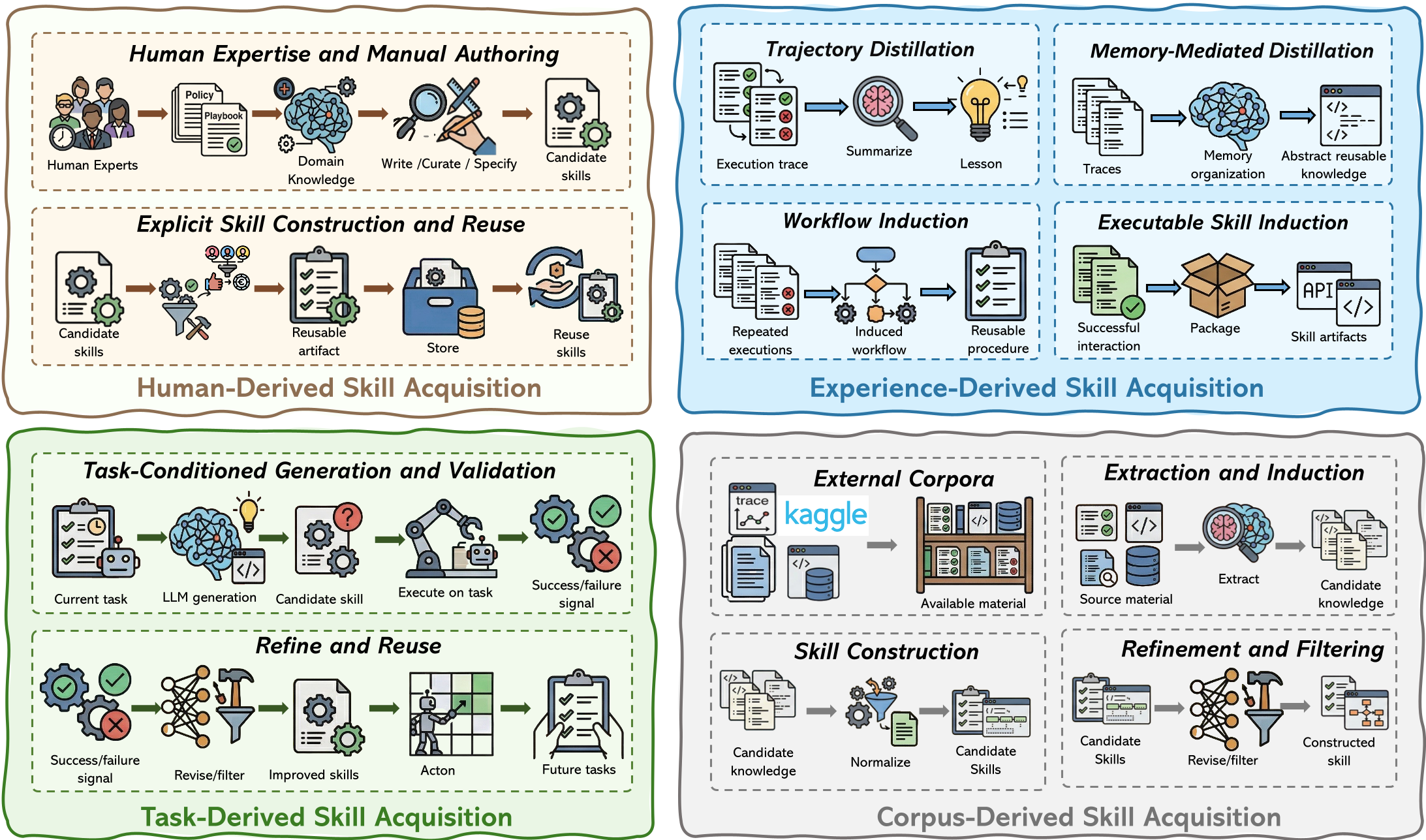
The process mirrors human learning:
- Selection: Keep the successful runs.
- Abstraction: Distill the "lesson" into a general rule.
- Packaging: Turn the lesson into a callable function or a structured workflow.
Real-World Impact: The Skill Platforms
The survey highlights a massive explosion in "Skill Hubs." To illustrate the scale, platforms like SkillsMP and SkillNet have reached hundreds of thousands of entries. In software engineering, these skills handle bug localization and repository refactoring; in robotics, they connect perception to motor control.
| Platform | Scale (Skills) | Focus Area |
|---|---|---|
| SkillNet | 300k+ | General AI Capabilities |
| SkillsMP | 700k+ | Multi-Platform Orchestration |
| ClawHub | 40k+ | Personal Assistant Skills |
Deep Insight: The Evolution Challenge
A critical takeaway is that "more skills" isn't always better. As libraries grow, agents face Skill Interference and Resource Drift. The authors argue that Skill Evolution—the ability to prune, merge, and validate skills through "survival checks"—is the next great frontier. A skill that works today might fail tomorrow if the external API it relies on changes.
Future Outlook
The paper concludes with a call for a Unified Skill Schema. Just as we have standardized protocols for the web (HTTP) and tools (MCP), we need a universal way for agents to share "how-to" knowledge.
We are moving toward an era where you don't just "prompt" an agent; you "hire" an agent that comes pre-equipped with a massive, battle-tested skill library for your specific domain.
Conclusion
This survey is a landmark for the "Second Half" of the Agent era. It moves the conversation beyond "Can the model reason?" to "How does the system manage its capabilities?" For anyone building production-grade agents, treating skills as a first-class citizen is no longer optional—it is the prerequisite for reliability.