
From S-Matrix Consistency to the Higgs Mechanism: An On-Shell Reconstruction
Consistent Scattering Amplitudes, Yang-Mills, the Higgs Mechanism and the EFTs Beyond
This paper explores the constraints on fundamental physics derived from a unitary, local, and perturbative S-matrix in 4D. It utilizes a novel "all-channel pole" approach for massless particles to reconstruct Yang-Mills theory and employs high-energy limit (HEL) analysis for massive particles to derive the Higgs mechanism and the structure of Gauged Non-linear Sigma Models (NLΣMs).
Executive Summary
TL;DR: This paper provides a sweeping reconstruction of perturbative particle physics using exclusively on-shell methods. By analyzing the complex factorization of massless gluons and the high-energy limit of massive vector bosons, the author derives the Lie algebra structure of Yang-Mills theory and the functional necessity of the Higgs mechanism without ever invoking off-shell lagrangians or gauge redundancies.
Positioning: This work acts as a rigorous bridge between the "Amplitude Bootstrap" school (pioneered by Arkani-Hamed et al.) and the traditional "High-Energy Unitarity" bounds of the 1970s. It moves the field from "What is the result?" to "Why must this be the theory?" in the academic coordinate system.
Problem & Motivation: The Tyranny of Gauge Redundancy
For decades, Quantum Field Theory (QFT) has been taught through the lens of gauge invariance. While successful, gauge invariance is a redundancy of our description—an unphysical bookkeeping device. On-shell methods seek to bypass this by working only with physical states characterized by their little group representations.
The difficulty lies in two areas:
- Massless Bootstrap: Identifying how three-particle amplitudes fuse into four-particle amplitudes in a way that is consistent across all Mandelstam channels ().
- Massive Energy Growth: Massive particles (especially spin-1) naturally lead to amplitudes that grow with energy (), quickly violating perturbative unitarity. How can we constrain these "wild" theories into the structured Standard Model we observe?
Methodology - The Core: All-Channel Poles and HEL Syzygies
The All-Channel Pole
The author identifies a special kinematic limit in massless scattering where right-handed spinors align, causing and to vanish simultaneously.
In this "all-channel pole," the residue is a coherent sum of all channels. Requiring this residue to be Lorentz invariant leads directly to the Jacobi Identity (). This effectively proves that vector bosons must transform under a Lie Algebra.
Unitarizing the Massive S-Matrix
For massive particles, the paper analyzes the "Anatomy of Helicity Sectors." The author constructs tree-level amplitudes and scrutinizes their behavior as . Total unitarisation (removing all growth) acts as a selection rule for consistent fundamental theories.
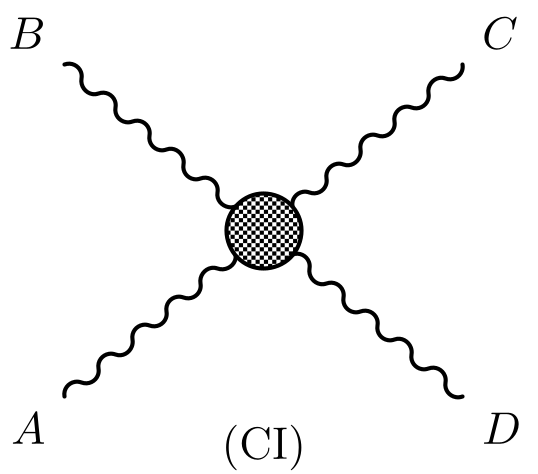 Figure 1: Factorization channels used to reconstruct the 4-leg massive vector amplitude.
To handle the algebra, the author uses Syzygies: mathematical identities that relate seemingly independent high-dimension Lorentz structures to lower-dimension ones when specific Mandelstam variables are present.
Experimental Results & Theoretical Landscape
The paper doesn't use "datasets" in the traditional AI sense but rather maps the Landscape of EFTs. The results are quantitative in their power-counting:
| Energy Growth | Condition for Removal | Emerging Theory |
|---|---|---|
| Suppress -type couplings | No operators | |
| Jacobi and GCS constraints | Gauged NLΣM | |
| Lie Algebra Representations | Higgs Mechanism |
The Inevitability of the Higgs
A key result is the proof that if a theory has a mass gap (finite masses with an upper bound) and seeks to be unitary at all energies, a Higgs boson is mandatory. Without the Higgs, the longitudinal modes of the vector bosons () scatter with growth. The paper shows that Higgs exchange precisely provides the term required to cancel this growth, provided the couplings obey the Lie Algebra commutator:
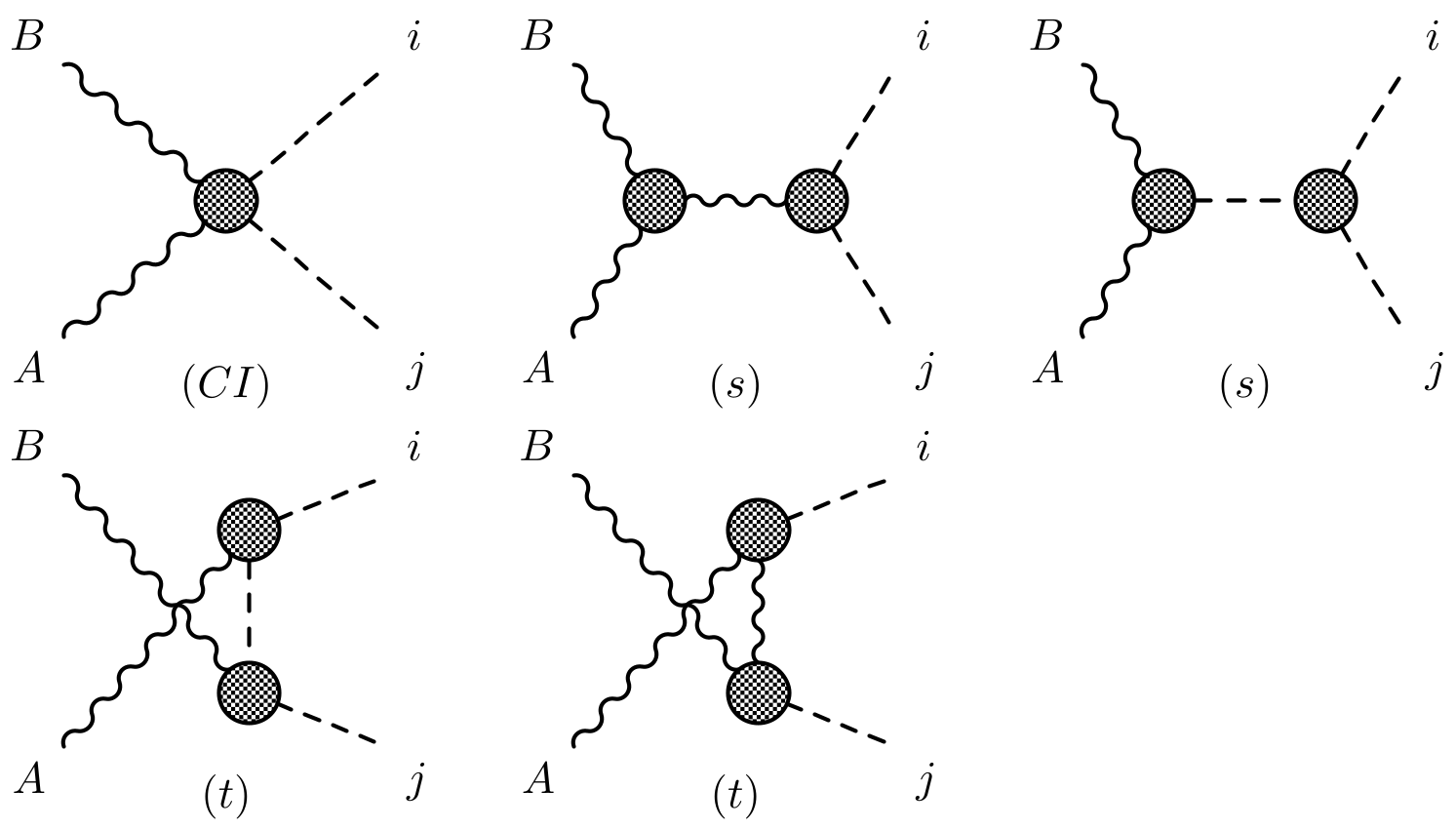 Figure 2: The interaction of vector bosons and scalars, where the scalars eventually take the role of Higgs bosons or Goldstone bosons.
Critical Analysis & Conclusion
Deep Insights
- Geometric Phase: The author notes that anomalous multipole moments (magnetic dipole, electric quadrupole) are not just "parameters" but encode the "geometric phase" of the theory (e.g., whether the Lie algebra is compact or non-compact).
- Supersymmetry Unification: The paper shows that Super-Yang-Mills amplitudes are the "elegant benchmarks" where all these energetic cancellations happen automatically due to BPS conditions.
Takeaway
The Standard Model is not just one possible choice among many; it is a fixed point in the space of consistent S-matrices. If you want a theory with mass states that doesn't explode at high energies, you are mathematically cornered into Yang-Mills and the Higgs Mechanism.
Limitations & Future Work
The derivation assumes a perturbative S-matrix and a mass gap. The author notes that "Higgsless" models (like Kaluza-Klein towers) can exist if one relaxes the mass gap assumption, leading to infinite towers of particles. The next frontier is extending this "Bootstrap" to loops and non-flat backgrounds (AdS/dS).