
ConsisVLA-4D: Bridging the Gap Between 2D Perception and 4D Spatiotemporal Reasoning in Robotics
ConsisVLA-4D: Advancing Spatiotemporal Consistency in Efficient 3D-Perception and 4D-Reasoning for Robotic Manipulation
ConsisVLA-4D is a unified Vision-Language-Action (VLA) framework that integrates efficient 3D perception and 4D spatiotemporal reasoning for robotic manipulation. It achieves SOTA performance on benchmarks like LIBERO (98.1% avg success rate) while delivering a 2.3x-2.4x inference speedup over OpenVLA.
TL;DR
Current Vision-Language-Action (VLA) models often struggle with "spatial blindness"—they act on 2D snapshots without a deep grasp of 3D geometry or how a scene evolves over time. ConsisVLA-4D changes this by introducing a framework that distills 2D views into instruction-aligned 3D representations and reasons about 4D dynamics (future states). The result? A 21.6% performance boost and a 2.3x speedup in inference, making high-level VLA reasoning fast enough for real-time hardware.
Problem & Motivation: The 2D Bottleneck
Why do state-of-the-art models like OpenVLA sometimes fail at simple tasks like "place the bowl in the microwave"?
- Spatial Ambiguity: A single 2D camera view hides depth and scale.
- Temporal Discontinuity: Traditional models don't "anticipate" how the scene changes as the robot moves, leading to unstable trajectories.
- Computational Heavyweight: Methods that use explicit point clouds or depth maps are often too slow for the closed-loop control required in reactive environments.
The authors observed that humans maintain a stable "world model" across different viewpoints and predict future spatial states to ensure smooth manipulation. ConsisVLA-4D replicates this by enforcing Spatiotemporal Consistency.
Methodology: Perception Meets Reasoning
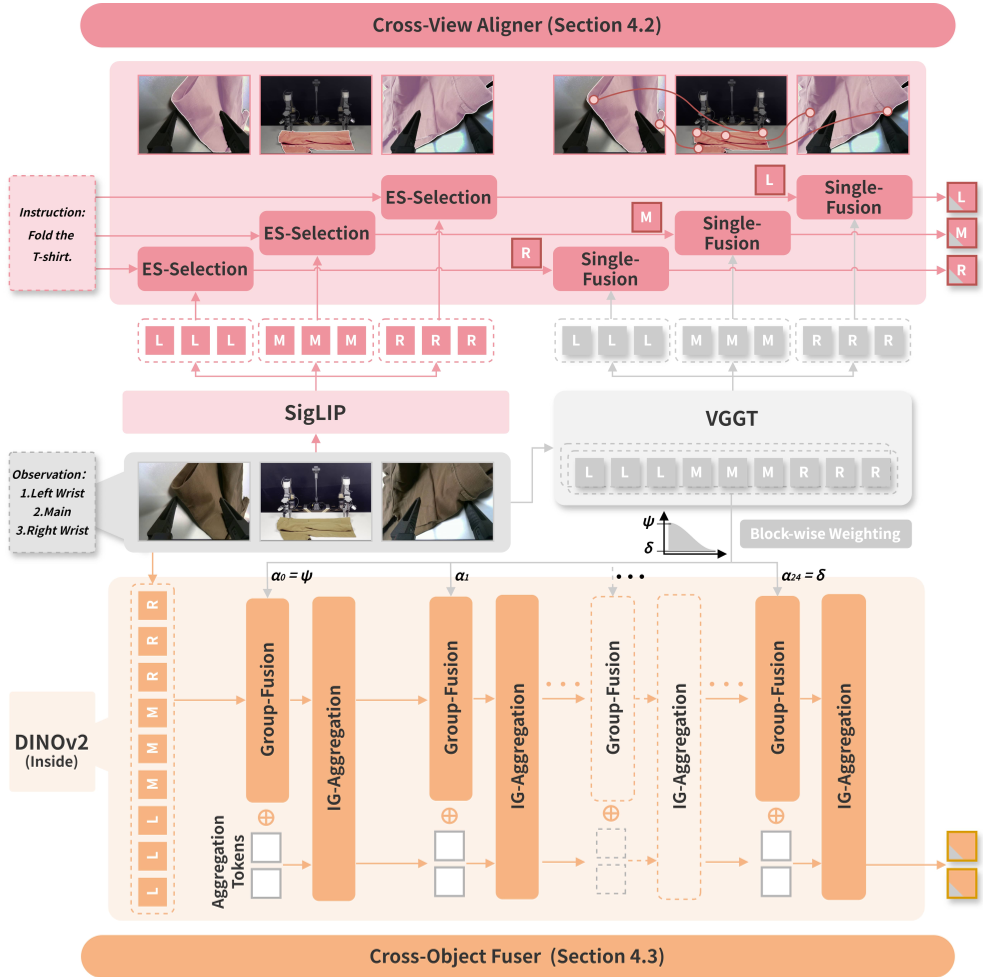
The architecture is divided into two phases: Efficient 3D-Perception and 4D-Reasoning.
1. CV-Aligner: Cross-View Object Semantic Consistency
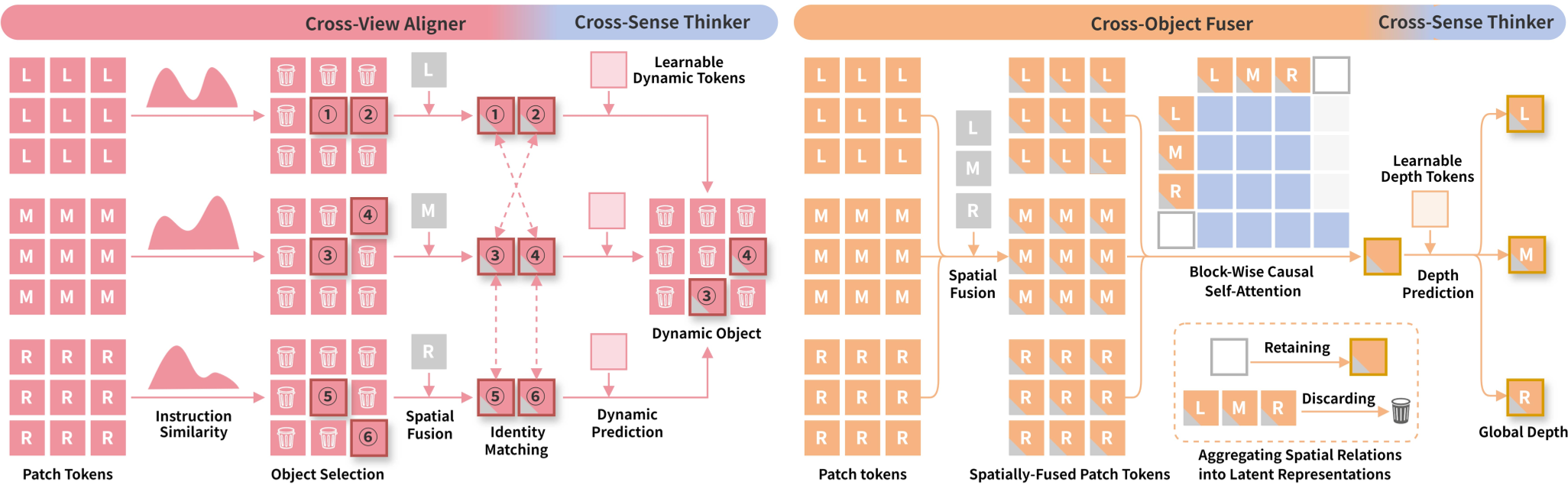
Robots don't need to process every pixel. CV-Aligner uses Explicit Semantic Object Selection to filter tokens relevant to the instruction (e.g., if the task is about a "bowl," it ignores the background). By aligning these object identities across multiple camera views (Main, Left, Right), the model maintains a consistent "identity" for the target object.
2. CO-Fuser: Cross-Object Spatial Geometric Consistency
Single-view depth is notoriously unreliable due to scale ambiguity. CO-Fuser integrates features from DINOv2 and VGGT through Group-Fusion. It uses a cosine-decayed weighting mechanism to blend geometric priors into the latent space, aggregating spatial relations into a compact set of "Aggregation Tokens."
3. CS-Thinker: Cross-Scene Spatiotemporal Consistency
The "Thinker" module extends 3D perception into the 4D temporal domain. During training, it learns to predict:
- Future Local Dynamics: How the object moves (supervised by CoTracker).
- Future Global Depth: How the scene depth changes (supervised by Depth-Anything).
During inference, these predictions are implicit. The model doesn't generate images; it uses the learned internal knowledge to decode action chunks in parallel via Spatiotemporal Consistency Attention (SC-Attn).
Experiments & Results: SOTA Performance with High Efficiency
The model was tested on LIBERO, ManiSkill2, and RoboTwin 2.0, as well as real-world platforms like the AgileX Cobot Magic.
- Success Rate: On the LIBERO-Spatial suite, it hit 98.8%, far outperforming SpatialVLA and CoT-VLA.
- Efficiency: Despite having more parameters (due to the geometry encoders), its selective token strategy (1/8 compression) allows it to run at 108.2 Hz in real-world bimanual tasks—nearly double the throughput of optimized OpenVLA-OFT.
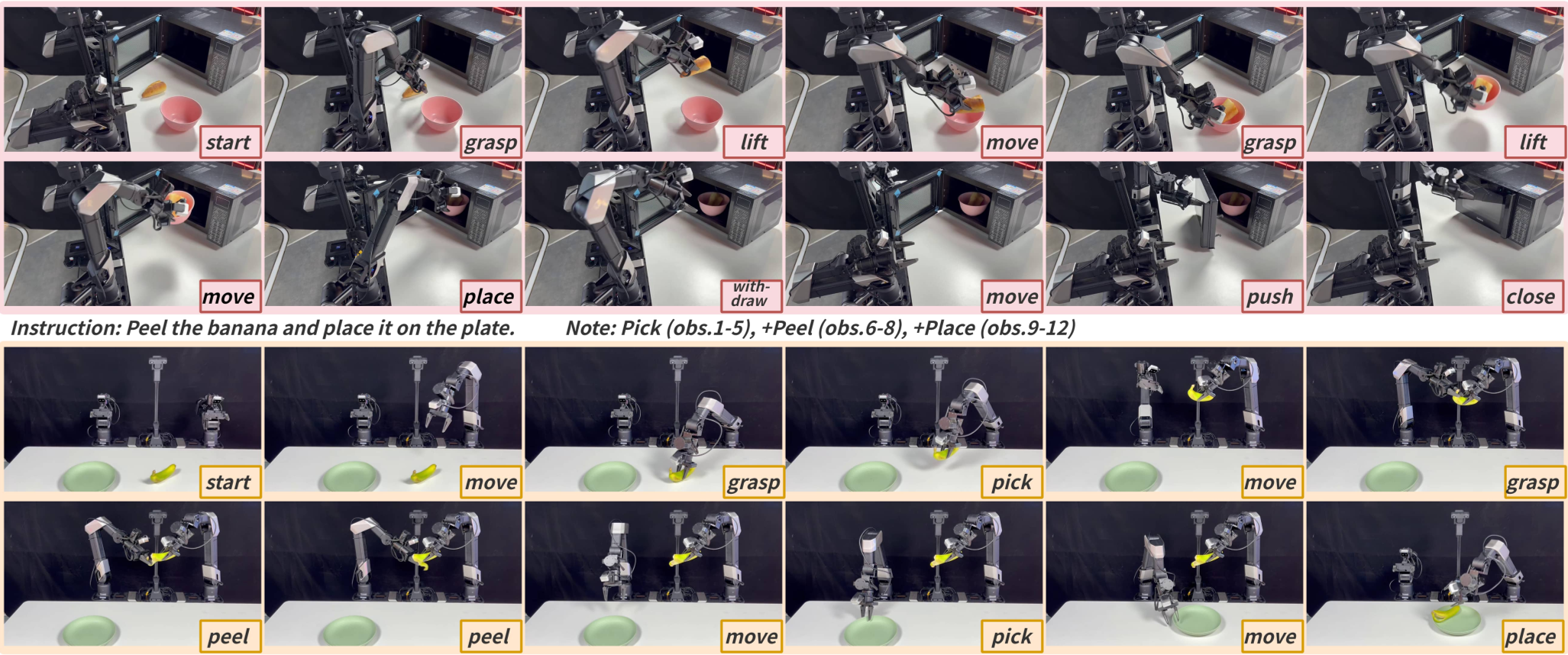 Visualization of Task Execution: From bread-to-microwave operation to bimanual banana peeling.
Critical Analysis & Conclusion
Takeaway
ConsisVLA-4D proves that effective sparsification—choosing which visual information to keep based on language and geometry—is the key to scaling VLAs for real-world use. By treating action prediction as a 4D reasoning problem rather than a 2D mapping problem, it achieves much-needed temporal stability.
Limitations
While the 1/8 sparsification ratio is effective, the model still relies on pre-trained geometry encoders (VGGT/DINOv2) which add to the memory footprint during training. Future work might explore end-to-end unified encoders that inherently capture these 3D/4D priors without separate branches.
Future Outlook
This paradigm of "Implicit 4D Reasoning" is highly promising. As robots move into more unconstrained domestic environments, the ability to maintain consistency across scenes and predict object dynamics will be the difference between a robot that stutters and one that moves with human-like fluidness.