
[ArXiv 2025] CBRL: Bootstrapping LLM Reasoning through Stochastic Context Scaffolding
Context Bootstrapped Reinforcement Learning
The paper introduces Context Bootstrapped Reinforcement Learning (CBRL), a method that addresses exploration inefficiency in Reinforcement Learning from Verifiable Rewards (RLVR). By stochastically injecting and then annealing few-shot demonstrations into training prompts, CBRL enables Large Language Models (LLMs) to acquire complex reasoning patterns and domain-specific knowledge (like the Q programming language) where standard RL often fails to find a sparse reward signal.
TL;DR
Reinforcement Learning from Verifiable Rewards (RLVR) is the engine behind modern "Reasoning Models" like DeepSeek-R1, but it breaks down when the model can't find the "answer" even once. Context Bootstrapped Reinforcement Learning (CBRL) solves this "Exploration Inefficiency" by temporarily giving the model "hints" (few-shot examples) during training. By gradually removing these hints (annealing), the model learns to solve the problems itself, leading to massive gains in logic-heavy tasks and domain-specific coding.
The Cold Start Problem: When RL Fails to Explore
In the current post-training landscape, we rely on Verifiable Rewards (binary Pass/Fail). However, if you ask a 3B model to solve a complex matrix manipulation or write code in an obscure language like Q, it might fail 100% of the time initially.
In RL terms, if the "Group Advantage" is zero because every rollout is wrong, the gradient is zero. The model learns nothing. Historically, researchers fixed this with Supervised Fine-Tuning (SFT) warm-ups, but SFT often leads to memorization rather than the "Aha!" moment of generalized reasoning.
CBRL: Scaffolding for the Mind
The authors propose a elegant, algorithm-agnostic solution: Context Bootstrapping.
Instead of changing the RL objective, they change the input distribution.
- The Bank: A small set of solved examples (Question + Thinking Trace + Answer).
- Stochastic Injection: During training, a prompt is prepended with 2 few-shot examples with probability .
- Curriculum Annealing: starts at 0.5 (half the training batch gets help) and linearly drops to 0.0.
Why this works: The Intuition
By seeing demonstrations during the RL rollout phase, the model is guided toward the "correct" ROI (Region of Interest) in the latent space. Because the examples are removed over time, the model cannot become "addicted" to the prompts; it must internalize the procedure to maximize reward.
 Figure 1: The CBRL workflow—demonstrations guide the early phase, then fade away as the model's internal policy takes over.
Results: Beyond Mainstream Programming
The most impressive validation of CBRL is in Q Programming. Q is a terse, array-oriented language used in high-frequency trading. Most LLMs have seen very little Q code during pre-training.
| Method | Avg. Pass (%) | Success Rate (%) |
|---|---|---|
| Standard GRPO | 27.3 | 5.0 |
| CBRL + GRPO | 43.0 | 26.3 |
In Reasoning Gym tasks like "Word Sorting" and "Puzzle-24," CBRL didn't just speed up training—it reached a much higher performance ceiling. The qualitative analysis shows that while the baseline model gives "hand-wavy" explanations, the CBRL-trained model learns to perform systematic, character-level ASCII computations.
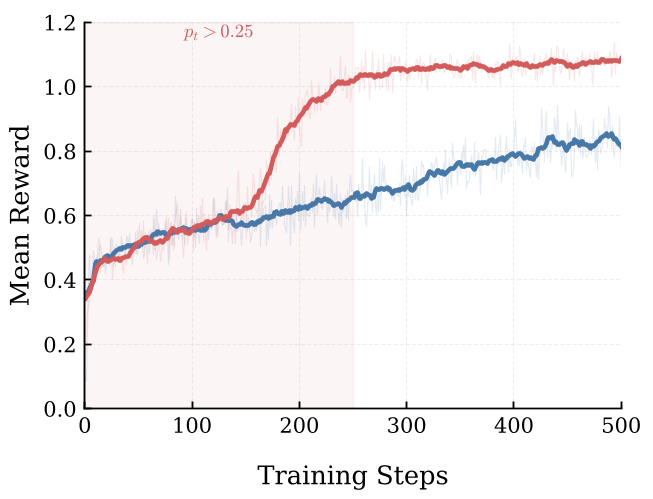 Figure 2: Reward curves across tasks. Notice how the CBRL reward (red) stays high even after the "shading" (injection) stops, proving it learned the underlying capability.
Critical Analysis & Conclusion
The Takeaway: CBRL proves that In-Context Learning (ICL) and Reinforcement Learning (RL) are not separate capabilities but can be leveraged together. ICL provides the "scaffolding" (exploration) and RL provides the "cement" (parameter updates).
Limitations:
- The "Addiction" Risk: As shown in the ablation studies, if the initial injection probability is too high (), the model fails to learn independence—a classic failure of "over-hinting."
- Context Selection: The method relies on a high-quality bank of examples. If the examples are poorly formatted, the model might internalize bad habits.
Future Outlook: CBRL is a major step toward Zero-Data RL. If we can use a "teacher" model to provide the context bank dynamically, we could potentially train reasoning models on entirely new domains without any human-labeled SFT data.
Note: This work demonstrates that the most effective way to teach an LLM a new trick isn't just to tell it the answer (SFT) or let it guess (RL), but to show it the way and then slowly let go of its hand.