
Continually Self-Improving AI: Transcending the Human-Data Ceiling
Continually self-improving AI
This dissertation presents a comprehensive framework for "Continually Self-Improving AI" through three key methodologies: EntiGraph for knowledge acquisition from small corpora, Synthetic Bootstrapped Pretraining (SBP) for fundamental capability enhancement, and execution-grounded test-time search for autonomous algorithm design. By leveraging synthetic data and automated reasoning, the work demonstrates that AI can surpass human-engineered training limits in domain adaptation and pretraining efficiency.
TL;DR
This Stanford dissertation by Zitong Yang redefines AI development as a recursive, self-improving process. It moves beyond distilling stronger models to show how AI can:
- Learn deeply from tiny corpora using graph-based synthetic expansion (EntiGraph).
- Bootstrap its own fundamental capabilities by exploiting latent document correlations (SBP).
- Automate the research process by generating and executing training algorithms through a closed-loop search.
The work positions pretraining as the ultimate foundation, suggesting that even our best reasoning models (like o1) merely surface capabilities already latent in the weights.
The Problem: The Human-Capped AI
Currently, AI progress is tethered to human output. If a domain is niche (proprietary legal docs, new physics), standard pretraining fails because the data is too sparse. Furthermore, we are running out of high-quality internet text. If AI only learns what we give it, using the algorithms we hand-code, its intelligence is effectively capped by human diligence and ingenuity.
Methodology: The Three Pillars of Self-Improvement
1. EntiGraph: Turning Niche Knowledge into Parametric Memory
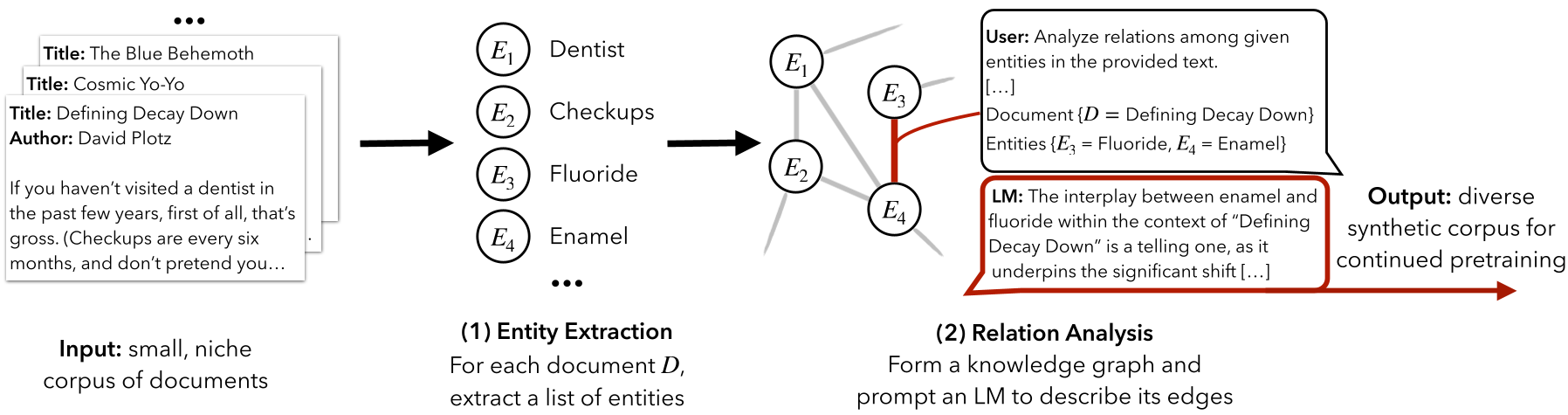
Standard continued pretraining (CPT) on a 1M-token corpus usually results in zero gain or catastrophic forgetting. Yang introduces EntiGraph, which extracts entities and prompts an LLM to analyze their relations combinatorially. This "fills in" the knowledge graph, expanding a small seed into a massive, diverse synthetic corpus.
2. SBP: The Bayesian Leap in Pretraining
How do you improve pretraining perplexity when you have no new data? Synthetic Bootstrapped Pretraining (SBP) identifies semantically similar document pairs (e.g., a paper and its code) and trains a "synthesizer" to model the conditional probability . This forces the model to infer latent concepts, acting as a form of self-distillation that regularizes the model better than simple data repetition.

3. Automated AI Research: Scaling from Tokens to Ideas
Finally, the dissertation moves search from the inference level to the algorithmic level. By building an Automated Idea Executor, the system generates natural language research ideas (e.g., "implement response diversity rewards"), patches them into a sandboxed codebase, and runs GPU experiments to verify if they actually work.
Experiments & Results: Brute Force with a Brain
- Knowledge Acquisition: EntiGraph CPT achieved a log-linear scaling in QA accuracy. On the QuALITY benchmark, CPT alone recovered 80% of the performance of a full Retrieval-Augmented Generation (RAG) system, but stored the facts directly in the weights.
- Pretraining Efficiency: In 1-trillion token experiments, SBP delivered 58% of the gains of an "Oracle" that had access to 20x more unique data.
- Reasoning Efficiency: The model s1-32B, trained on only 1,000 curated samples, matched the performance of OpenAI's o1-preview, proving that reasoning is mostly latent and just needs "triggering."
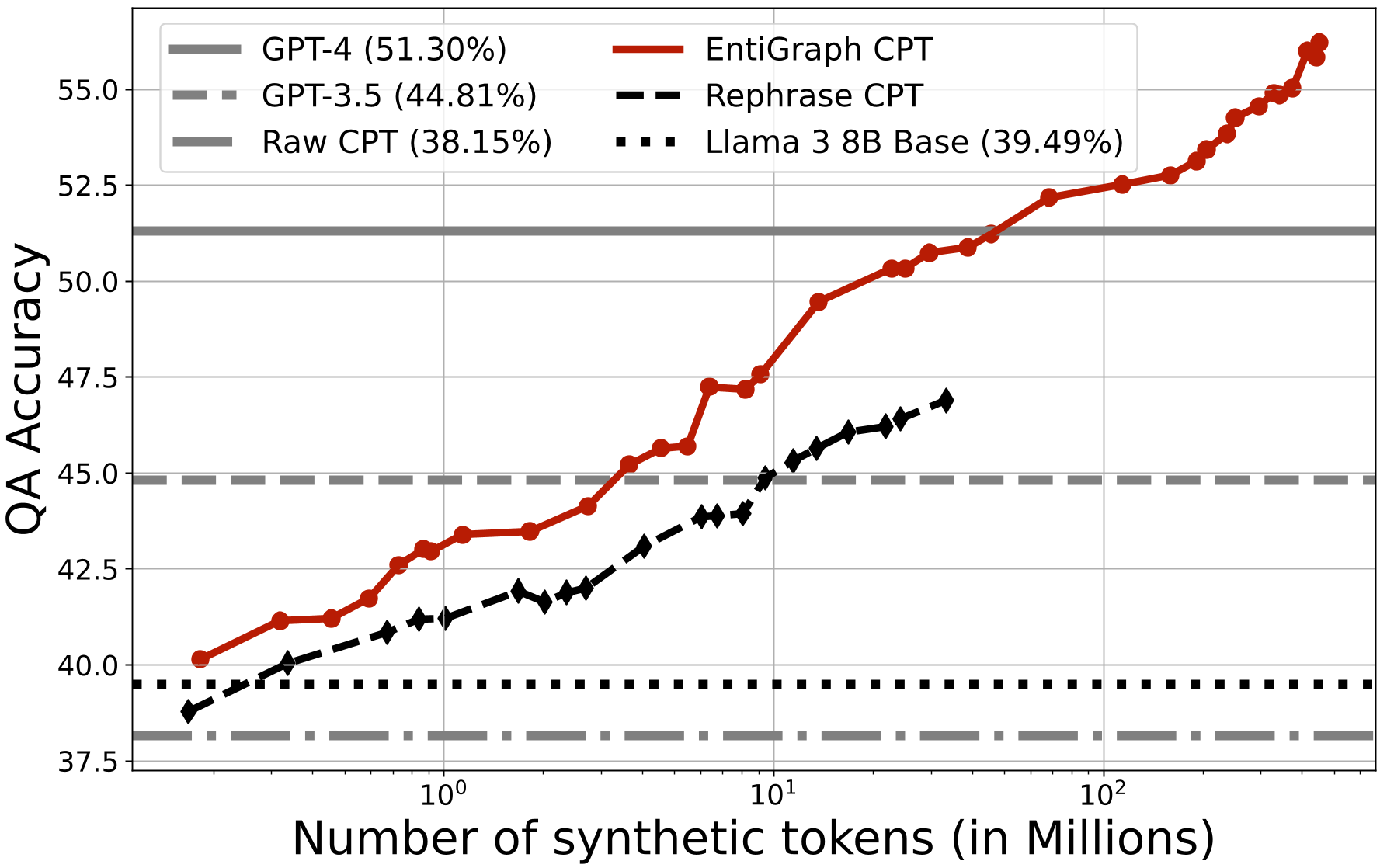 Figure: The log-linear scaling of EntiGraph tokens vs QA accuracy.
Critical Analysis: Can AI be "Smarter" than us?
The dissertation concludes with a powerful physics parable: Einstein’s field equations predicted an expanding universe, but Einstein himself didn't believe it and added a "cosmological constant" to force a static solution. The mathematical structure he created knew more than he did.
Takeaway: We are currently in the "brute force" era, where AI improves by stacking quantity over quality. However, as AI starts designing its own regularizers and learning algorithms, we may reach a point where the emergent structure of the AI contains truths that we, its creators, cannot yet see.
Limitations:
- Hallucination: Synthetic data can still "fabricate" relations, especially in highly technical domains where the synthesizer model is weak.
- Generalizability: Ideas that work at a small "nanoGPT" scale might not scale to frontier models.
Future Outlook
The role of the human researcher is shifting from "doing the research" to Harness Engineering—designing the environments and objectives (the "mountain") while the AI does the climbing.