
[PRB 2026] The Ice-VII and Ice-X Paradox: Why Monopole Screening Makes High-Pressure Ice a Continuous Journey
Continuous crossover between high-pressure ice phases VII and X driven by monopole screening: a model study
This study utilizes an effective spin-1 Blume-Capel model on a pyrochlore lattice to investigate the phase transition between high-pressure water ice phases VII and X. Using Monte Carlo simulations, the authors demonstrate that the transformation is a continuous crossover rather than a singular thermodynamic phase transition, achieving a theoretical reconciliation of identical macroscopic symmetries in dense ice.
TL;DR
Researchers have solved a long-standing thermodynamic puzzle in high-pressure physics: whether Ice-VII (molecular) and Ice-X (non-molecular) are truly distinct phases. By employing a spin-1 Blume-Capel model on a pyrochlore lattice, this study proves that at any finite temperature, the transformation is a continuous crossover caused by the thermal proliferation of "magnetic monopoles" that screen the emergent gauge fields.
Executive Summary: The Symmetry Paradox
In the standard Landau-Ginzburg paradigm, phases are distinguished by symmetry breaking. However, Ice-VII and Ice-X share the exact same space group (). This leads to a fundamental question: Is there a hidden topological transition, or are they effectively the same state? This paper identifies that while a singularity might exist, thermal fluctuations "wash out" the boundary, creating a continuous bridge between the two.
Problem & Motivation: The Fragility of Topology
In Ice-VII, protons are disordered but obey the "ice rules" (two-in, two-out). In Ice-X, protons sit symmetrically between oxygen atoms. Transitioning between them involves breaking the ice rules. Earlier theoretical models suggested sharp topological transitions in the "monopole-free" limit. However, physical ice isn't monopole-free. Thermal energy inevitably creates ionic defects ( and ), which act as point-like magnetic monopoles. The authors' insight is focusing on how these point-like defects interact with the 3D topology of the hydrogen-bond network.
Methodology: Mapping Proton Moves to Spins
The authors map the system to a pyrochlore lattice (the midpoints of O-O bonds).
- : Protons at asymmetric positions (Ice-VII).
- : Protons at the symmetric center (Ice-X).
- : The "chemical potential" or penalty for being in the asymmetric state. Increasing pressure effectively increases .
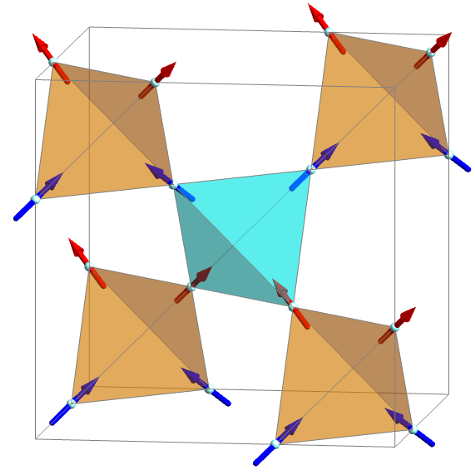 Figure: The mapping from the oxygen diamond lattice to the hydrogen pyrochlore lattice. (b) shows the Ice-VII spin representation, while (d) shows the Ice-X state.
Experiments & Results: The Death of the Singularity
Through Monte Carlo simulations, the team monitored the specific heat () and susceptibility ().
- No Divergence: In a real phase transition, these values should skyrocket as the system size () increases. Here, they saturated.
- Peak Mismatch: The peaks for and occurred at different values and showed no signs of converging in the thermodynamic limit.
- Ice-VIII is Different: Conversely, the transition to Ice-VIII (the ordered phase) showed a massive, volume-scaling peak, confirming a genuine first-order transition because it involves explicit symmetry breaking.
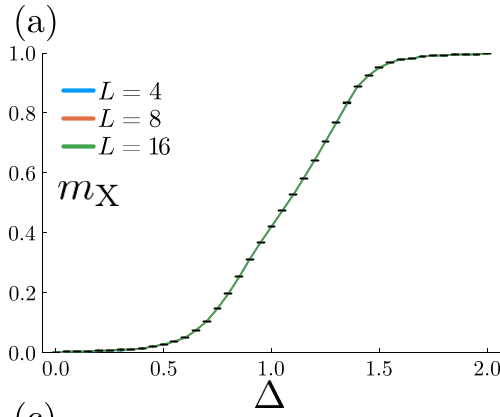 Figure: Specific heat and susceptibility plots demonstrating the lack of divergence at the Ice-VII to Ice-X transition.
Deep Insight: Debye-Hückel Screening
The mathematical "Why" behind the crossover is the Debye-Hückel screening. Just as ions in a plasma screen electric fields, the thermal monopoles in ice screen the emergent gauge field. This destroys the algebraic correlations required for a "Coulomb phase," reducing the topological distinction to a mere difference in density or occupation—much like the transition between liquid and gas above the critical point.
Conclusion & Future Outlook
This work confirms that Ice-VII and Ice-X are adiabatically connected. The "transition" observed in rooms-temperature experiments is actually a broad regime of dynamic disorder. Takeaway: Topological protection in 3D is only robust if the defects are extended strings (like in the Kitaev model). Point-like defects, like the monopoles in ice, are "topologically fragile."
Future Work: Could this same mechanism explain the relationship between other ice polymorphs, like Ice-III and Ice-IX? The hunt for genuine topological transitions in simple molecular solids continues.