
CDM: Migrating Distribution Matching to Continuous-Time for High-Fidelity Few-Step Generation
Continuous-Time Distribution Matching for Few-Step Diffusion Distillation
The paper introduces Continuous-Time Distribution Matching (CDM), a novel distillation framework that migrates Distribution Matching Distillation (DMD) from discrete anchoring to continuous optimization. By employing a dynamic continuous schedule and a velocity-driven off-trajectory alignment objective, CDM achieves state-of-the-art 4-step image generation on SD3-Medium and Longcat-Image, significantly outperforming previous discrete methods like DMD2.
TL;DR
Continuous-Time Distribution Matching (CDM) is a breakthrough in diffusion distillation that moves away from traditional "discrete-step anchoring." By training models on a dynamic, continuous time schedule and using velocity-driven extrapolation to correct off-trajectory drift, CDM enables high-fidelity 4-step image synthesis that outperforms existing SOTA methods without needing GANs or complex reward models.
Motivation: The Shackles of Discrete Timesteps
In the race to make Diffusion Models faster, Distribution Matching Distillation (DMD) has emerged as a powerhouse. However, it has a "dirty secret": most DMD implementations are forced to use the exact same discrete timesteps during training as those used in inference. This creates a sparse supervision environment where the model only knows how to behave at specific "anchors."
The authors of CDM identified that this restriction is the root cause of many artifacts. Because the model isn't supervised in the gaps between steps, the resulting "velocity field" (the path the model takes to create an image) becomes unsmooth. Furthermore, the mode-seeking nature of the KL divergence used in DMD often leads to "over-smoothing"—images that look clean but lose the high-frequency "crunch" and detail of the original teacher.
Methodology: The Shift to Continuity
CDM breaks the discrete constraint through two primary innovations:
1. Dynamic Continuous Time Schedule
Instead of fixing the training to a set schedule (e.g., ), CDM randomizes the simulation length and the timesteps for every iteration. This forces the student model to learn a continuous velocity field that is valid at any point in time, essentially "filling in the blanks" that discrete methods leave behind.
2. Velocity-Driven Extrapolation ()
One of the hardest problems in few-step generation is Integration Error. When you take a big leap from one step to another, you naturally drift off the ideal "data manifold." CDM introduces a loss term that anticipates this drift. It uses the student's own predicted velocity to extrapolate an "off-trajectory" point, then asks the teacher model to provide a correction signal for that specific drifted latent.
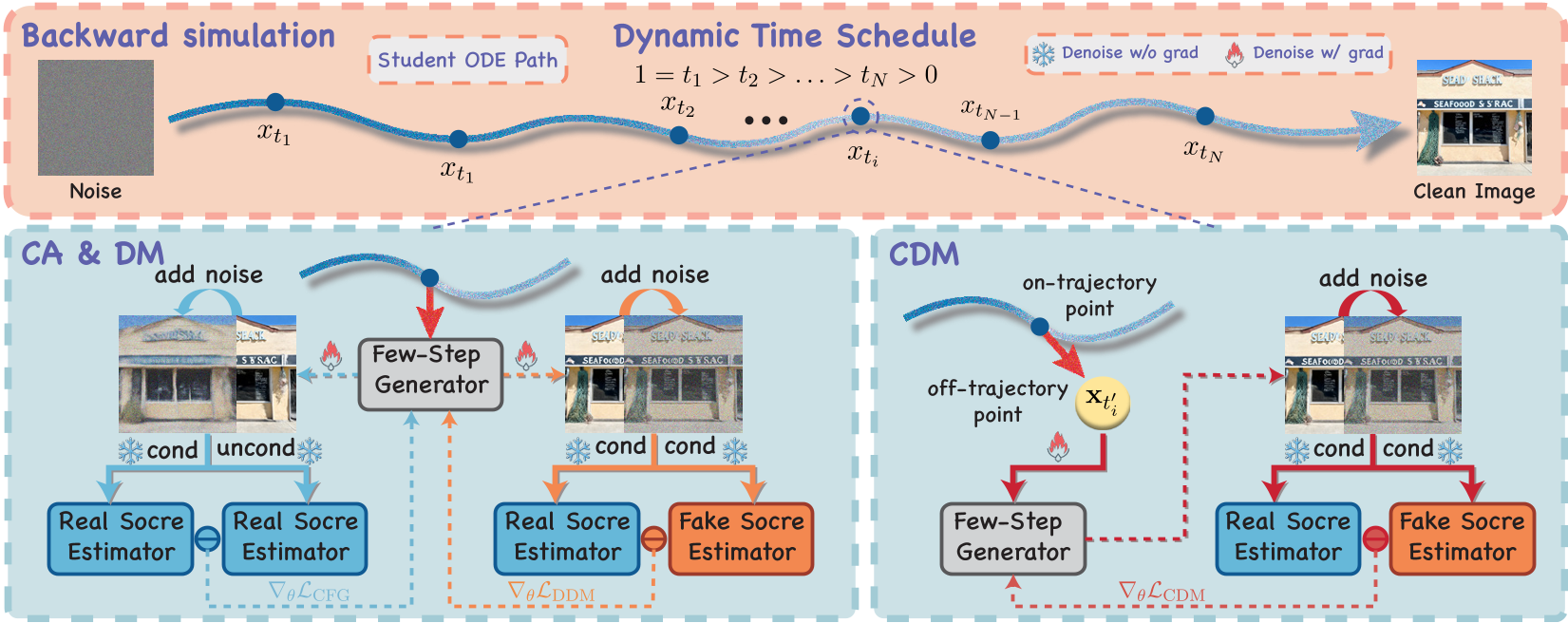 Figure: The CDM framework combines on-trajectory anchors with off-trajectory extrapolation to smooth the flow.
Experiments and Comparative SOTA
The results are striking. Under a 4-step (NFE) setting, CDM outperforms established baselines like DMD2 and Hyper-SD across nearly all metrics, including Aesthetic Score, PickScore, and HPSv3.
Qualitative Edge
While discrete methods often produce images with "waxy" textures or missing background details, CDM retains the perceptual sharpness of the 100-step teacher. In some metrics, the 4-step student even surpasses the 100-step teacher, suggesting that the distillation process acts as a form of "refinement."
 Figure: CDM vs DMD2. CDM (right) exhibits significantly sharper detail and textural depth compared to the over-smoothed DMD2 baseline.
The "CFG-Free" Insight
A fascinating side-discovery in the paper is the role of the Distribution Matching (DM) loss. The authors found that the DM loss is not just a "regularizer"; it specifically drives the student to align with the teacher’s CFG-free distribution. To get high-quality alignment, the CFG Augmentation (CA) loss must act as the "spear," while the DM/CDM losses act as the "shield" to maintain structural integrity.
Critical Insight & Conclusion
CDM proves that the "discretization gap" is a major bottleneck in distillation. By treating the diffusion trajectory as a continuous flow rather than a series of snapshots, we can achieve efficiency without the traditional "distillation tax" on image quality.
Limitations: The training cost is roughly 1.8x higher than simpler methods like D-DMD due to the dynamic simulations. however, since this is a one-time training cost and the inference speed remains identical, it represents a Pareto-optimal trade-off for production-grade AI.
The move toward "continuous-time" logic is likely the next frontier for video generation and complex multi-modal synthesis, where trajectory consistency is even more critical.