
CoRAL: Bridging the Reasoning-Execution Gap in Contact-Rich Robotics
CoRAL: Contact-Rich Adaptive LLM-based Control for Robotic Manipulation
The paper introduces CoRAL (Contact-Rich Adaptive LLM-based control), a modular neuro-symbolic framework for zero-shot, contact-rich robotic manipulation. It decouples high-level reasoning (LLM) from low-level reactive execution (MPPI), achieving SOTA results in challenging tasks like flipping objects against walls.
TL;DR
CoRAL is a modular framework that enables robots to perform complex, contact-rich tasks—like flipping a box using a wall—without any prior demonstrations. By using an LLM to "write the code" for a high-speed physics resident planner (MPPI), the system combines high-level common sense with low-level reactive precision.
Background Positioning
In the current landscape of AI-driven robotics, we see a tug-of-war between End-to-End VLA models (which are general but data-hungry and brittle) and Traditional Planners (which are robust but lack semantic understanding). CoRAL moves beyond this by positioning the LLM not as a controller, but as a strategist and cost designer, creating a hierarchical architecture that is both explainable and zero-shot capable.
The "Contact-Rich" Challenge
Most robotic tasks focus on collision avoidance. However, "contact-rich" manipulation requires the robot to embrace collisions—using friction, gravity, and external surfaces (like walls or table edges) to its advantage. Existing systems fail here because they lack:
- Physical Grounding: Traditional LLMs don't "feel" mass or friction.
- Adaptive Loops: If a box is heavier than it looks, a static plan will fail.
Methodology: The Neuro-Symbolic Architecture
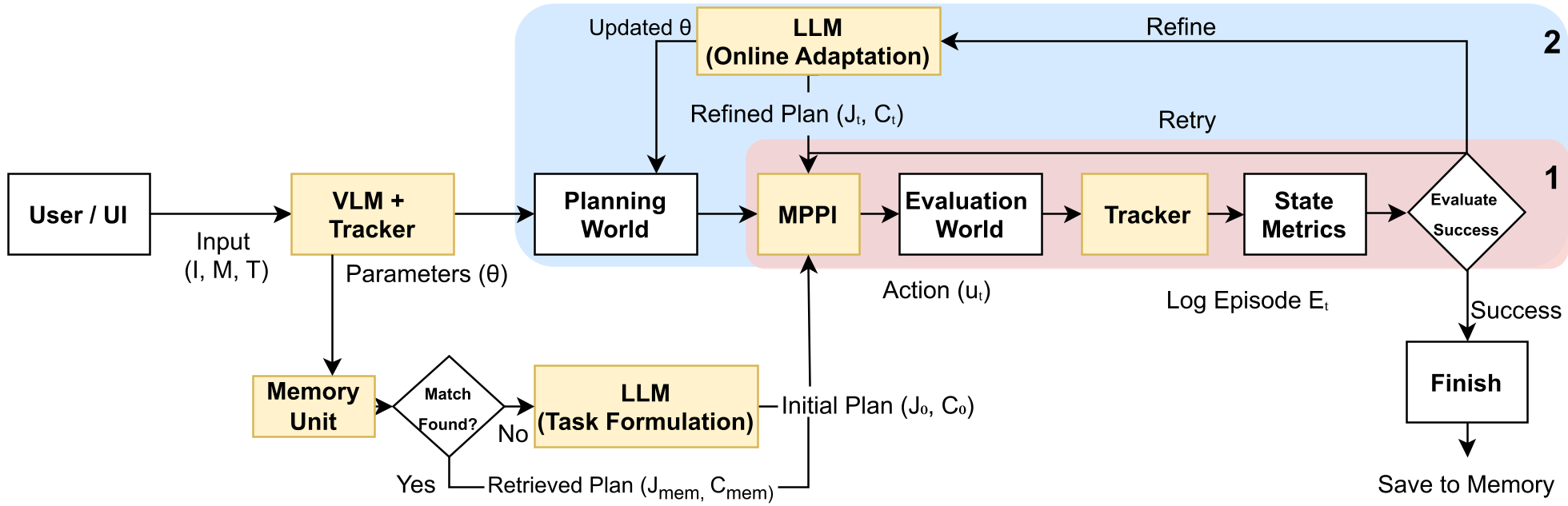
CoRAL solves this through a decoupled, three-tier hierarchy:
- Tier 1 (Execution): 1kHz joint impedance control for safety.
- Tier 2 (Planning): 10Hz MPPI planner that "rehearses" thousands of trajectories in a simulated mental world.
- Tier 3 (Reasoning): An asynchronous LLM loop that observes failures and rewrites the cost function or updates environmental beliefs (e.g., "The board is slipping, increase the friction estimate").
The Secret Sauce: LLM as Cost Designer
Instead of outputting direct motor commands, the LLM generates a Python cost function. This allows the robot to balance complex goals, such as "push until the handle overhangs, then switch to a lifting motion." The use of a sigmoid-based "soft switch" allows for smooth transitions between these phases.
Experiments & Results
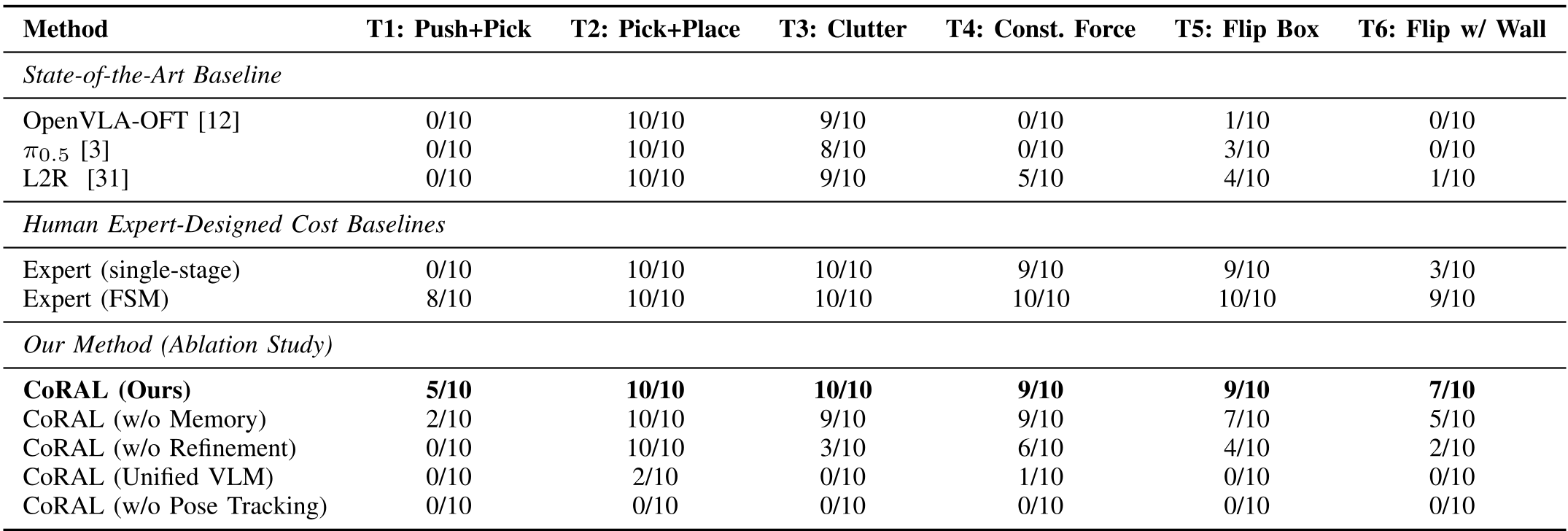
The researchers tested CoRAL on six challenging tasks, including "Flip with Wall" and "Push and Pick Cutting Board."
SOTA Comparison
CoRAL decimated pure VLA baselines like OpenVLA, which often failed completely on tasks requiring force regulation. While OpenVLA is excellent at "Pick and Place," it has no "physical intuition" for pushing a board against a wall to flip it.
The Power of Online Adaptation
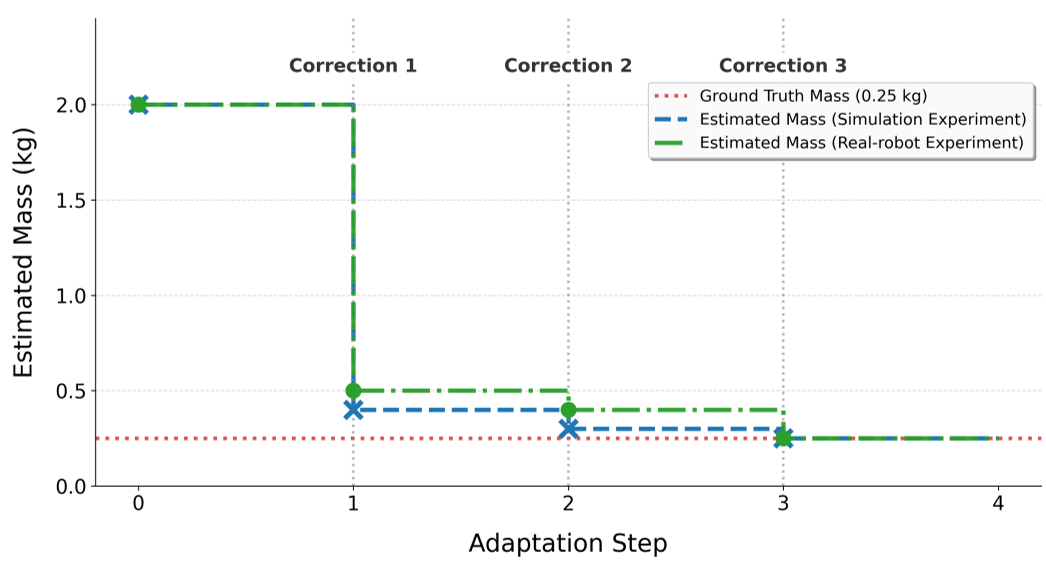
A standout feature is the Online System Identification. When the robot failed because of a mismatched mass estimate (2kg vs. 0.25kg), the LLM diagnosed the discrepancy and updated the internal world model in real-time, allowing the robot to succeed on subsequent attempts within the same session.
Critical Insight & Conclusion
CoRAL demonstrates that we don't necessarily need "more data" to solve complex robotics; we need better architectures. By separating semantic reasoning from physical execution, we can leverage the "common sense" of LLMs without being limited by their slow inference speeds or lack of physical presence.
Limitations: The system still relies on a high-fidelity vision module (FoundationPose). If the vision tracking fails, the "mental world" of the robot becomes decoupled from reality. Future work likely lies in "Residual Physics"—learning the tiny, unmodeled nuances of the real world that even the best simulators miss.